
Uncategorized
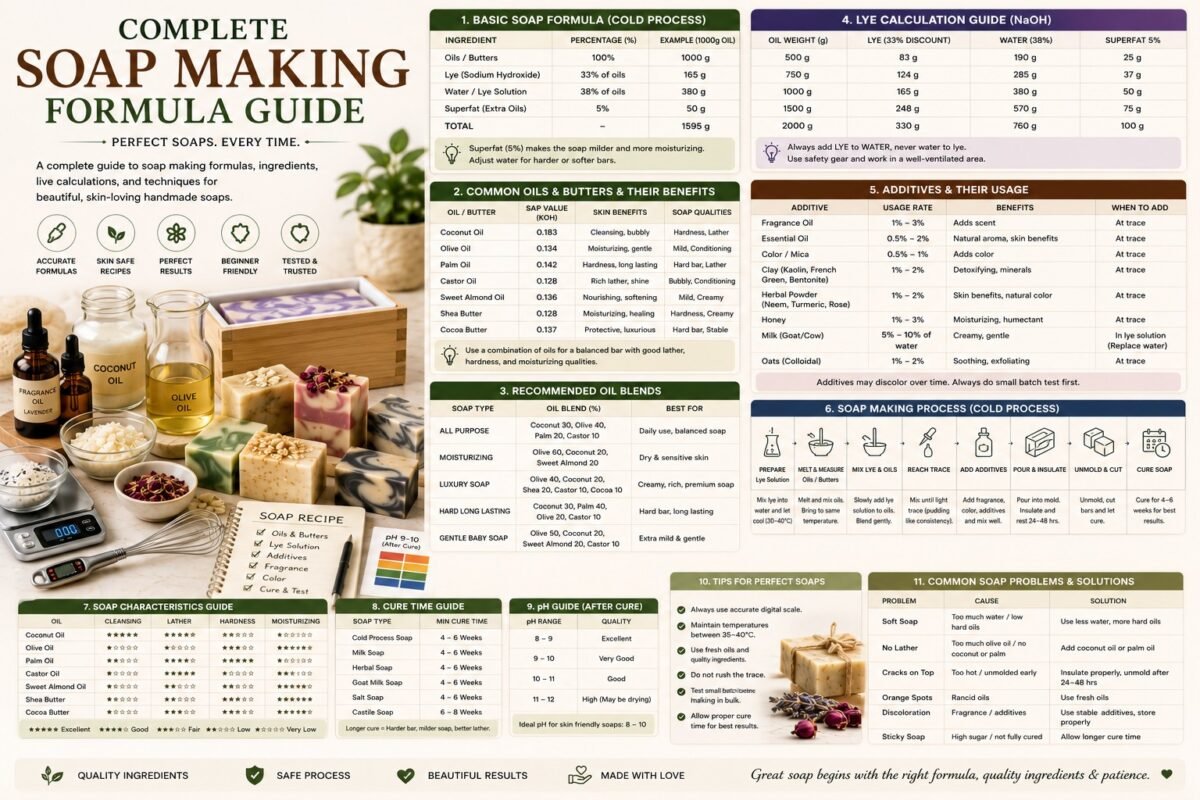
Complete Soap Making Formula Guide
Jun
Complete Soap Making Formula Guide
Learn beginner-friendly soap making formulas for melt and pour soap, transparent glycerin soap, goat milk soap, herbal soap, clay soap, ubtan soap, charcoal soap, fragrance usage, colors, additives, costing, testing, and safe small-batch production.
Quick Answer
A basic melt and pour soap formula is soap base + fragrance oil + color + optional clay, herbal powder, or oil. For beginners, a good test formula is 96% to 98% soap base, 1% to 3% fragrance oil, 0.1% to 0.5% color, and 0.5% to 2% clay or herbal powder. Always test sweating, fragrance retention, hardness, lather, color stability, and packaging before selling.
Table of Contents
Basic Soap Making Formula
The easiest soap making method for beginners is melt and pour soap. In this method, you use a ready soap base, melt it gently, add fragrance, color, and optional additives, then pour it into a silicone mold.
Melt and pour soap is beginner-friendly because the soap base is already made. You do not need to handle lye directly. Your main work is formula balance, fragrance selection, color design, additive choice, molding, packaging, and quality testing.
For melt and pour soap bases, fragrance oils, essential oils, cosmetic colors, mica, clays, herbal powders, silicone molds, labels, and packaging, visit Jindeal.com.
Soap Formula Chart
Use this chart as a beginner starting point for melt and pour soap. Always check supplier recommended usage levels and test your formula.
| Ingredient | Beginner Usage Range | For 1 kg Batch | Purpose | Important Note |
|---|---|---|---|---|
| Soap Base | 96% to 98.5% | 960 g to 985 g | Main soap body | Choose clear, white, goat milk, shea, aloe, or other base |
| Fragrance Oil | 1% to 3% | 10 g to 30 g | Soap fragrance | Follow supplier limit; too much may cause sweating or softness |
| Essential Oil | 0.5% to 2% | 5 g to 20 g | Natural aroma theme | Use safe levels and avoid strong oils in high quantity |
| Mica / Soap Color | 0.1% to 0.5% | 1 g to 5 g | Color and design | Too much can stain or create colored foam |
| Clay | 0.5% to 2% | 5 g to 20 g | Natural color and spa appeal | Disperse first to avoid lumps |
| Herbal Powder | 0.5% to 2% | 5 g to 20 g | Botanical label appeal | May fade, brown, or feel gritty |
| Carrier Oil | 0.5% to 1% | 5 g to 10 g | Luxury label appeal | Too much can reduce lather or make soap soft |
| Vitamin E Oil | 0.2% to 0.5% | 2 g to 5 g | Premium cosmetic positioning | Use small amount only |
Formula by Soap Base Type
These formulas are starting points only. Every soap base, fragrance, color, and additive behaves differently. Always test before making bulk batches.
Fragrance Oil Usage Guide
Fragrance gives soap its identity, but too much fragrance can create problems. Use the supplier-recommended safe level for each fragrance oil.
| Soap Product | Beginner Fragrance Range | For 1 kg Batch | Best Fragrance Ideas |
|---|---|---|---|
| Basic Melt and Pour Soap | 1% to 3% | 10 g to 30 g | Rose, sandalwood, lavender, lemon, mogra |
| Transparent Glycerin Soap | 1% to 2.5% | 10 g to 25 g | Aqua, citrus, floral, fruity, spa |
| Goat Milk Soap | 1% to 2.5% | 10 g to 25 g | Milk, honey, vanilla, rose, shea |
| Ubtan Soap | 1% to 2.5% | 10 g to 25 g | Sandalwood, rose, saffron-style, herbal |
| Charcoal Soap | 1% to 2.5% | 10 g to 25 g | Tea tree, mint, musk, charcoal, oud |
| Essential Oil Soap | 0.5% to 2% | 5 g to 20 g | Lavender, tea tree, peppermint, rosemary, eucalyptus |
Soap Color and Additive Guide
Colors and additives make soap attractive, but they should be used in small controlled quantities. Too much can affect lather, texture, color stability, and packaging appearance.
| Additive | Usage Range | Best Soap Theme | Testing Note |
|---|---|---|---|
| Mica Color | 0.1% to 0.5% | Luxury colorful soap | Test staining and colored foam |
| Liquid Soap Color | Few drops per 100 g | Beginner transparent soap | Test bleeding and fading |
| Kaolin Clay | 0.5% to 2% | Gentle clay soap | Can reduce lather if overused |
| French Green Clay | 0.5% to 2% | Green spa soap | Natural color may look muted |
| Multani Mitti | 0.5% to 2% | Ubtan soap | Use fine cosmetic-grade powder |
| Red Sandalwood Powder | 0.3% to 1.5% | Herbal red-brown soap | May stain or shift color |
| Rose Petal Powder | 0.5% to 1.5% | Floral herbal soap | May brown over time |
| Activated Charcoal | 0.2% to 1% | Black charcoal soap | Too much may create black foam |
Beginner Soap Recipes
| Soap Recipe | Formula for 1 kg Batch | Product Theme | Testing Focus |
|---|---|---|---|
| Basic Rose Soap | 970 g white soap base + 20 g rose fragrance + 3 g pink mica + 7 g rose powder/kaolin | Floral beauty soap | Color stability and fragrance retention |
| Transparent Lemon Soap | 975 g clear soap base + 20 g lemon fragrance + 2 g yellow color + 3 g vitamin E oil | Fresh transparent soap | Clarity, sweating, and color |
| Ubtan Soap | 965 g white soap base + 20 g sandalwood fragrance + 5 g yellow mica + 10 g Multani Mitti/red sandalwood | Indian herbal ubtan soap | Texture, lather, and staining |
| Green Clay Soap | 970 g soap base + 20 g tea tree fragrance + 3 g green color + 7 g French Green Clay | Spa-style clay soap | Color, lather, and clay dispersion |
| Charcoal Soap | 975 g soap base + 20 g mint/musk fragrance + 2 g charcoal + 3 g kaolin clay | Men’s charcoal soap | Black foam and staining |
| Goat Milk Honey Soap | 975 g goat milk base + 20 g honey/milk fragrance + 3 g gold mica + 2 g vitamin E oil | Creamy luxury soap | Softness and sweating |
Step-by-Step Soap Making Process
1. Cut and Weigh Soap Base
Cut the soap base into small cubes and weigh the exact amount using a digital scale. Accurate weighing helps repeat the same formula again.
2. Melt Gently
Melt the soap base slowly using a microwave-safe beaker or double boiler. Avoid overheating because it can cause moisture loss, bubbles, skin formation, or poor finish.
3. Prepare Color and Additives
Disperse mica, pigments, clays, or herbal powders in a small amount of glycerin, oil, alcohol, or melted soap base to avoid lumps.
4. Add Fragrance
Add fragrance oil or essential oil at a suitable temperature and within safe usage levels. Mix slowly to avoid bubbles.
5. Add Color and Additives
Add color, clay, herbal powder, or other cosmetic additives and mix gently until uniform.
6. Pour Into Silicone Mold
Pour the melted soap into a clean silicone mold. Spray the surface lightly with alcohol if needed to reduce bubbles.
7. Cool and Demold
Let the soap cool completely before demolding. Demolding too early can bend or damage the soap.
8. Pack Quickly
Melt and pour soap can attract moisture in humid conditions. Wrap properly using shrink wrap, butter paper, soap box, or suitable packaging.
9. Label and Store
Add product label, batch number, net weight, manufacturing date, ingredient details, usage instructions, and storage instructions. Store away from heat, sunlight, and humidity.
Soap Testing Checklist
Testing helps you avoid customer complaints and product quality issues. Every new soap base, fragrance, color, or additive should be tested.
| Test Area | What to Check | Good Result | Problem Sign |
|---|---|---|---|
| Sweating | Moisture droplets on soap | Soap stays dry in packaging | Sticky or wet surface |
| Fragrance Retention | Smell after 7, 15, and 30 days | Fragrance remains pleasant | Weak or changed smell |
| Hardness | Soap shape and firmness | Firm bar after cooling | Soft, bending, or oily soap |
| Lather | Foam and wash feel | Good lather and rinse | Low foam due to excess additive |
| Color Stability | Fading, bleeding, browning | Color stays acceptable | Bleeding or discoloration |
| Texture | Grit, lumps, specks | Smooth even texture | Powder lumps or rough feel |
| Packaging | Sweat, label damage, sticking | Clean and sale-ready | Wet packaging or peeling label |
| Shelf Appearance | Look after storage | Stable color and shape | Cracks, sweating, fading, shrinkage |
Soap Costing Formula
A good soap formula should also be profitable. Many beginners calculate only soap base cost and forget fragrance, packaging, labor, wastage, and selling costs.
| Cost Item | Include This | Why Important |
|---|---|---|
| Soap Base | Clear, white, goat milk, shea butter, aloe vera base | Main raw material cost |
| Fragrance / Essential Oil | Rose, sandalwood, lavender, lemon, mogra, coffee | Major product appeal and cost |
| Color / Additive | Mica, clay, herbal powder, vitamin E, carrier oil | Builds product theme and design |
| Mold Cost | Silicone molds, loaf molds, cavity molds | Include as long-term equipment cost |
| Packaging | Wrap, box, label, sticker, ribbon, pouch | Improves shelf value |
| Labor | Melting, pouring, demolding, packing, cleaning | Your time must be counted |
| Wastage | Spillage, trimming, damaged bars, testing loss | Real business cost |
| Selling Cost | Marketplace fee, payment gateway, ads, samples | Important for online selling |
Common Soap Formula Mistakes
1. Adding Too Much Fragrance Oil
Too much fragrance can cause sweating, softness, separation, poor setting, or skin-safety concerns.
2. Adding Too Much Oil
Extra carrier oil can reduce lather and make melt and pour soap soft or greasy.
3. Using Too Much Powder
Excess clay or herbal powder can make soap gritty, dull, low-lather, or messy.
4. Not Dispersing Mica or Clay
Powder colors and clays can form specks and lumps if added directly.
5. Overheating Soap Base
Overheating can cause bubbles, skin formation, moisture loss, and poor finish.
6. Using Non-Cosmetic Colors
Use soap-safe cosmetic-grade colors only. Avoid food color, fabric color, Holi color, or unknown pigments.
7. Not Packing Soap Properly
Melt and pour soap can sweat in humidity. Proper packaging is important.
8. Not Testing Fragrance Discoloration
Some fragrance oils can turn soap yellow, cream, brown, or darker over time.
9. No Batch Record
Without batch records, you cannot repeat good formulas or fix bad batches.
10. Making Medical Claims
Do not claim soap cures acne, eczema, pigmentation, infection, skin disease, dandruff, or any medical condition.
FAQ
1. What is the basic formula for melt and pour soap?
A basic formula is 96% to 98% soap base, 1% to 3% fragrance oil, 0.1% to 0.5% color, and optional 0.5% to 2% clay or herbal powder.
2. How much fragrance oil should I add to soap?
For melt and pour soap, a beginner starting range is 1% to 3%, but always check supplier safe usage limit.
3. How much fragrance oil for 1 kg soap base?
At 2%, use 20 g fragrance oil for a 1 kg final soap batch.
4. How much mica should I add to soap?
Start around 0.1% to 0.5% and test for staining, colored foam, and final shade.
5. Can I add clay to melt and pour soap?
Yes. Kaolin Clay, French Green Clay, Multani Mitti, Rhassoul Clay, and Bentonite Clay can be used in small amounts.
6. Can I add herbal powder to soap?
Yes, but use fine cosmetic-grade powder and test for color change, gritty texture, and lather impact.
7. Why is my soap sweating?
Soap can sweat due to humidity, high glycerin base, excess fragrance, poor packaging, or storage conditions.
8. Why is my soap soft?
Soap may become soft if too much oil, fragrance, liquid, or additive is added, or if the base is overheated.
9. Why did my soap lose fragrance?
Fragrance can fade due to low fragrance level, poor-quality fragrance, overheating, poor storage, or long exposure to air.
10. Can I use essential oils in soap?
Yes, but use safe levels and test fragrance retention. Essential oils may smell softer than fragrance oils.
11. Can soap cure acne or skin problems?
No. Do not make medical claims. Soap can be described as cleansing, beauty, fragrance, herbal, luxury, spa, or gifting product.
12. Which soap base is best for beginners?
Clear soap base and white soap base are best for beginners. Goat milk, shea butter, and aloe vera bases are good premium options.
13. How do I calculate soap cost?
Add soap base, fragrance, color, additives, packaging, labor, wastage, selling cost, and profit margin.
14. Can I sell melt and pour soap?
Yes, but before commercial selling, check cosmetic manufacturing, labeling, GST, packaging, and local business requirements.
15. Where can I buy soap making supplies?
You can buy soap bases, fragrance oils, essential oils, mica colors, clays, herbal powders, silicone molds, and packaging from Jindeal.com.
Final Words
A complete soap making formula is about balance. Soap base gives structure, fragrance gives aroma, color gives beauty, and additives give product theme. But too much fragrance, oil, color, clay, or herbal powder can create sweating, softness, staining, low lather, or texture problems.
Use cosmetic-grade ingredients, follow safe usage levels, test every formula, keep batch records, and pack soap properly. For soap bases, fragrance oils, colors, clays, herbal powders, silicone molds, and packaging, visit Jindeal.com.
Shop Soap Making Supplies on Jindeal.com
Buy melt and pour soap bases, fragrance oils, essential oils, soap colors, mica, cosmetic clays, herbal powders, silicone molds, and packaging materials from Jindeal.com.