
Uncategorized
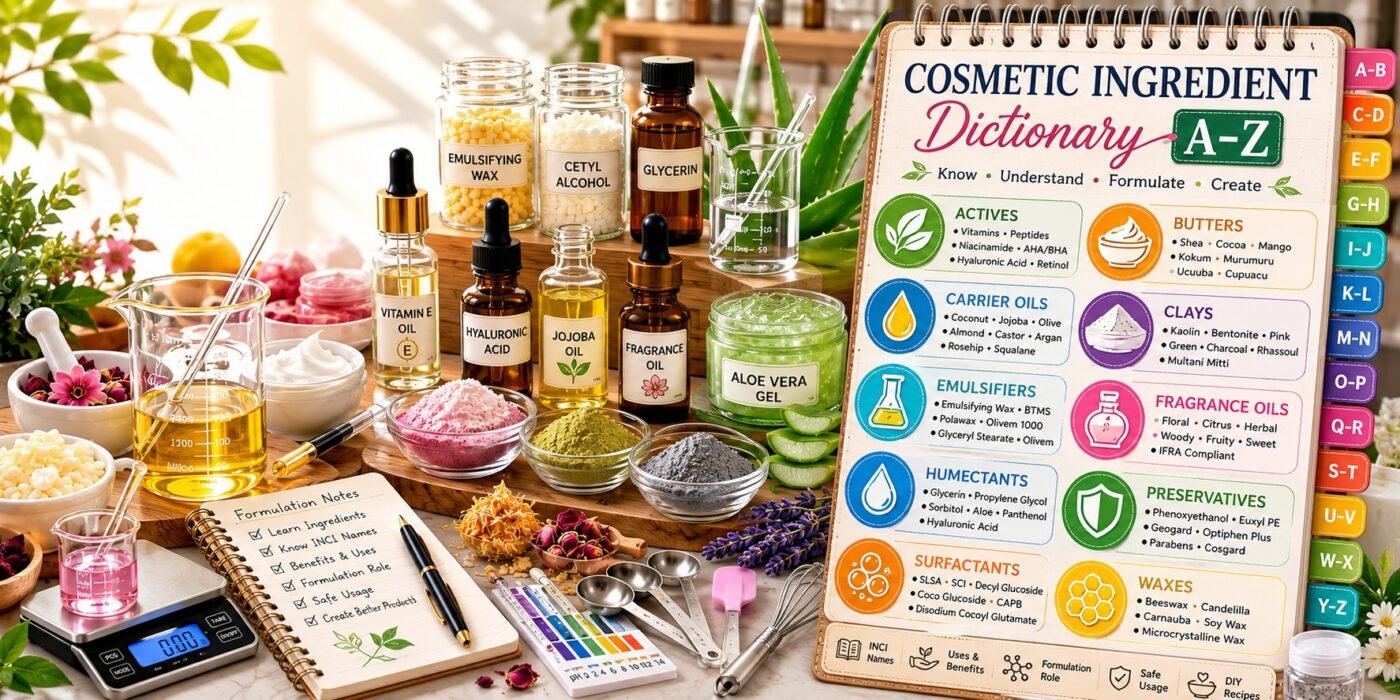
Cosmetic Ingredient Dictionary A-Z
Jun
Cosmetic Ingredient Dictionary A-Z
A beginner-friendly cosmetic raw material dictionary for DIY makers, small brands, soap makers, candle makers, skincare formulators, and handmade cosmetic businesses in India.
Quick Answer
A cosmetic ingredient dictionary helps beginners understand what each raw material does in a formula. Oils soften and condition, butters add richness, waxes add structure, clays add texture and color, humectants attract water, emulsifiers help oil and water mix, preservatives protect water-based products, surfactants create cleansing foam, and fragrances add aroma.
Table of Contents
How to Read Cosmetic Ingredients
Every cosmetic ingredient has a purpose. Some ingredients create the base of a product, some improve feel, some add fragrance or color, some help preserve the formula, and some help the product spread, foam, thicken, or stay stable.
For example, a face serum may contain carrier oil, vitamin E oil, fragrance-free active oil, and packaging in a dropper bottle. A lotion may contain water, oil, emulsifier, humectant, thickener, preservative, and fragrance. A soap may contain soap base, fragrance oil, color, clay, and botanical powder.
For cosmetic raw materials, carrier oils, essential oils, clays, herbal powders, soap bases, butters, waxes, preservatives, emulsifiers, surfactants, jars, bottles, and packaging, visit Jindeal.com.
Main Cosmetic Ingredient Categories
A-Z Cosmetic Ingredient Dictionary
Use this A-Z dictionary to understand common cosmetic raw materials and their beginner-friendly uses.
A
B
C
D
E
F
G
H
I
J
K
L
M
N
O
P
R
S
T
V
W
X
Z
Beginner Usage Chart
This chart gives broad beginner-friendly ranges. Always follow supplier documentation and test your exact formula.
| Ingredient Type | Typical Beginner Use | Common Products | Important Note |
|---|---|---|---|
| Carrier Oils | 1% to 100% | Serums, oils, balms, body butter | Oil-only products do not need water-phase preservative but need good storage |
| Essential Oils | 0.1% to 2% | Soaps, oils, balms, hair oils, candles | Use safe dilution and avoid sensitive areas |
| Fragrance Oils | 0.5% to 3% cosmetics, 6% to 10% candles | Soap, candles, scrubs, diffuser products | Check skin-safe or candle-safe category |
| Clays | 0.5% to 100% dry masks | Masks, soaps, bath powders | Dry powders stay safer when kept dry |
| Herbal Powders | 0.5% to 100% dry blends | Masks, ubtan, hair packs, soaps | Can fade, stain, or feel gritty |
| Humectants | 1% to 10% | Lotions, gels, serums, cleansers | Too much can feel sticky |
| Emulsifiers | 2% to 8% | Creams, lotions, conditioners | Depends on oil phase and emulsifier type |
| Preservatives | As supplier recommended | Water-based products | Depends on pH, formula type, and preservative system |
| Surfactants | Depends on active matter | Shampoo, cleanser, body wash | Requires formulation knowledge and pH testing |
| Colors / Mica | 0.1% to 0.5% starting range | Soap, bath products, decorative cosmetics | Use cosmetic-grade and test staining |
Safety and Formulation Notes
Cosmetic formulation requires more than mixing ingredients. You must consider ingredient compatibility, safe usage level, pH, preservation, packaging, stability, texture, fragrance level, and customer instructions.
- Use cosmetic-grade raw materials for cosmetic products.
- Do not use industrial, food-only, craft-only, or unknown-grade ingredients in cosmetics.
- Water-containing products need suitable preservatives.
- Dry masks and powders should be kept dry and packed in moisture-resistant packaging.
- Essential oils and fragrance oils should be used at safe recommended levels.
- Strong essential oils need extra caution in face, scalp, children’s, and sensitive-skin themed products.
- Patch test finished products before regular use.
- Keep batch records for raw material supplier, lot number, formula percentage, date, and testing notes.
- Avoid medical claims such as curing acne, eczema, dandruff, hair fall, pigmentation, infection, or disease.
- Check applicable labeling, GST, cosmetic manufacturing, and local business rules before selling.
Common Mistakes
1. Mixing Ingredients Without Understanding Function
Every ingredient should have a purpose. Avoid adding ingredients only because they sound attractive.
2. Making Water-Based Products Without Preservative
This is one of the biggest beginner mistakes. Stored water-based products need preservation.
3. Using Too Much Essential Oil
Essential oils are concentrated and must be diluted safely.
4. Using Candle Fragrance in Skin Products
Candle fragrance oil should not be used in skin-contact products unless supplier confirms it is suitable.
5. Making Medical Claims
Cosmetic products should not claim to cure acne, eczema, dandruff, hair fall, pigmentation, infection, or disease.
6. Not Checking pH
pH matters in shampoos, cleansers, lotions, gels, and preservative performance.
7. Not Testing Stability
Products can separate, change smell, change color, grow contamination, or lose texture over time.
8. Using Non-Cosmetic Colors
Use cosmetic-grade colors and pigments only.
9. Poor Packaging Choice
Wrong packaging can cause leaking, contamination, moisture entry, oxidation, or product damage.
10. No Batch Records
Batch records help repeat good formulas and solve complaints.
FAQ
1. What is a cosmetic ingredient dictionary?
It is a reference guide that explains common cosmetic raw materials, their function, and where they are used in formulas.
2. What are carrier oils?
Carrier oils are vegetable oils used in serums, massage oils, hair oils, balms, body butters, and creams.
3. What are essential oils?
Essential oils are concentrated aromatic plant oils used for fragrance at safe diluted levels.
4. What is the difference between fragrance oil and essential oil?
Essential oil comes from plants, while fragrance oil is an aroma blend. Both need safe usage limits depending on product type.
5. What is an emulsifier?
An emulsifier helps oil and water mix into stable creams and lotions.
6. What is a preservative?
A preservative helps protect water-containing cosmetic products from microbial growth.
7. Do oil-based products need preservatives?
Oil-only products usually do not need water-phase preservatives, but they may need antioxidant support and clean manufacturing.
8. Do dry powders need preservatives?
Dry powders are easier to preserve if kept completely dry. Stored wet masks need preservatives.
9. What are surfactants?
Surfactants are cleansing and foaming ingredients used in shampoos, body washes, cleansers, and bath products.
10. What are humectants?
Humectants attract water and improve hydration feel in lotions, gels, creams, and serums.
11. Can herbal powders cure skin problems?
No. Avoid medical claims. Herbal powders can be used in cosmetic rinse-off products, masks, soaps, and hair-care themes.
12. Can essential oils cure hair fall?
No. Do not claim essential oils cure hair fall, dandruff, or scalp disease. Use cosmetic-safe hair-care wording.
13. What ingredients should beginners start with?
Beginners can start with soap base, carrier oils, clays, herbal powders, fragrance oils, essential oils, glycerin, jars, bottles, and silicone molds.
14. What should I check before selling cosmetics?
Check formulation safety, preservation, stability, labels, batch records, GST, cosmetic manufacturing rules, and local business requirements.
15. Where can I buy cosmetic ingredients?
You can buy cosmetic raw materials, oils, clays, herbal powders, soap bases, fragrance oils, essential oils, jars, bottles, and packaging from Jindeal.com.
Final Words
This Cosmetic Ingredient Dictionary A-Z gives beginners a simple way to understand common raw materials and their functions. Before making any cosmetic product, learn what each ingredient does, how much to use, whether it needs preservation, and how it behaves in the final formula.
Use cosmetic-grade ingredients, follow supplier guidance, test every formula, keep batch records, and avoid medical claims. For cosmetic raw materials, soap bases, clays, herbal powders, oils, butters, waxes, fragrance oils, essential oils, jars, bottles, and packaging, visit Jindeal.com.
Shop Cosmetic Ingredients on Jindeal.com
Buy carrier oils, essential oils, fragrance oils, soap bases, clays, herbal powders, butters, waxes, colors, mica, jars, bottles, molds, and packaging materials from Jindeal.com.