
Uncategorized
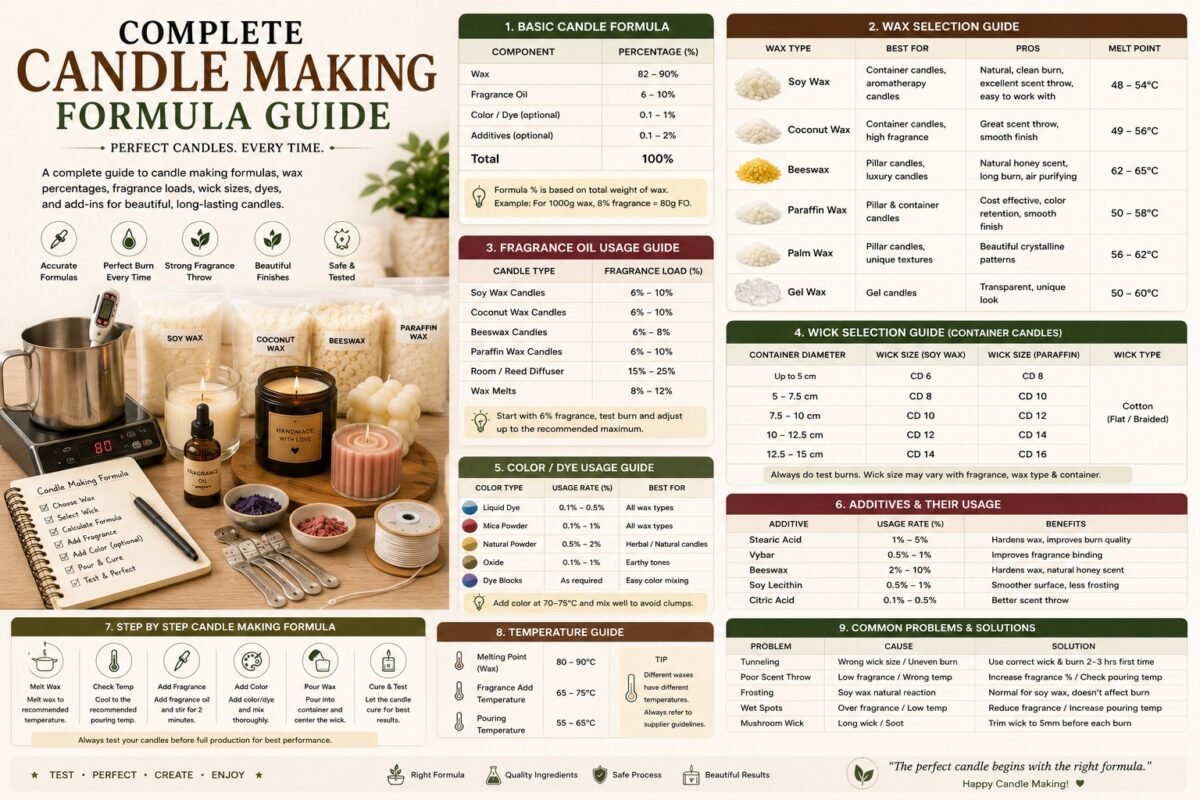
Complete Candle Making Formula Guide
Jun
Complete Candle Making Formula Guide
Learn candle making formulas for soy wax candles, paraffin candles, coconut wax blends, candle tins, jar candles, wax melts, molded candles, fragrance load, wick testing, costing, and safe small-batch production.
Quick Answer
A basic candle formula is wax + fragrance oil + wick + container. For many beginner jar candles, a good test formula is 92% wax and 8% fragrance oil by final fill weight. But every wax, jar, wick, fragrance, dye, and container combination must be tested for hot throw, cold throw, flame height, smoke, jar heat, tunneling, and burn time before selling.
Table of Contents
Basic Candle Formula
The simplest candle formula is based on the final fill weight of your candle. Final fill weight means the total wax plus fragrance oil that goes inside the jar or tin.
This formula is only a starting point. Candle making is not only about mixing wax and fragrance. The wick must match the jar diameter, wax type, fragrance oil, dye, and desired burn performance.
For candle wax, fragrance oils, essential oils, candle jars, tins, wicks, wick stickers, wick holders, candle dyes, silicone candle molds, thermometers, pouring pots, and packaging, visit Jindeal.com.
Candle Formula Chart
Use this chart as a beginner starting point. Always adjust after testing your exact raw materials.
| Candle Type | Wax % | Fragrance Oil % | Best Use | Testing Note |
|---|---|---|---|---|
| Soy Wax Jar Candle | 92% to 94% | 6% to 8% | Premium handmade jar candles | Test frosting, wet spots, hot throw, and wick size |
| Paraffin Jar Candle | 92% to 95% | 5% to 8% | Strong scented candles | Test smoke, soot, jar heat, and scent throw |
| Coconut Wax Blend Candle | 90% to 94% | 6% to 10% | Luxury jar candles | Follow wax supplier maximum fragrance load |
| Wax Melts | 88% to 92% | 8% to 12% | Wax warmer melts | Test sweating, hardness, melt performance, and scent throw |
| Pillar Candle | 93% to 96% | 4% to 7% | Molded pillar candles | Test hardness, demolding, flame, and dripping |
| Tealight Candle | 94% to 97% | 3% to 6% | Small tealight candles | Test flame height and cup heat |
| Essential Oil Candle | 94% to 97% | 3% to 6% | Natural aroma candle theme | Hot throw may be softer than fragrance oil |
Formula by Wax Type
These are starting formulas only. Wax brands can behave differently. Some waxes hold more fragrance, some need longer curing, some frost more, and some need specific pour temperature.
Fragrance Load Guide
Fragrance load means the percentage of fragrance oil in the final candle fill weight. Higher fragrance does not always mean a better candle. Too much fragrance can cause sweating, weak structure, wick clogging, smoking, poor burning, or safety issues.
| Fragrance Load | For 1 kg Final Fill | Wax Amount | Best Use |
|---|---|---|---|
| 5% | 50 g fragrance | 950 g wax | Light fragrance, tealights, pillars |
| 6% | 60 g fragrance | 940 g wax | Beginner jar candle test |
| 8% | 80 g fragrance | 920 g wax | Popular jar candle starting point |
| 10% | 100 g fragrance | 900 g wax | Wax melts or supplier-approved luxury wax blends |
| 12% | 120 g fragrance | 880 g wax | Wax melts only after testing |
Wick Selection Guide
Wick selection is the most important part of candle formula development. The same wax and fragrance can perform differently with different wick sizes.
| Jar Diameter | Wick Testing Direction | What to Check | Common Issue |
|---|---|---|---|
| Small jars / tins | Start with smaller wick range | Flame height, cup heat, tunneling | Overheating if wick is too large |
| Medium jars | Test 2 to 3 wick sizes | Melt pool, hot throw, smoke | Tunneling if wick is too small |
| Wide jars | May need larger wick or double wick | Even melt pool and jar heat | Uneven burn or excessive heat |
| Wooden wick candles | Test crackle, flame, and wax pool | Stability and relighting | Weak flame if wick is wrong |
Beginner Candle Recipes
| Formula | Ingredients | Product Theme | Testing Focus |
|---|---|---|---|
| Basic Soy Jar Candle | 920 g soy wax + 80 g fragrance oil | Premium handmade candle | Hot throw, frosting, wick size |
| Paraffin Strong Scent Candle | 930 g paraffin wax + 70 g fragrance oil | Strong scented jar candle | Soot, smoke, scent throw |
| Coconut Wax Luxury Candle | 920 g coconut wax blend + 80 g fragrance oil | Luxury jar candle | Jar adhesion, hot throw, smooth top |
| Wax Melts | 900 g wax + 100 g fragrance oil | Wax warmer product | Sweating, melt performance, fragrance throw |
| Lavender Essential Oil Candle | 950 g wax + 50 g lavender essential oil | Natural aroma theme | Hot throw and burn quality |
| Colored Jar Candle | 920 g wax + 80 g fragrance oil + candle dye as needed | Decorative candle | Dye compatibility, wick, soot |
Step-by-Step Candle Making Process
1. Prepare Container and Wick
Clean the candle jar or tin, attach wick with wick sticker, and center it using a wick holder. A misaligned wick can cause uneven burning and unsafe jar heat.
2. Weigh Wax and Fragrance
Use a digital scale. Do not measure by spoons or cups. Candle formula should be repeatable in grams.
3. Melt Wax Slowly
Melt wax using controlled heat. Avoid overheating because it can affect fragrance bonding, surface finish, and final candle quality.
4. Add Fragrance at Suitable Temperature
Add fragrance oil according to wax supplier guidance. Stir slowly and thoroughly so fragrance mixes evenly into wax.
5. Add Candle Dye if Needed
Add candle dye chips or liquid candle dye in small amounts. Too much color can affect burn quality.
6. Pour Into Jar
Pour at the tested temperature for your wax. Pouring too hot or too cold can cause frosting, wet spots, sinkholes, or rough tops.
7. Let Candle Set and Cure
Allow the candle to cool undisturbed. Many candles improve after proper curing time because fragrance settles better into the wax.
8. Trim Wick and Label
Trim wick, add warning label, product label, batch code, fragrance name, net quantity, and usage instructions.
9. Burn Test
Test the candle for flame, melt pool, jar heat, smoking, tunneling, scent throw, and burn time before selling.
Candle Testing Checklist
Testing is compulsory for safe and professional candle making. Every new jar, wick, wax, fragrance, dye, or formula change should be tested.
| Test Area | What to Check | Good Result | Problem Sign |
|---|---|---|---|
| Cold Throw | Smell before burning | Clear fragrance from jar | No smell after curing |
| Hot Throw | Smell while burning | Good room aroma | Weak fragrance while burning |
| Melt Pool | Wax pool after burn | Even melt pool over time | Tunneling or too deep melt pool |
| Flame Height | Flame size and stability | Stable controlled flame | Large flame or flickering |
| Jar Heat | Container temperature | Warm but not unsafe | Very hot glass/tin |
| Soot / Smoke | Black smoke or soot | Clean burn | Sooting or mushrooming wick |
| Surface Finish | Top appearance | Smooth and clean | Cracks, sinkholes, rough top |
| Shipping | Breakage, melting, leakage | Safe delivery-ready packaging | Broken jar or damaged label |
Candle Costing Formula
A profitable candle formula must include all raw material, packaging, testing, and selling costs. Do not calculate only wax and fragrance.
| Cost Item | Include This | Why Important |
|---|---|---|
| Wax | Soy wax, paraffin wax, coconut wax, beeswax blend | Main candle base cost |
| Fragrance Oil | Candle-safe fragrance oil or essential oil | Major cost and customer appeal |
| Wick | Cotton wick, wooden wick, wick tab, wick sticker | Controls burn performance |
| Container | Glass jar, candle tin, ceramic jar | Major visual and cost factor |
| Color | Candle dye chips or liquid candle dye | Product appearance |
| Packaging | Label, warning sticker, box, dust cover, ribbon | Branding and safety |
| Testing Loss | Burn tests, failed batches, broken jars | Required before selling |
| Labor | Making, cleaning, curing, packing, customer support | Your time has cost |
| Selling Cost | Ads, marketplace fee, payment gateway, samples | Important for online profit |
Common Candle Formula Mistakes
1. Using Too Much Fragrance Oil
High fragrance load can cause sweating, weak structure, poor burn, smoking, or wick clogging.
2. Wrong Wick Size
The wrong wick can cause tunneling, high flame, black smoke, overheating, or weak scent throw.
3. Not Testing Jar Heat
A candle jar that gets too hot can become unsafe. Always check container temperature during burn tests.
4. Changing Fragrance Without Retesting
Every fragrance oil can burn differently. A new fragrance may need a different wick size.
5. Ignoring Wax Supplier Guidance
Different waxes have different melting points, pour temperatures, and fragrance load limits.
6. Measuring by Volume
Use grams, not cups or spoons. Candle formulas should be weight-based.
7. Adding Too Much Dye
Too much candle dye can affect wick performance and burn quality.
8. Selling Without Warning Labels
Every candle should include basic fire safety instructions.
9. Weak Packaging
Candles can break, melt, leak, or scratch during shipping if packaging is poor.
10. Making Medical Claims
Do not claim candles cure anxiety, insomnia, headache, stress, depression, or any medical condition.
FAQ
1. What is the basic candle making formula?
A basic candle formula is wax plus fragrance oil in a suitable jar with a tested wick. For example, 92% wax and 8% fragrance oil for a beginner jar candle test.
2. How much fragrance oil should I use in candles?
For many jar candles, 6% to 8% is a common starting point, but always follow wax and fragrance supplier recommendations.
3. How much fragrance oil for 1 kg candle?
At 8% fragrance load, use 80 g fragrance oil and 920 g wax for 1 kg final candle fill weight.
4. Which wax is best for beginners?
Soy wax is popular for beginner jar candles. Paraffin wax is economical and often gives strong scent throw. Choose based on your product style and testing.
5. What is the best formula for soy candles?
A common test formula is 92% soy wax and 8% candle fragrance oil, but wick and pour temperature must be tested.
6. What is the best formula for wax melts?
A common wax melt test formula is 90% wax and 10% fragrance oil. Test sweating, hardness, and scent throw.
7. Why is my candle tunneling?
Tunneling usually happens when the wick is too small, burn time is too short, or the formula is not balanced.
8. Why is my candle smoking?
Smoking can happen due to oversized wick, too much fragrance, poor wick trimming, draft, or poor formula compatibility.
9. Why is my candle not smelling strong?
Weak hot throw can happen due to low fragrance load, poor fragrance oil, wrong wax, wrong wick, short cure time, or small candle size.
10. Can I add essential oils to candles?
Yes, but essential oil candles often have softer scent throw. Use suitable levels and test burn performance.
11. Can I mix fragrance oil and essential oil?
Yes, if both are suitable for candle use and the total fragrance load remains within the recommended limit.
12. How do I choose wick size?
Wick size depends on jar diameter, wax type, fragrance oil, dye, and desired burn performance. Test multiple wick sizes.
13. Do candles need curing?
Many candles improve after curing because fragrance settles into the wax. Curing time depends on wax type and formula.
14. Can candles cure stress or insomnia?
No. Do not make medical claims. Candles can be described for aroma, decor, ambience, gifting, and relaxation-style mood.
15. Where can I buy candle making supplies?
You can buy soy wax, paraffin wax, fragrance oils, essential oils, candle jars, tins, wicks, dyes, molds, and packaging from Jindeal.com.
Final Words
A complete candle making formula is more than wax and fragrance. You must balance wax type, fragrance load, wick size, jar diameter, dye, pour temperature, curing, and burn testing. A beautiful candle should also be safe, stable, well-packed, and properly labeled.
Use quality candle raw materials, test every formula, keep batch records, add warning labels, and calculate real cost before selling. For candle wax, fragrance oils, essential oils, jars, tins, wicks, colors, molds, and packaging, visit Jindeal.com.
Shop Candle Making Supplies on Jindeal.com
Buy soy wax, paraffin wax, fragrance oils, essential oils, candle jars, tins, cotton wicks, wooden wicks, wick stickers, candle dyes, silicone molds, and packaging materials from Jindeal.com.