
Uncategorized
Why Is My Cream Grainy?
Jun
Why Is My Cream Grainy?
Learn why handmade cream becomes grainy, gritty, lumpy, sandy, or uneven and how to fix cream texture problems with better melting, emulsification, cooling, mixing, ingredient selection, pH control, and stability testing.
Quick Answer
Cream becomes grainy when butters, waxes, emulsifiers, thickeners, powders, or actives do not melt, dissolve, hydrate, or cool properly. Common causes include overheated shea butter, slow cooling, unmelted wax, poorly hydrated gum, wrong mixing, crystallization, incompatible ingredients, or adding powders directly without proper dispersion.
Table of Contents
What Is Grainy Cream?
Grainy cream means the cream does not feel smooth. It may feel sandy, gritty, waxy, lumpy, curdled, or uneven when rubbed on the skin. Sometimes the cream looks normal in the jar but feels grainy during application.
Graininess can happen in lotions, creams, body butters, cold creams, emulsified body butters, whipped creams, hair creams, and balm-style products. It is usually a formulation or process issue, not just an ingredient issue.
To fix graininess, identify what is causing the particles: butter crystals, unmelted wax, poorly dissolved powders, hydrated gum lumps, separated emulsion, or incompatible ingredients.
For cosmetic butters, emulsifying wax, carrier oils, preservatives, thickeners, glycerin, vitamin E oil, jars, bottles, and DIY cosmetic raw materials, visit Jindeal.com.
What Causes the Problem?
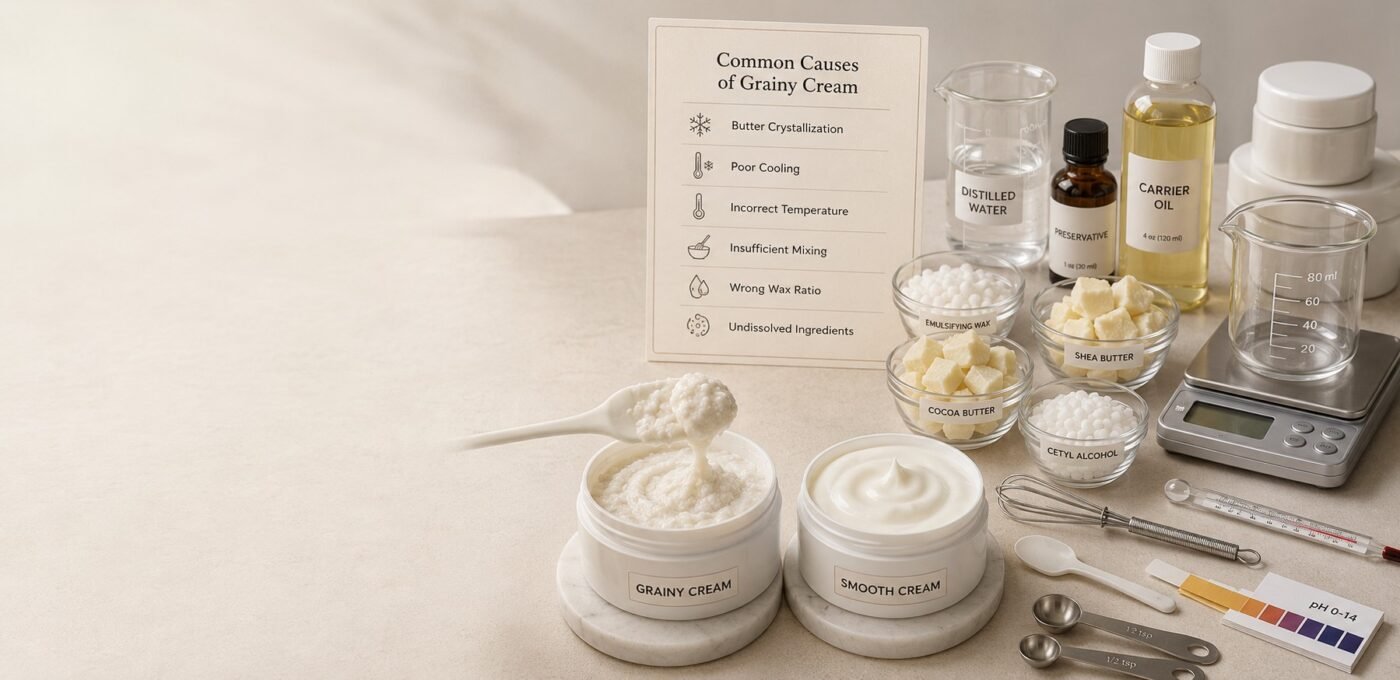
Graininess happens when ingredients form particles, crystals, lumps, or uneven structures inside the cream. The most common reasons are wrong melting, wrong cooling, poor dispersion, and unstable emulsion.
Common causes include:
- Shea butter or mango butter crystallized during slow cooling
- Butters were overheated for too long
- Cocoa butter, wax, stearic acid, or cetyl alcohol did not fully melt
- Emulsifying wax was not heated enough to melt fully
- Oil phase and water phase were mixed at the wrong temperature
- Xanthan gum or thickener formed lumps
- Powders were added directly without proper dispersion
- Fragrance oil, essential oil, or extract destabilized the emulsion
- pH was wrong for the thickener, preservative, or active
- Cream cooled too slowly or unevenly
- Mixing was too weak or too short
- Formula contains incompatible ingredients
For example, shea butter can become grainy if it is melted and then allowed to cool slowly. Fatty crystals form inside the product and create a sandy feel later.
Grainy Cream Fix Chart
Use this chart to quickly identify the reason for grainy cream and choose the best fix.
| Texture Problem | Likely Cause | Best Fix |
|---|---|---|
| Sandy grains after 24 hours | Shea butter or butter crystallization | Melt gently, cool faster, and avoid slow cooling |
| Waxy hard particles | Unmelted wax, stearic acid, cetyl alcohol, or emulsifier | Heat oil phase until all solids are fully melted |
| Gummy lumps | Poorly hydrated xanthan gum or thickener | Pre-disperse gum in glycerin before adding water |
| Powdery grit | Powder or clay not dispersed finely | Use fine powder and disperse properly before adding |
| Curdled grainy cream | Weak or broken emulsion | Check emulsifier, mixing, temperature, and pH |
| Grains after storage | Temperature changes or crystallization | Improve formula stability and store at stable temperature |
Step-by-Step Solution
Step 1: Identify the Type of Graininess
Rub a small amount of cream between fingers. If the grains melt with body warmth, the issue may be butter crystals or wax particles. If they stay gritty, the problem may be powder, gum lumps, or undissolved ingredient.
Step 2: Melt Oil Phase Properly
Heat the oil phase until all butters, waxes, emulsifying wax, cetyl alcohol, stearic acid, and solid ingredients are fully melted. Do not stop heating when the mixture only looks partly melted.
Step 3: Avoid Overheating Butters
Do not keep shea butter, mango butter, or cocoa butter on high heat for too long. Gentle heating is better. Overheating and slow cooling can increase the chance of grainy texture.
Step 4: Cool Butter Formulas Faster
If graininess comes from shea butter or mango butter, cool the melted mixture faster. For body butter or butter-heavy creams, place the mixture in a cool area or refrigerator for a short time until semi-solid, then whip or emulsify properly.
Step 5: Hydrate Gums Correctly
If using xanthan gum, disperse it first in glycerin or another suitable medium before adding to the water phase. Adding gum directly to water can create fish-eye lumps that feel grainy.
Step 6: Disperse Powders Properly
Powders like arrowroot, clay, herbal powders, zinc oxide, mica, or starch should be very fine and properly dispersed. Do not add rough powder directly into finished cream.
Step 7: Combine Phases at Correct Temperature
Oil and water phases should usually be hot and close in temperature before combining, depending on emulsifier guidelines. Large temperature difference can create weak emulsion and uneven texture.
Step 8: Mix Strongly During Emulsification
Use a stick blender or suitable cosmetic mixer to create a smooth emulsion. Spoon mixing is usually not enough for stable creams.
Step 9: Mix Gently During Cool-Down
After initial emulsification, continue mixing gently while cooling. This helps reduce lumps and improves final texture.
Step 10: Check pH
pH can affect thickeners, preservatives, and some active ingredients. Check pH when making water-based creams and adjust according to the formula requirements.
Step 11: Add Cool-Down Ingredients at the Right Time
Preservatives, fragrance oils, essential oils, extracts, and heat-sensitive ingredients should be added at the supplier-recommended cool-down temperature.
Step 12: Test Stability
Check cream after 24 hours, 7 days, 2 weeks, and 1 month. Graininess can develop later due to crystallization or temperature changes.
Common Mistakes
1. Cooling Shea Butter Too Slowly
Slow cooling can create butter crystals and grainy texture.
2. Overheating Butters
Long high heat can worsen graininess in some butter-heavy formulas.
3. Not Fully Melting Waxes
Unmelted wax, stearic acid, cetyl alcohol, or emulsifier can feel like grains.
4. Adding Xanthan Gum Directly to Water
This can create gummy lumps. Pre-disperse gum properly.
5. Adding Powders Directly to Finished Cream
Powders can create gritty texture if not finely milled and dispersed well.
6. Mixing with a Spoon Only
Creams usually need proper high-shear mixing or stick blending during emulsification.
7. Combining Oil and Water at Wrong Temperature
Wrong phase temperature can cause weak texture and separation.
8. Ignoring pH
Wrong pH can affect thickener, preservative, and ingredient performance.
9. Using Too Many Additives
Too many extracts, powders, salts, or actives can destabilize texture.
10. Selling Without Stability Testing
A cream may become grainy later, so test before selling.
Expert Tips
- Use a thermometer to control heating and cool-down stages.
- Melt waxes, emulsifiers, fatty alcohols, and solid butters completely.
- Avoid prolonged high heat with shea butter and mango butter.
- Cool butter-heavy formulas faster to reduce graininess.
- Pre-disperse xanthan gum in glycerin before hydrating.
- Use fine cosmetic-grade powders only.
- Disperse powders before adding to cream.
- Use a stick blender or suitable mixer for stable emulsions.
- Check pH in water-based creams.
- Use a proper preservative for water-containing creams.
- Make small test batches before bulk production.
- Buy emulsifying wax, cosmetic butters, carrier oils, thickeners, preservatives, jars, and DIY cosmetic raw materials from Jindeal.com.
FAQ
1. Why is my cream grainy?
Your cream may be grainy because of crystallized butters, unmelted wax, poorly hydrated gum, undispersed powders, weak emulsion, wrong pH, or incompatible ingredients.
2. Why does shea butter make cream grainy?
Shea butter can form crystals when melted and cooled slowly. Faster cooling and proper processing can reduce this issue.
3. Can I fix grainy cream?
Sometimes. If the grains are butter or wax crystals, you may be able to gently remelt, mix, cool faster, and reprocess. If grit is from powders, reformulation may be needed.
4. Why does my cream feel sandy?
Sandy texture often comes from butter crystals, undissolved solids, rough powders, or poorly dispersed ingredients.
5. Why are there waxy particles in my cream?
Waxy particles usually mean emulsifying wax, beeswax, stearic acid, cetyl alcohol, or solid butter did not fully melt.
6. Can xanthan gum make cream grainy?
Yes. If xanthan gum is not dispersed properly, it can create gummy lumps in cream.
7. Can powders make cream gritty?
Yes. Clay, arrowroot, herbal powders, mica, and other powders can feel gritty if not fine enough or properly dispersed.
8. Does pH affect cream texture?
Yes. pH can affect thickeners, preservatives, emulsifiers, and some active ingredients.
9. Can fragrance oil make cream grainy?
Fragrance oil may destabilize texture if used too high or if it is not compatible with the formula.
10. Why did my cream become grainy after a few days?
Delayed graininess can happen due to butter crystallization, temperature changes, unstable emulsion, or ingredient incompatibility.
11. Should I refrigerate cream to prevent graininess?
Quick cooling can help butter-heavy formulas, but finished creams should be stored according to formula and preservative requirements. Avoid repeated heat-cold cycles.
12. Can I sell grainy cream?
No. Grainy cream looks unprofessional and may indicate formula or process instability. Reformulate and test before selling.
13. Does cream need preservative?
Yes. Any cream containing water needs a suitable broad-spectrum preservative system.
14. Is vitamin E a preservative for cream?
No. Vitamin E is mainly an antioxidant for oils and does not preserve water-based creams from bacteria, yeast, and mold.
15. Where can I buy cream-making ingredients?
You can buy emulsifying wax, cosmetic butters, carrier oils, preservatives, thickeners, glycerin, vitamin E oil, jars, bottles, and DIY cosmetic raw materials from Jindeal.com.
Final Words
Grainy cream usually happens because ingredients did not melt, disperse, hydrate, cool, or emulsify correctly. The fix depends on the cause: butter crystals need better cooling, wax particles need full melting, gum lumps need proper dispersion, and broken emulsions need better formula balance.
For emulsifying wax, cosmetic butters, carrier oils, thickeners, preservatives, glycerin, vitamin E oil, jars, bottles, and DIY cosmetic raw materials, visit Jindeal.com.
Make Smooth Creams with Jindeal.com
Shop emulsifying wax, shea butter, mango butter, cocoa butter, carrier oils, thickeners, preservatives, jars, bottles, and DIY cosmetic ingredients from Jindeal.com.
