
Uncategorized
How to Make Face Serum at Home
Jun
How to Make Face Serum at Home
Learn how to make beginner-friendly face serum at home using carrier oils, vitamin E oil, essential oils, humectants, preservatives, and cosmetic raw materials with simple formulas and safe DIY skincare guidance.
Quick Answer
The easiest face serum for beginners is an oil-based serum made with lightweight carrier oils like jojoba, grapeseed, sweet almond, or argan oil plus a small amount of vitamin E oil. Water-based serums need proper preservative, pH checking, and formulation knowledge, so beginners should start with oil-based serum first.
Table of Contents
What Is a Face Serum?
A face serum is a lightweight cosmetic product used before cream, lotion, or moisturizer. It can be oil-based, water-based, gel-based, or emulsion-based depending on the ingredients and formulation system.
For beginners, oil-based face serum is the simplest option because it does not contain water and is easier to make. It usually contains carrier oils, vitamin E oil, and sometimes a very small amount of skin-safe essential oil.
Water-based serums are more advanced. They may contain distilled water, glycerin, aloe, hydrosol, niacinamide, hyaluronic acid, botanical extracts, gums, preservative, and pH adjustment. These require proper preservation and pH testing.
For carrier oils, vitamin E oil, essential oils, cosmetic preservatives, glycerin, aloe vera powder, jars, dropper bottles, and DIY cosmetic raw materials, visit Jindeal.com.
What Causes Beginner Problems?
Face serum looks simple, but mistakes can make it greasy, sticky, unsafe, separated, irritating, or unstable. The biggest issue is mixing water-based ingredients into a serum without using a preservative system.
Common beginner problems include:
- Using heavy oils that feel greasy on the face
- Adding essential oils at unsafe levels
- Adding water or aloe juice without preservative
- Using vitamin E oil as a preservative
- Not checking pH in water-based serums
- Adding too many active ingredients together
- Using fragrance oil not suitable for leave-on face products
- Not patch testing before use
- Using dirty bottles or wet tools
- Making large batches before testing
- Using old or rancid carrier oils
- Making medical claims like curing acne or pigmentation
A good beginner serum should be simple, lightweight, properly measured, hygienically packed, and tested in small quantity first.
Face Serum Ingredient Guide
This chart explains beginner-friendly ingredient choices for face serum making.
| Ingredient Type | Examples | Purpose | Beginner Note |
|---|---|---|---|
| Light Carrier Oils | Jojoba oil, grapeseed oil, sunflower oil | Light skin feel and easy spread | Good for oily and combination skin formulas |
| Medium Carrier Oils | Sweet almond oil, apricot kernel oil, argan oil | Balanced nourishment feel | Good for normal to dry skin formulas |
| Rich Carrier Oils | Olive oil, avocado oil, castor oil | Rich feel and heavier texture | Use carefully in face serum; can feel heavy |
| Vitamin E Oil | Cosmetic-grade Vitamin E oil | Antioxidant support for oils | Not a preservative for water-based serum |
| Essential Oils | Lavender EO, rosemary EO, tea tree EO | Aroma and product appeal | Use only if suitable for face and at safe low levels |
| Water-Based Ingredients | Distilled water, glycerin, aloe, hydrosol | Hydrating feel | Needs preservative and pH check |
| Packaging | Amber dropper bottle, serum bottle | Easy use and better storage | Use clean, dry bottles |
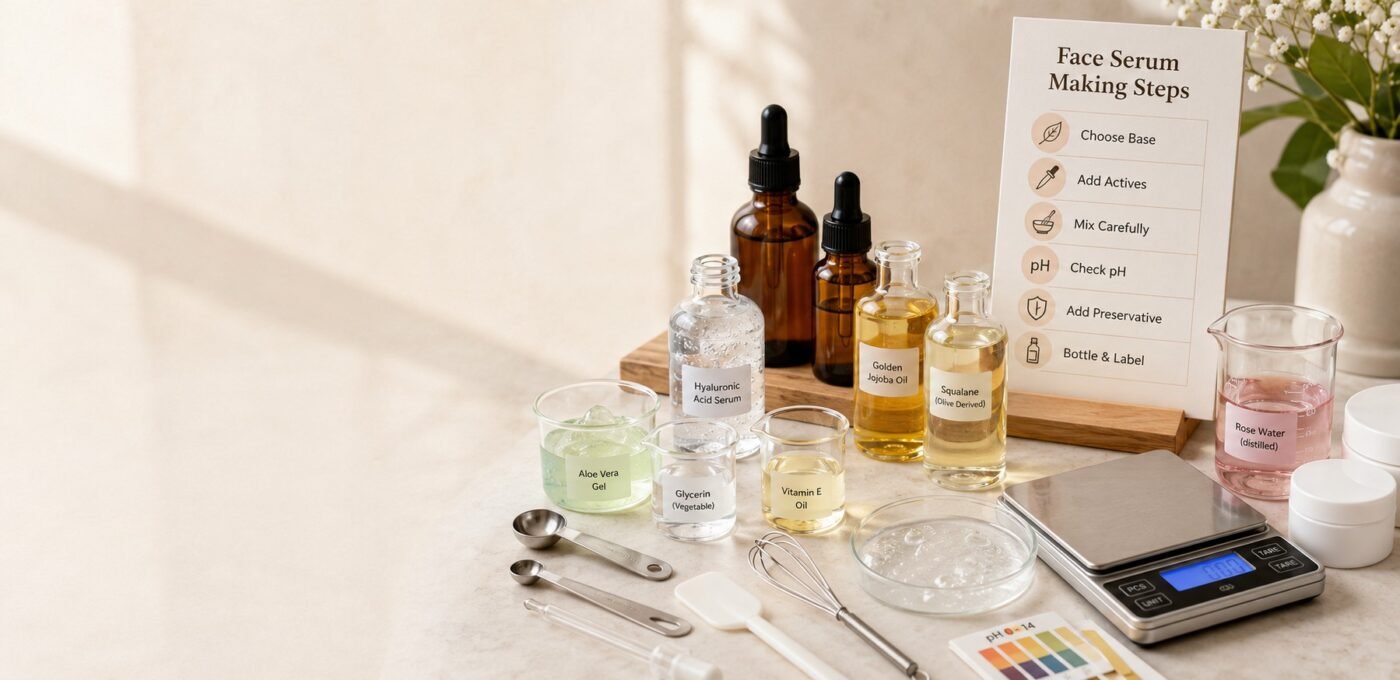
Step-by-Step Face Serum Method
Step 1: Start with Oil-Based Serum
For beginners, oil-based face serum is the safest and easiest starting point. It does not need emulsifier or water-phase preservative because it contains only oils, butters, and oil-soluble ingredients.
Step 2: Choose Carrier Oils by Skin Feel
Choose light oils for oily or combination skin feel. Choose medium oils for normal skin feel. Choose richer oils for dry-skin products. Avoid very heavy oils as the main oil in face serum unless your customer wants a rich night oil.
Step 3: Weigh Ingredients
Use a digital scale and measure ingredients by weight. This gives better accuracy and helps you repeat the same formula again.
Step 4: Mix Carrier Oils
Add selected carrier oils into a clean beaker or glass bowl. Mix slowly with a clean dry stirrer until uniform.
Step 5: Add Vitamin E Oil
Add vitamin E oil in a small amount as antioxidant support for the oil blend. Mix well. Vitamin E oil is not a preservative, but it can help support oil freshness.
Step 6: Add Essential Oil Only If Needed
Essential oils are optional and should be used carefully. Face products need low, skin-safe usage. Avoid strong or irritating essential oils unless you know their safe leave-on limits.
Step 7: Fill in Clean Dropper Bottles
Fill the serum into clean, dry amber dropper bottles. Avoid introducing water into the bottle. Close tightly after filling.
Step 8: Label the Batch
Write product name, ingredients, batch date, and batch number. If selling, follow proper cosmetic labeling requirements.
Step 9: Patch Test
Patch test the serum before regular use. Apply a small amount on a small area and observe skin response. Stop use if irritation occurs.
Step 10: Store Properly
Store face serum away from heat, sunlight, and moisture. Use clean hands and avoid touching the dropper to skin directly.
Step 11: For Water-Based Serum, Learn Preservation First
If you want to make water-based serum with glycerin, aloe, hydrosol, or active ingredients, learn preservative system, pH adjustment, and stability testing before making it for use or sale.
Common Mistakes
1. Adding Water Without Preservative
Water-based serum can grow bacteria, yeast, or mold without a proper preservative system.
2. Thinking Vitamin E Is a Preservative
Vitamin E oil supports oil freshness but does not preserve water-based products.
3. Using Too Much Essential Oil
Essential oils can irritate facial skin if used too high.
4. Using Heavy Oils Only
Heavy oils can make face serum greasy and uncomfortable for many users.
5. Making Too Many Claims
Avoid claims like curing acne, removing pigmentation, or treating skin disease. Keep claims cosmetic.
6. Not Patch Testing
Even natural oils can irritate some users. Patch testing is important.
7. Using Dirty or Wet Bottles
Contamination can reduce product quality and safety.
8. Using Old Oils
Rancid oils can smell bad and reduce product quality.
9. Adding Fragrance Not Suitable for Face
Use only face-safe, leave-on compatible fragrance or avoid fragrance completely.
10. Selling Without Stability Testing
Test appearance, smell, texture, packaging, and stability before selling.
Expert Tips
- Start with oil-based serum before trying water-based serum.
- Use light carrier oils for a non-greasy face feel.
- Use jojoba oil as a beginner-friendly base oil.
- Add vitamin E oil in small amount for antioxidant support.
- Do not treat vitamin E oil as a preservative.
- Avoid essential oils in face serum unless you know safe usage limits.
- Use clean, dry amber dropper bottles.
- Patch test every new serum formula.
- Make small batches first.
- Store away from heat, sunlight, and water contamination.
- Use proper preservative and pH testing for water-based serum.
- Buy carrier oils, vitamin E oil, essential oils, dropper bottles, preservatives, and DIY cosmetic raw materials from Jindeal.com.
FAQ
1. How do I make face serum at home?
For beginners, mix lightweight carrier oils with a small amount of vitamin E oil, fill into a clean dropper bottle, label, patch test, and store properly.
2. Which oil is best for face serum?
Jojoba oil, grapeseed oil, sunflower oil, sweet almond oil, and argan oil are popular choices depending on skin feel and product goal.
3. Can I make serum without preservative?
Oil-only serum usually does not need water-phase preservative. Water-based serum needs a suitable broad-spectrum preservative.
4. Is vitamin E oil a preservative?
No. Vitamin E oil is mainly an antioxidant for oils and does not protect water-based products from bacteria, yeast, and mold.
5. Can I add aloe vera to face serum?
Aloe vera juice or gel is water-based, so it needs proper preservation and pH checking in a serum formula.
6. Can I add glycerin to oil serum?
Glycerin is water-soluble and does not mix well into oil-only serum. It is better for water-based or emulsion formulas.
7. Can I use essential oils in face serum?
Yes, only if the essential oil is suitable for facial leave-on products and used at a safe low level. Beginners can skip essential oils.
8. Can I use fragrance oil in face serum?
Only use fragrance oil if it is suitable for leave-on facial cosmetics and used within supplier safe limits. Fragrance-free is often better for beginner face serum.
9. Why is my face serum greasy?
Your oil blend may contain too many heavy oils. Use lighter oils like jojoba, grapeseed, or sunflower oil.
10. Why did my serum separate?
Separation happens when oil-based and water-based ingredients are mixed without emulsifier or solubilizer. Keep oil serum oil-only or formulate properly.
11. Can I use castor oil in face serum?
Castor oil is thick and sticky, so use it in very small amounts if needed rather than as the main face serum oil.
12. How should I store homemade face serum?
Store it in a clean closed bottle away from heat, sunlight, moisture, and direct contamination.
13. How long does homemade face serum last?
Oil-only serum shelf life depends on oil freshness and storage. Water-based serum shelf life depends on preservative system and testing.
14. Can beginners sell face serum?
Beginners should first learn formulation, preservation, labeling, stability testing, hygiene, and applicable cosmetic rules before selling.
15. Where can I buy ingredients for face serum?
You can buy jojoba oil, sweet almond oil, grapeseed oil, argan oil, vitamin E oil, essential oils, preservatives, dropper bottles, and DIY cosmetic raw materials from Jindeal.com.
Final Words
Making face serum at home is easy when you start simple. A beginner oil-based serum with lightweight carrier oils and vitamin E oil is a good starting point. Water-based serums need preservative, pH control, and more formulation knowledge.
Use clean tools, measure by weight, patch test, and avoid unsafe claims. For carrier oils, vitamin E oil, essential oils, preservatives, dropper bottles, jars, and DIY cosmetic raw materials, visit Jindeal.com.
Make DIY Face Serum with Jindeal.com
Shop carrier oils, vitamin E oil, essential oils, cosmetic preservatives, glycerin, dropper bottles, serum bottles, labels, and DIY cosmetic ingredients from Jindeal.com.
