
Uncategorized
Natural Preservatives vs Synthetic Preservatives
Jun
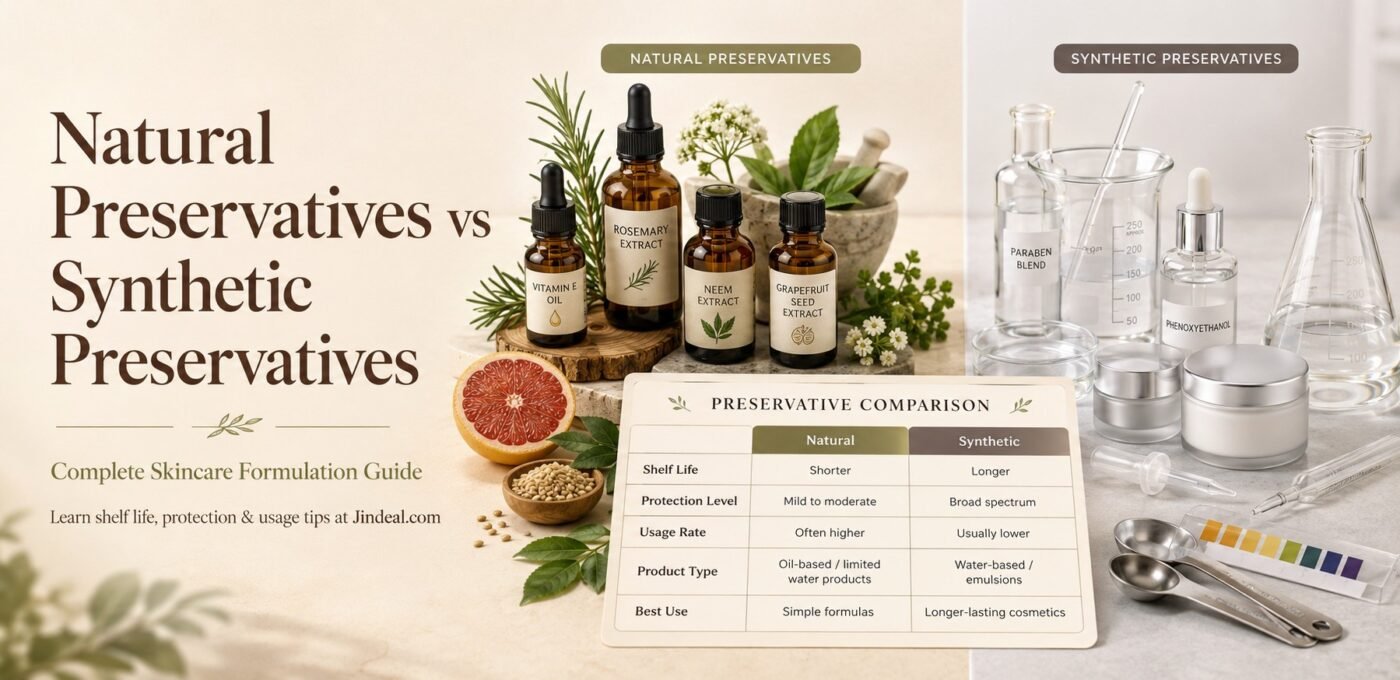
Natural Preservatives vs Synthetic Preservatives
Learn the difference between natural and synthetic preservatives in handmade cosmetics, when preservatives are needed, which products need preservation, and how to choose a safer preservative system for lotions, creams, scrubs, gels, shampoos, and DIY skincare.
Quick Answer
Natural preservatives are often chosen for clean-label cosmetic products, but they may have limited performance and stricter pH requirements. Synthetic preservatives are usually more predictable, broad-spectrum, and reliable when used correctly. Any cosmetic product containing water needs a proper preservative system; vitamin E, essential oils, and herbs are not complete preservatives.
Table of Contents
What Are Cosmetic Preservatives?
Cosmetic preservatives are ingredients used to help protect water-containing cosmetic products from microbial growth such as bacteria, yeast, and mold. They are important for product safety, shelf life, customer trust, and business quality.
Preservatives are needed in products that contain water, aloe vera juice, hydrosol, floral water, herbal extract, milk, tea, gel, or any water-based ingredient. Examples include lotions, creams, shampoos, conditioners, body wash, face wash, gels, toners, body scrubs with water exposure, and emulsions.
Oil-only products like body butter, balm, salve, lip balm, and pure carrier oil usually do not need a water-phase preservative, but they still need clean handling and may benefit from antioxidants like vitamin E to slow oil oxidation.
For cosmetic preservatives, emulsifiers, humectants, carrier oils, butters, fragrance oils, essential oils, jars, bottles, and DIY cosmetic raw materials, visit Jindeal.com.
What Causes the Problem?
Many DIY skincare products spoil because makers confuse antioxidants, fragrances, herbs, and essential oils with true preservatives. A product can look and smell normal but still contain microbial contamination if it is not preserved correctly.
Common causes include:
- Adding water-based ingredients without preservative
- Assuming vitamin E is a preservative
- Using essential oils as the only preservative
- Using herbal extracts without proper preservation
- Choosing preservative without checking pH range
- Using preservative at the wrong percentage
- Adding preservative at too high a temperature
- Not mixing preservative evenly
- Using dirty jars, tools, or hands
- Making large batches without stability testing
- Not checking product shelf life
- Selling products without proper formulation knowledge
For example, a lotion made with water, shea butter, oil, and emulsifier needs a broad-spectrum preservative. Adding only vitamin E oil or lavender essential oil is not enough to protect it from bacteria, yeast, and mold.
Natural Preservatives vs Synthetic Preservatives Chart
This chart gives a beginner-friendly comparison. Always follow supplier usage rate, pH range, temperature limit, and regional cosmetic rules before selling.
| Feature | Natural Preservatives | Synthetic Preservatives |
|---|---|---|
| Customer Appeal | Good for clean-label, natural, herbal, and eco-positioned products | Good for performance-focused, stable, professional cosmetic products |
| Preservation Strength | Can work, but often more sensitive to formula conditions | Usually more predictable and broad-spectrum when used correctly |
| pH Sensitivity | Often very pH-dependent | Also pH-dependent, but many systems are easier to formulate with |
| Ease for Beginners | Needs careful checking of usage and limitations | Often easier to use with clear supplier guidelines |
| Shelf-Life Support | May give shorter or more formula-dependent shelf life | Often gives stronger shelf-life support with testing |
| Marketing | Supports natural or clean beauty positioning | Supports professional reliability and stable product quality |
| Common Mistake | Assuming essential oils or vitamin E are complete preservatives | Using wrong dosage, wrong pH, or adding at high temperature |
| Best Use | Natural-positioned products after correct formula testing | Lotions, creams, gels, shampoos, washes, and commercial formulas |
Step-by-Step Selection Guide
Step 1: Check If Your Product Contains Water
If your product contains water, aloe vera juice, hydrosol, herbal tea, floral water, milk, gel, or water-based extracts, it needs a proper preservative system.
Step 2: Understand Broad-Spectrum Protection
A good preservative system should help protect against bacteria, yeast, and mold. Some ingredients only support one area and may need to be combined with another preservative system.
Step 3: Choose Based on Product Type
A rinse-off shampoo may need a different preservative approach than a leave-on face cream. Choose preservative based on whether the product is leave-on, rinse-off, high water, low water, scrub, gel, lotion, or emulsion.
Step 4: Check pH Range
Many preservatives only work within a specific pH range. Always check and adjust product pH according to the preservative supplier’s recommendation.
Step 5: Check Usage Percentage
Use preservative only within the supplier’s recommended usage percentage. Too little may not protect the product. Too much may create irritation risk, formula problems, or regulatory issues.
Step 6: Check Heat Sensitivity
Some preservatives must be added during cool-down phase because high heat can reduce effectiveness. Always check the maximum temperature allowed by the supplier.
Step 7: Mix Properly
Add the preservative at the correct stage and mix thoroughly. Poor mixing can leave parts of the batch under-preserved.
Step 8: Use Clean Manufacturing Practice
Preservatives are not a replacement for hygiene. Use clean tools, sanitized jars, dry workspace, gloves if needed, and avoid contamination during filling.
Step 9: Test Small Batch First
Before selling, make small batches and observe smell, color, texture, separation, pH, and appearance over time. Professional microbial challenge testing is recommended for commercial products.
Step 10: Label and Store Properly
Use clean packaging, avoid open-mouth jars for watery products when possible, mention storage instructions, and keep product away from heat, direct sunlight, and contamination.
Common Mistakes
1. Thinking Vitamin E Is a Preservative
Vitamin E is mainly an antioxidant for oils. It does not protect water-based products from bacteria, yeast, and mold.
2. Using Essential Oils as the Only Preservative
Essential oils can add aroma, but they are not reliable complete cosmetic preservatives.
3. Adding Water Without Preservation
Any water-containing product needs a preservative system.
4. Ignoring pH
Preservatives may fail if the pH is wrong.
5. Guessing Usage Percentage
Preservative should be measured accurately by weight and used within supplier limits.
6. Adding Preservative Too Hot
Heat-sensitive preservatives can lose effectiveness if added at high temperature.
7. Not Mixing Properly
Uneven mixing may leave some parts of the product unprotected.
8. Using Dirty Packaging
Contaminated jars or bottles can introduce microbes into the product.
9. Making Large Batches Without Testing
Small test batches are safer before bulk production.
10. Selling Without Stability and Safety Checks
Commercial cosmetics should be properly formulated, documented, tested, and compliant with applicable rules.
Expert Tips
- Use preservative in any product containing water.
- Do not treat vitamin E as a full preservative.
- Do not rely on essential oils alone for preservation.
- Choose preservative based on product type and pH.
- Check supplier usage percentage before adding.
- Add heat-sensitive preservatives during cool-down phase.
- Measure preservative by weight using a digital scale.
- Use clean tools, jars, bottles, and work area.
- Prefer pump bottles or tubes for watery products when possible.
- Test pH, texture, smell, color, and stability over time.
- For commercial products, consider professional microbial testing.
- Buy cosmetic preservatives, emulsifiers, carrier oils, butters, jars, bottles, and DIY raw materials from Jindeal.com.
FAQ
1. What is the difference between natural and synthetic preservatives?
Natural preservatives are often preferred for clean-label positioning, while synthetic preservatives are usually more predictable and reliable when used correctly.
2. Do handmade cosmetics need preservatives?
Yes, if the product contains water or water-based ingredients, it needs a proper preservative system.
3. Does body butter need preservative?
Oil-only body butter usually does not need a water-phase preservative, but it should be made and packed hygienically.
4. Is vitamin E a preservative?
No. Vitamin E is mainly an antioxidant for oils and does not protect water-based products from bacteria, yeast, and mold.
5. Can essential oils preserve cosmetics?
Essential oils are not reliable complete preservatives for cosmetic products. They should not replace a proper preservative system.
6. Which products need preservatives?
Lotions, creams, gels, shampoos, conditioners, face wash, body wash, toners, and water-containing products need preservatives.
7. Are natural preservatives safer than synthetic preservatives?
Not automatically. Safety depends on correct ingredient, usage rate, pH, product type, and testing.
8. Are synthetic preservatives harmful?
Not automatically. Many synthetic preservatives are widely used at controlled percentages and are chosen for reliable product protection.
9. What does broad-spectrum preservative mean?
Broad-spectrum means the preservative system helps protect against bacteria, yeast, and mold.
10. Why does pH matter for preservatives?
Preservatives work only within certain pH ranges. Wrong pH can reduce or stop preservative performance.
11. Can I use preservatives in soap?
Traditional high-pH bar soap usually does not need the same preservative system as lotions, but liquid soap and water-based products need proper formulation checks.
12. Do scrubs need preservatives?
Oil-only scrubs may not need a water-phase preservative, but if water can enter during use, preservation and hygienic packaging become important.
13. How much preservative should I use?
Use the exact percentage recommended by the preservative supplier and confirm it suits your product type and pH.
14. Can I sell cosmetics without preservative?
You should not sell water-containing cosmetics without a suitable preservative system and proper safety checks.
15. Where can I buy cosmetic preservatives and raw materials?
You can buy cosmetic preservatives, emulsifiers, carrier oils, butters, fragrance oils, essential oils, jars, bottles, labels, and DIY cosmetic raw materials from Jindeal.com.
Final Words
Natural and synthetic preservatives both have a place in cosmetic formulation. Natural preservatives can support clean-label products, while synthetic preservatives often offer reliable broad-spectrum protection. The right choice depends on product type, pH, usage rate, formula compatibility, and testing.
Remember: water-containing cosmetics need a real preservative system. Vitamin E, essential oils, and herbs are not enough by themselves. For cosmetic preservatives, emulsifiers, carrier oils, butters, fragrances, jars, bottles, and DIY raw materials, visit Jindeal.com.
Choose Better Cosmetic Raw Materials with Jindeal.com
Shop cosmetic preservatives, emulsifiers, carrier oils, butters, vitamin E, fragrance oils, essential oils, jars, bottles, and DIY cosmetic ingredients from Jindeal.com.
