
 Vedini 4 Cavity Silicone Cake Mold, Cute Chicken Molds, Bear DIY Baking Handmade Soap Mold JKB-3428
 Uncategorized
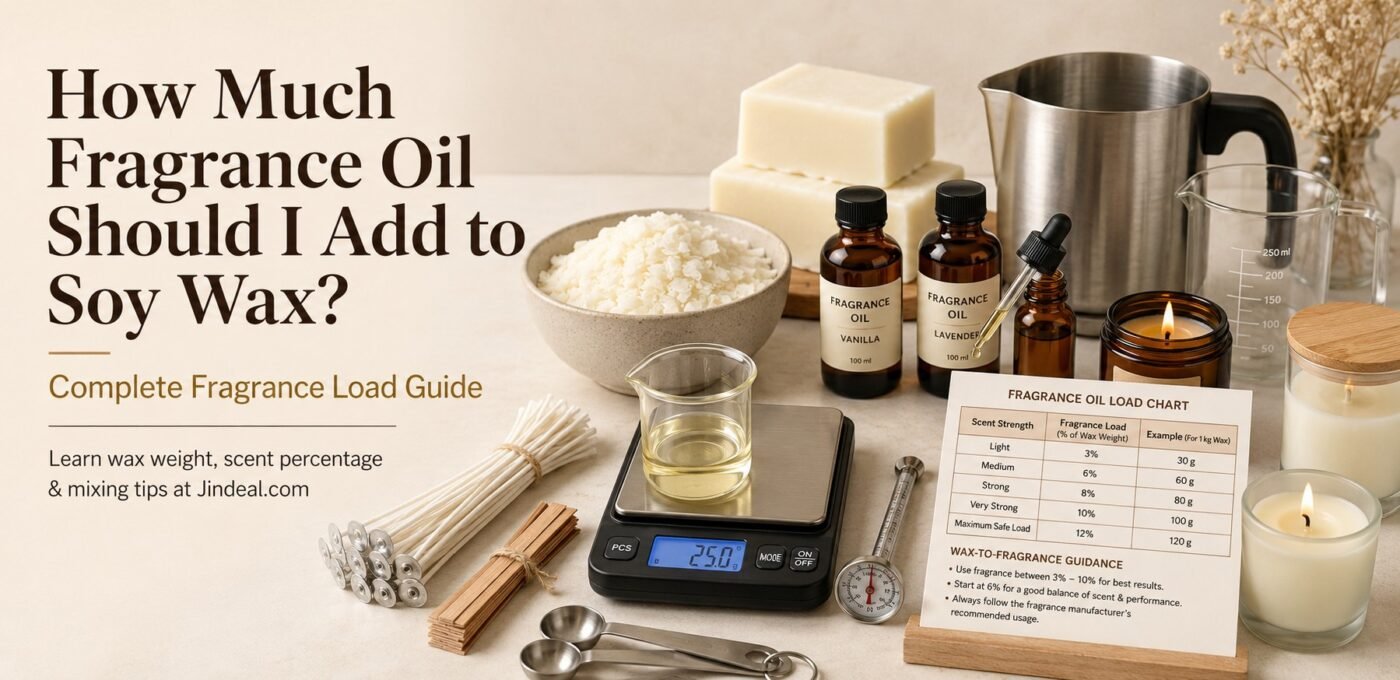
How Much Fragrance Oil Should I Add to Soy Wax?
Jun
How Much Fragrance Oil Should I Add to Soy Wax?
Learn the correct fragrance oil percentage for soy wax candles, how to calculate fragrance load in grams, and how to avoid weak scent, sweating, tunneling, black smoke, and poor candle burning.
Quick Answer
For soy wax candles, fragrance oil is commonly used around 6% to 10% of wax weight, depending on the wax, fragrance strength, and supplier limit. A safe beginner starting point is 8%. For 1000g soy wax at 8%, add 80g fragrance oil and always burn test before selling.
Table of Contents
What Is Fragrance Load in Soy Wax?
Fragrance load means the percentage of fragrance oil added to candle wax. In soy wax candles, fragrance load affects hot throw, cold throw, burn quality, flame stability, surface finish, sweating, frosting, and wick performance.
Many soy wax candle makers test fragrance oil between 6% and 10%. Some soy waxes may hold more or less fragrance depending on supplier specification. More fragrance does not always mean a better candle. Too much fragrance can cause oil sweating, weak flame, black smoke, poor burning, tunneling, or wax separation.
The best fragrance amount depends on your soy wax type, fragrance oil strength, candle jar size, wick size, color, additives, and customer scent preference.
For soy wax, candle fragrance oils, candle wicks, candle jars, wick stickers, candle colors, thermometers, pouring pots, silicone molds, and DIY candle-making supplies, visit Jindeal.com.
What Causes the Problem?
Many candle problems happen because fragrance oil is added by guessing instead of calculating. Too little fragrance gives weak scent. Too much fragrance can damage candle performance. The correct percentage must be measured and tested.
Common causes include:
- Adding fragrance oil by drops instead of grams
- Using too little fragrance oil and getting weak scent throw
- Using too much fragrance oil and causing sweating or black smoke
- Ignoring the maximum fragrance load of the soy wax
- Adding fragrance at the wrong wax temperature
- Not mixing fragrance oil thoroughly into melted wax
- Using fragrance oil not suitable for candles
- Choosing the wrong wick after adding fragrance
- Skipping cure time before testing scent throw
- Not burn testing before selling
- Changing fragrance oil without retesting
- Using too much dye, mica, or additive with fragrance
For example, if you add 12% fragrance oil to a soy wax that performs best at 8%, the candle may sweat, smoke, tunnel, or burn poorly even if the scent smells strong in the jar.
Soy Wax Fragrance Oil Chart
This chart gives simple fragrance oil examples for soy wax. Always check your wax and fragrance supplier recommendation before final production.
| Soy Wax Weight | 6% Fragrance | 8% Fragrance | 10% Fragrance |
|---|---|---|---|
| 100g wax | 6g fragrance oil | 8g fragrance oil | 10g fragrance oil |
| 250g wax | 15g fragrance oil | 20g fragrance oil | 25g fragrance oil |
| 500g wax | 30g fragrance oil | 40g fragrance oil | 50g fragrance oil |
| 1000g wax | 60g fragrance oil | 80g fragrance oil | 100g fragrance oil |
| 5000g wax | 300g fragrance oil | 400g fragrance oil | 500g fragrance oil |
Step-by-Step Solution
Step 1: Check the Soy Wax Fragrance Limit
Every soy wax has a recommended fragrance load. Some waxes perform well at 6% to 8%, while others may handle up to 10% or slightly more. Always check the wax supplier guideline before deciding the final percentage.
Step 2: Choose a Starting Percentage
For beginners, 8% is a practical starting point for many soy wax candles. If the fragrance is very strong, 6% may be enough. If the fragrance is light and the wax allows it, 9% to 10% may be tested.
Step 3: Calculate Fragrance Oil in Grams
Always calculate fragrance by weight, not by drops or spoons. A digital weighing scale gives consistent results for candle making.
Example calculation for 500g soy wax at 8% fragrance:
Step 4: Use Candle-Grade Fragrance Oil
Use fragrance oil made for candles. Soap fragrance, diffuser fragrance, perfume oil, or room freshener fragrance may not perform correctly in soy wax unless the supplier confirms candle suitability.
Step 5: Add Fragrance at Correct Temperature
Add fragrance oil at the temperature recommended for your wax. If fragrance is added too hot, scent may evaporate. If added too cool, it may not bind properly with wax.
Step 6: Mix Slowly but Thoroughly
After adding fragrance, stir slowly and thoroughly so the oil bonds evenly with the soy wax. Poor mixing can cause weak scent, wet spots, sweating, or uneven burn.
Step 7: Choose the Right Wick
Fragrance oil changes how a candle burns. After adding fragrance, wick performance can change. Test wick size with the final wax and fragrance formula, not only plain wax.
Step 8: Allow Proper Cure Time
Soy candles often need cure time for better scent throw. Let the candle cure before judging the final hot throw and cold throw. Cure time depends on wax and fragrance type.
Step 9: Burn Test the Candle
Burn testing is compulsory for candle business. Check flame height, melt pool, tunneling, black smoke, jar temperature, mushrooming, scent throw, and leftover wax.
Step 10: Adjust and Record Formula
If scent is weak, test a slightly higher fragrance load within the wax limit, improve cure time, or try another fragrance. If candle smokes or sweats, reduce fragrance load or adjust wick size. Record every result.
Common Mistakes
1. Adding Fragrance by Drops
Drops are not accurate for candle production. Always measure fragrance oil in grams.
2. Thinking More Fragrance Always Means Better Candle
Too much fragrance can cause sweating, smoke, weak flame, poor burn, and safety issues.
3. Ignoring Wax Supplier Limits
Every soy wax has a maximum fragrance load. Do not exceed it without testing and supplier support.
4. Adding Fragrance at Wrong Temperature
Wrong temperature can cause poor scent binding or scent loss.
5. Not Mixing Long Enough
Poor mixing can cause fragrance separation, sweating, and uneven scent throw.
6. Using Non-Candle Fragrance
Only use fragrance oil suitable for candles and wax burning.
7. Skipping Cure Time
Testing scent too early can make you think the candle is weak when it may need more cure time.
8. Not Retesting Wick Size
Changing fragrance load can change wick performance, smoke, melt pool, and flame size.
9. Using Too Much Dye or Mica
Extra color or powder can affect scent throw and wick performance.
10. Selling Without Burn Testing
Every soy wax candle formula should be burn tested before selling.
Expert Tips
- Start with 8% fragrance load for many soy wax candle tests.
- Use 6% for very strong fragrances or cleaner burn testing.
- Test 9% to 10% only if your wax supports it.
- Never exceed supplier recommended fragrance limit.
- Measure fragrance oil by weight using a digital scale.
- Use candle-grade fragrance oils only.
- Add fragrance at the wax supplier’s recommended temperature.
- Mix fragrance slowly and thoroughly.
- Allow proper cure time before final scent testing.
- Burn test every wax, wick, jar, fragrance, and color combination.
- Keep detailed formula and testing records.
- Buy soy wax, fragrance oils, wicks, jars, colors, thermometers, and packaging from Jindeal.com.
FAQ
1. How much fragrance oil should I add to soy wax?
A common range is 6% to 10% of wax weight, depending on wax and fragrance. A good beginner starting point is 8%.
2. How much fragrance oil for 100g soy wax?
At 6%, use 6g. At 8%, use 8g. At 10%, use 10g fragrance oil for 100g soy wax.
3. How much fragrance oil for 500g soy wax?
At 8% fragrance load, use 40g fragrance oil for 500g soy wax.
4. How much fragrance oil for 1kg soy wax?
At 8% fragrance load, use 80g fragrance oil for 1000g soy wax.
5. Is 10% fragrance oil too much for soy wax?
10% can work only if the wax supports it and the candle passes burn testing. For some waxes, 10% may cause sweating or poor burn.
6. Can too much fragrance oil cause black smoke?
Yes. High fragrance load can clog the wick or create poor burning, which may cause black smoke or soot.
7. Can too much fragrance oil cause candle sweating?
Yes. If soy wax cannot hold the fragrance properly, oil may appear on the candle surface.
8. Why is my soy candle scent weak?
Weak scent can happen due to low fragrance load, poor fragrance quality, wrong adding temperature, poor mixing, short cure time, or wrong wick.
9. Should fragrance oil be measured by weight or volume?
Measure fragrance oil by weight in grams for accurate and repeatable candle making.
10. Can I use essential oils in soy wax?
Some essential oils can be used in candles if they are suitable for candle making, but performance varies. Always test burn and scent throw.
11. Can I use soap fragrance oil in soy candles?
Only if the supplier confirms it is suitable for candle wax and burning. Otherwise, use candle-grade fragrance oil.
12. What happens if fragrance oil is added too hot?
Some scent may evaporate or weaken if fragrance is added when wax is too hot.
13. What happens if fragrance oil is added too cool?
If added too cool, fragrance may not bind evenly with wax and may cause poor scent throw or sweating.
14. Do I need to cure soy candles?
Yes, curing helps improve scent throw and overall performance. Cure time depends on wax and fragrance.
15. Where can I buy soy wax and candle fragrance oils?
You can buy soy wax, candle fragrance oils, wicks, candle jars, colors, thermometers, molds, packaging, and DIY supplies from Jindeal.com.
Final Words
For soy wax candles, fragrance oil is commonly tested around 6% to 10%, with 8% being a good beginner starting point. But the best amount depends on your soy wax, fragrance oil, wick, jar, color, cure time, and burn test results.
Measure fragrance oil correctly, follow supplier limits, mix properly, cure the candle, and burn test before selling. For soy wax, candle fragrance oils, wicks, jars, colors, thermometers, pouring pots, molds, and packaging, visit Jindeal.com.
Make Better Soy Wax Candles with Jindeal.com
Shop soy wax, candle fragrance oils, wicks, jars, colors, thermometers, molds, packaging, and DIY candle-making materials from Jindeal.com.
