
Candle Fragrance Oils, Carrier Oils
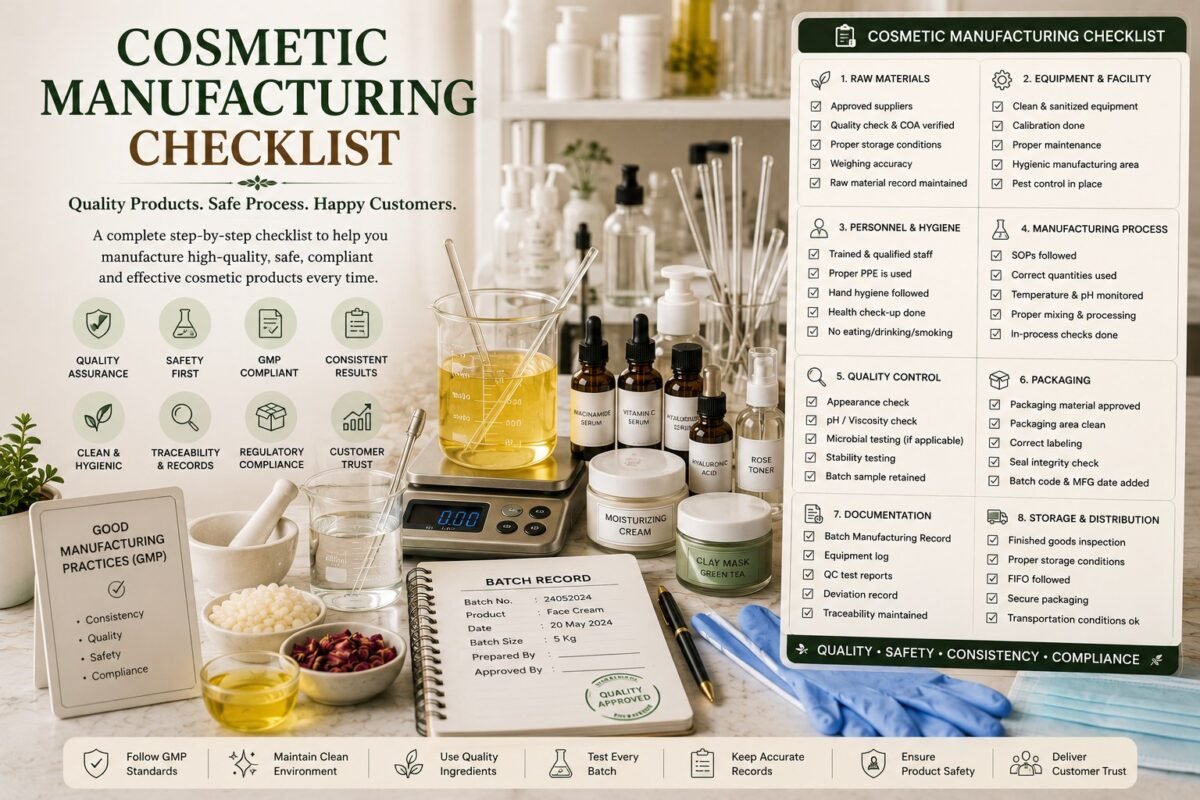
Cosmetic Manufacturing Checklist.
Jun
Cosmetic Manufacturing Checklist
A practical checklist for small cosmetic brands, handmade cosmetic makers, soap makers, skincare formulators, hair-care product makers, and DIY beauty businesses before starting production, packing, labeling, storage, and dispatch.
Quick Answer
A cosmetic manufacturing checklist should cover product category, formula approval, cosmetic-grade raw materials, supplier documents, batch records, weighing accuracy, hygiene, equipment cleaning, preservative planning, pH checks where required, packaging compatibility, label details, shelf-life testing, finished product inspection, storage, dispatch, customer instructions, and applicable regulatory compliance. For commercial selling in India, cosmetic products should be planned according to applicable Cosmetics Rules, labeling requirements, state licensing process, and relevant business requirements.
Table of Contents
- Before You Start Manufacturing
- Raw Material Checklist
- Formula and Product Development Checklist
- Production Area and Hygiene Checklist
- Batch Manufacturing Record Checklist
- Quality Control Checklist
- Packaging and Labeling Checklist
- Storage and Dispatch Checklist
- India Compliance Reminder
- Common Mistakes
- FAQ
- Related Products
Before You Start Manufacturing
Before making any cosmetic product for sale, decide the product type, customer use, target price, formula style, packaging size, label claim, and production method. A soap, body butter, hair oil, clay mask, lotion, scrub, serum, and shampoo all need different planning.
For cosmetic raw materials, carrier oils, essential oils, fragrance oils, clays, herbal powders, soap bases, waxes, jars, bottles, and packaging, visit Jindeal.com.
Raw Material Checklist
Raw materials directly affect product quality, shelf life, safety, fragrance, texture, and customer trust. Use cosmetic-grade ingredients and keep records for each purchase.
| Checklist Item | What to Check | Why Important |
|---|---|---|
| Cosmetic Grade | Confirm ingredient is suitable for cosmetic use | Avoids unsafe or unsuitable materials |
| Supplier Details | Supplier name, invoice, batch/lot number | Traceability and quality control |
| Documents | COA, MSDS/SDS, specification sheet where available | Supports formulation and compliance records |
| Expiry / Best Before | Check material shelf life and storage requirement | Prevents old or unstable raw material use |
| Appearance | Color, smell, texture, contamination, leakage | Detects damaged or poor material |
| Storage | Cool, dry, sealed, away from sunlight | Maintains quality |
| Allergen / Sensitizer Review | Fragrance, essential oils, botanicals | Helps label and safety planning |
| Restricted Ingredients | Check if ingredient has limits or is unsuitable | Prevents non-compliant formulation |
| Water-Based Ingredients | Hydrosol, aloe juice, floral water, extracts | Need preservation planning |
| Raw Material Quarantine | Hold new material until checked | Prevents accidental use of rejected stock |
Formula and Product Development Checklist
Every cosmetic formula should be written in percentage and grams. This helps you scale from 100 g to 1 kg, 10 kg, or larger batches without mistakes.
| Checklist Item | What to Check | Example |
|---|---|---|
| Formula Percentages | Total formula must equal 100% | Water 70%, oil 15%, emulsifier 5% |
| Product Type | Leave-on, rinse-off, soap, powder, oil | Body lotion, hair oil, clay mask |
| Preservation Need | Water-containing product needs suitable preservative system | Lotion, gel, toner, scrub with water |
| pH Target | Check pH where relevant | Shampoo, cleanser, lotion, gel |
| Fragrance Level | Use safe and product-suitable fragrance percentage | Soap, cream, lotion, oil, scrub |
| Essential Oil Dilution | Use safe diluted levels | Face products need extra caution |
| Color Compatibility | Use cosmetic-grade color and test staining | Mica, liquid color, pigment |
| Packaging Compatibility | Test formula in final jar/bottle/pouch | Oil may affect label or cap liner |
| Stability Trial | Check separation, smell, color, texture | 7, 15, 30, 60 days |
| Batch Scaling | Convert percentage to grams correctly | 1% in 1 kg = 10 g |
Production Area and Hygiene Checklist
Clean production practices reduce contamination, batch failure, customer complaints, and product spoilage. Even small handmade cosmetic brands should follow a disciplined production routine.
| Checklist Item | What to Check | Why Important |
|---|---|---|
| Clean Work Area | Dust-free, clean surface, no unrelated items | Prevents contamination |
| Personal Hygiene | Clean hands, gloves, hair cover, mask where needed | Improves production hygiene |
| Sanitized Tools | Beakers, spatulas, weighing bowls, mixers | Reduces contamination risk |
| Calibrated Scale | Digital scale working accurately | Prevents formula errors |
| Separate Utensils | Dedicated cosmetic tools, not kitchen use | Avoids cross-contamination |
| Water Quality | Use suitable purified/distilled water where required | Important for water-based formulas |
| Temperature Control | Monitor heat phase, cooling, and pouring | Prevents separation and texture issues |
| Batch Segregation | Do not mix raw material, WIP, and finished stock | Prevents confusion |
| Cleaning Record | Record cleaning before and after production | Improves process control |
| Waste Disposal | Dispose rejected materials safely | Keeps workplace clean |
Batch Manufacturing Record Checklist
A batch manufacturing record helps you repeat good products and investigate complaints. Every batch should have a unique batch number.
| Record Field | What to Write | Example |
|---|---|---|
| Batch Number | Unique batch code | BB-0626-001 |
| Product Name | Exact product made | Lavender Body Butter |
| Batch Size | Total quantity made | 5 kg / 50 units |
| Manufacturing Date | Date of production | 29 Jun 2026 |
| Formula Version | Formula code or version | Formula V2 |
| Raw Materials | Ingredient name, supplier, lot number, quantity | Shea butter lot no. etc. |
| Weighing Record | Actual weight used for each ingredient | 500 g, 100 g, 5 g |
| Process Notes | Temperature, mixing time, order of addition | Heated to 70°C, mixed 10 min |
| In-Process Checks | pH, appearance, smell, texture | pH 5.5, smooth texture |
| Filling Record | Jar/bottle quantity, fill weight | 100 jars × 50 g |
| Yield | Expected vs actual output | Expected 5 kg, actual 4.85 kg |
| Approved / Rejected | Final quality decision | Approved after inspection |
Quality Control Checklist
Quality control helps prevent customer complaints and product returns. The level of testing depends on product type and commercial scale.
| Quality Check | What to Check | Products Where Important |
|---|---|---|
| Appearance | Color, texture, lumps, separation, particles | All products |
| Odor | Expected smell, no rancid or off smell | Oils, creams, soaps, scrubs |
| pH | pH within formula target | Lotions, gels, shampoos, cleansers |
| Viscosity | Thickness and flow | Lotions, shampoos, gels |
| Weight Check | Net quantity per unit | All packed products |
| Leak Test | Cap closure and upside-down test | Oils, serums, lotions, shampoos |
| Packaging Check | Label, cap, seal, box, printing | All finished products |
| Stability Check | Separation, color change, smell change | All new formulas |
| Microbial Risk Review | Preservation and contamination risk | Water-based products |
| Retain Sample | Keep sample from each batch | All commercial batches |
Packaging and Labeling Checklist
Packaging must protect the product, support shelf life, prevent leakage, and make the product look professional. Labels should be readable and complete.
| Checklist Item | What to Check | Example |
|---|---|---|
| Packaging Type | Jar, bottle, pouch, tube, dropper, pump | Amber dropper bottle for serum |
| Compatibility | Formula does not react, leak, stain, or damage packaging | Oil compatibility with cap liner |
| Closure | Cap, pump, dropper, seal, inner plug tightness | No leakage in shipping test |
| Label Adhesion | Label sticks properly and does not peel | Oil-resistant label for hair oil |
| Product Name | Clear product name | Rose Body Butter |
| Net Quantity | Correct weight or volume | 50 g / 100 ml |
| Ingredient List | Complete ingredient declaration as applicable | Use correct names and order |
| Batch Number | Unique batch code | RB-0626-001 |
| MFG / Best Before | Manufacturing and best-before details | MFG Jun 2026 |
| Usage Direction | How to use the product | Apply on clean skin |
| Storage Direction | How to store | Store in cool, dry place |
| Business Details | Brand/company, address, customer care | Website and support details |
- Use moisture-resistant labels for bathroom-use products.
- Use oil-resistant labels for oils, serums, and body butters.
- Use tamper bands or inner seals for premium products where possible.
- Test packaging during heat, shaking, and shipping conditions.
Storage and Dispatch Checklist
Finished products should be stored batch-wise and dispatched in clean, safe, and traceable condition.
| Checklist Item | What to Check | Why Important |
|---|---|---|
| Batch Segregation | Keep batches separated and labeled | Prevents mix-ups |
| Storage Area | Cool, dry, clean, away from sunlight | Protects shelf life |
| FIFO / FEFO | First in first out / first expiry first out | Reduces old stock risk |
| Retain Samples | Keep sample from each batch | Helps complaint investigation |
| Dispatch Inspection | Check leaks, labels, seals, damage | Reduces returns |
| Shipping Packaging | Outer box, filler, tape, fragile protection | Prevents courier damage |
| Temperature Risk | Heat-sensitive products during summer | Prevents melting or leakage |
| Invoice / Order Check | Right product, quantity, batch | Prevents dispatch errors |
| Complaint Record | Track customer complaints by batch | Improves quality control |
India Compliance Reminder
In India, cosmetics are regulated under the Drugs and Cosmetics framework and Cosmetics Rules, 2020. Before commercial manufacturing or selling, check the applicable requirements for your product type, manufacturing arrangement, labeling, claims, registration or licensing route, GST, packaging, and local business operations.
| Compliance Area | What to Review | Practical Action |
|---|---|---|
| Manufacturing Permission | Whether your product requires a manufacturing licence or approved facility | Consult state drug control authority or qualified consultant |
| Cosmetic Definition | Ensure product is cosmetic, not drug/medicine | Avoid treatment claims and medicinal positioning |
| Ingredient Compliance | Check prohibited/restricted ingredients and standards | Use cosmetic-grade ingredients and supplier documents |
| Labeling | Product name, net quantity, ingredients, batch, MFG, best before, manufacturer details | Prepare compliant label before printing bulk stock |
| Claims | No misleading or medical claims | Use cosmetic-safe claims only |
| Quality Records | Batch records, raw material traceability, retain samples | Maintain records for every batch |
| Online Selling | Product description, claims, pricing, GST, return policy | Keep website content claim-safe |
| Exports | Destination country requirements | Check destination rules before export |
Common Cosmetic Manufacturing Mistakes
1. Manufacturing Without Proper Compliance Review
Before selling, check applicable cosmetic manufacturing, labeling, GST, packaging, and business requirements.
2. No Batch Records
Without batch records, you cannot trace raw materials, repeat formulas, or investigate complaints.
3. Using Non-Cosmetic Ingredients
Do not use industrial, textile, food-only, craft, or unknown-grade ingredients in skin-contact products.
4. Making Water-Based Products Without Preservation
Stored water-based cosmetics need suitable preservative systems and quality checks.
5. No pH Testing Where Needed
pH is important for many cleansers, shampoos, lotions, gels, and preservative performance.
6. Overclaiming Benefits
Avoid claims like cures acne, treats eczema, stops hair fall, removes pigmentation, or cures dandruff.
7. Poor Packaging Compatibility
Packaging can leak, react, peel labels, or fail in shipping if not tested.
8. No Retain Samples
Keep one sample from each batch for future reference and complaint checks.
9. Ignoring Shelf-Life Testing
Products can separate, change smell, change color, grow contamination, or leak during storage.
10. Poor Finished Product Inspection
Every unit should be checked for fill weight, label, cap, leakage, and damage before dispatch.
FAQ
1. What is a cosmetic manufacturing checklist?
It is a step-by-step list used to control raw materials, formula, hygiene, production, batch records, quality checks, packaging, labels, storage, and dispatch.
2. Do handmade cosmetics need batch records?
Yes. Batch records help you trace raw materials, repeat formulas, manage shelf life, and investigate customer complaints.
3. What documents should I keep for raw materials?
Keep supplier invoice, batch or lot number, COA, MSDS/SDS, specification sheet, expiry or best-before details where available.
4. Do water-based cosmetics need preservatives?
Stored water-based products such as lotions, gels, toners, shampoos, and body wash need a suitable preservative system and testing.
5. Do dry powders need preservatives?
Dry powders are safer when kept dry. If mixed with water and stored as a wet product, preservation and testing become important.
6. What should be included on cosmetic labels?
Labels should include product name, net quantity, ingredients, batch number, manufacturing details, MFG/best-before, usage, storage, and business details as applicable.
7. Can I make cosmetics at home and sell them?
Before selling, check applicable manufacturing licence, local authority, GST, labeling, and business requirements for your product type and location.
8. Can cosmetics claim to cure skin or hair problems?
No. Avoid medical claims such as curing acne, eczema, dandruff, hair fall, pigmentation, infection, or disease.
9. Why is pH testing important?
pH affects skin feel, stability, preservative performance, and product suitability for many water-based products.
10. What is a retain sample?
A retain sample is a saved sample from each batch kept for quality tracking, shelf-life observation, and complaint investigation.
11. What is packaging compatibility testing?
It checks whether the formula leaks, reacts, stains, damages the cap, peels labels, or changes inside the final packaging.
12. What is FIFO or FEFO?
FIFO means first in first out. FEFO means first expiry first out. Both help manage inventory and reduce old stock risk.
13. What is the first step for starting cosmetic manufacturing?
Start with product category selection, formula planning, compliance review, raw material sourcing, pilot batch, testing, and packaging planning.
14. Should I test every new fragrance or essential oil?
Yes. Fragrances and essential oils can affect smell, color, stability, skin suitability, and packaging compatibility.
15. Where can I buy cosmetic raw materials?
You can buy cosmetic raw materials, oils, essential oils, fragrance oils, clays, herbal powders, soap bases, jars, bottles, and packaging from Jindeal.com.
Final Words
A cosmetic manufacturing checklist helps small brands make products more consistently, safely, and professionally. The most important steps are raw material traceability, written formulas, hygiene, batch records, suitable preservation, pH and stability checks where needed, packaging compatibility, correct labels, retain samples, and dispatch inspection.
Before commercial selling, verify current compliance requirements for your product type and location. For cosmetic raw materials, oils, clays, herbal powders, soap bases, fragrance oils, bottles, jars, and packaging, visit Jindeal.com.
Shop Cosmetic Raw Materials on Jindeal.com
Buy carrier oils, essential oils, fragrance oils, soap bases, cosmetic clays, herbal powders, jars, bottles, labels, and DIY cosmetic packaging from Jindeal.com.