
Candle Fragrance Oils, Uncategorized
How Much c Should I Add to Candles?
Jun
How Much Fragrance Oil Should I Add to Candles?
Learn the correct fragrance oil amount for soy candles, paraffin candles, coconut wax candles, candle tins, glass jar candles, wax melts, strong scented candles, and small candle business production.
Quick Answer
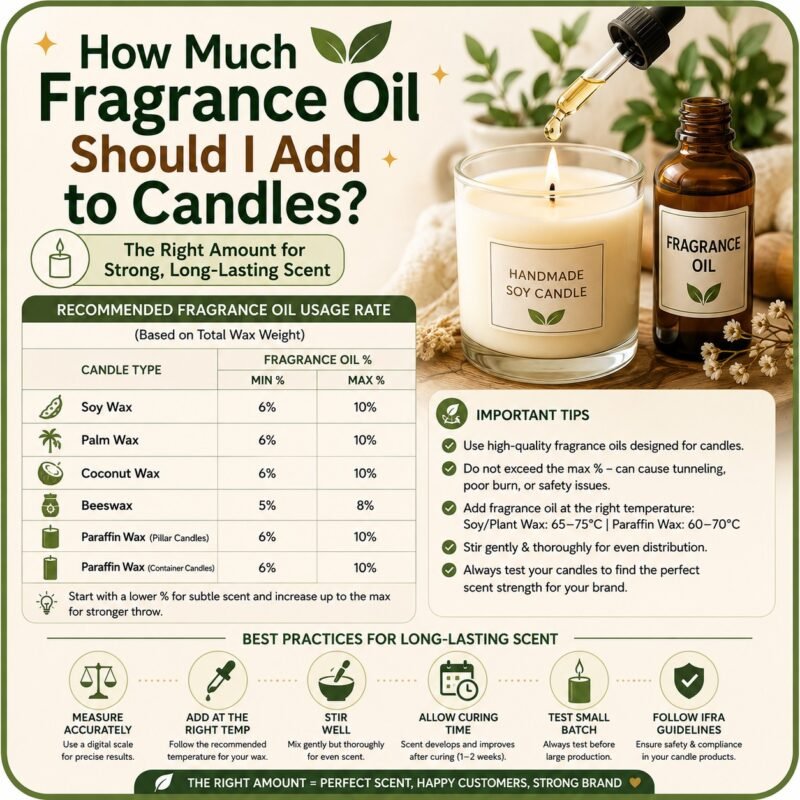
For most beginner container candles, a practical fragrance oil load is usually around 6% to 10% of the total wax weight, depending on wax type and supplier recommendation. For 1 kg wax, 6% means 60 g fragrance oil, 8% means 80 g fragrance oil, and 10% means 100 g fragrance oil. Always check your wax supplier’s maximum fragrance load and test the candle for hot throw, cold throw, sweating, wick performance, flame size, smoke, and jar temperature before selling.
Table of Contents
- Why Fragrance Load Matters
- Recommended Candle Fragrance Oil Range
- Candle Fragrance Calculation Formula
- Fragrance Oil Usage Chart
- Jar Candle Calculation Examples
- Fragrance Load by Wax Type
- How to Make Candles Smell Stronger
- What Happens If You Add Too Much Fragrance?
- Candle Fragrance Testing Checklist
- Common Mistakes
- FAQ
- Related Products
Why Fragrance Load Matters
Fragrance oil is one of the most important ingredients in scented candles. It decides cold throw, hot throw, customer experience, product identity, repeat buying, and perceived value. But fragrance oil must be used in the right amount. More fragrance does not always mean stronger or better candles.
Too little fragrance can make candles smell weak. Too much fragrance can cause sweating, poor burn, wick clogging, black smoke, large flame, sinkholes, rough tops, weak structure, jar overheating, and wasted cost.
For candle fragrance oils, soy wax, paraffin wax, coconut wax blend, candle jars, tins, cotton wicks, wooden wicks, wick stickers, candle dyes, silicone molds and packaging, visit Jindeal.com.
Recommended Candle Fragrance Oil Range
For beginner candle making, start with a controlled fragrance load and test performance before increasing.
| Fragrance Load | Percentage | For 1 kg Wax | Best Use |
|---|---|---|---|
| Light Scent | 5% to 6% | 50 g to 60 g | Small rooms, mild aroma, budget candles, wax melts testing |
| Medium Scent | 7% to 8% | 70 g to 80 g | Most beginner jar candles and tins |
| Strong Scent | 9% to 10% | 90 g to 100 g | Premium jar candles after wick and burn testing |
| Very High Load | Above 10% | Above 100 g | Only if wax supplier permits and candle passes testing |
Candle Fragrance Calculation Formula
Always measure candle fragrance oil by weight in grams. Do not measure by drops, spoons, bottle caps, or rough ml guesses.
Example: If you are using 1000 g wax and want 8% fragrance load:
This means your total batch becomes approximately 1080 g before pouring, because the fragrance oil is added on top of the wax weight.
Fragrance Oil Usage Chart
Use this chart for quick candle fragrance oil calculations.
| Wax Weight | 6% Light-Medium | 8% Medium | 10% Strong |
|---|---|---|---|
| 100 g | 6 g | 8 g | 10 g |
| 250 g | 15 g | 20 g | 25 g |
| 500 g | 30 g | 40 g | 50 g |
| 750 g | 45 g | 60 g | 75 g |
| 1 kg | 60 g | 80 g | 100 g |
| 2 kg | 120 g | 160 g | 200 g |
| 5 kg | 300 g | 400 g | 500 g |
| 10 kg | 600 g | 800 g | 1000 g |
- Use 6% for mild fragrance candles and early testing.
- Use 8% as a strong beginner starting point for many jar candles.
- Use 10% only after confirming wax capacity and wick performance.
- Record fragrance oil name, percentage, wax type, wick size and jar size for every test.
Jar Candle Calculation Examples
Example 1: 100 g Candle at 8%
If you want a final candle around 100 g total fill weight, you can estimate wax and fragrance separately. At 8% fragrance load based on wax weight, use about 92.6 g wax and 7.4 g fragrance oil for a 100 g final candle.
Example 2: 10 Candles of 100 g Each at 8%
Total final fill weight = 1000 g. Approximate wax = 925.9 g and fragrance oil = 74.1 g if calculating fragrance as 8% of wax weight.
Example 3: 1 kg Wax at 8%
1000 g wax + 80 g fragrance oil = about 1080 g total candle mixture.
| Final Candle Fill Target | Fragrance Load | Approx. Wax Needed | Approx. Fragrance Oil Needed |
|---|---|---|---|
| 100 g | 6% | 94.3 g | 5.7 g |
| 100 g | 8% | 92.6 g | 7.4 g |
| 100 g | 10% | 90.9 g | 9.1 g |
| 500 g | 8% | 463 g | 37 g |
| 1000 g | 8% | 925.9 g | 74.1 g |
| 5000 g | 8% | 4629.6 g | 370.4 g |
Fragrance Load by Wax Type
Different waxes hold fragrance differently. Always follow supplier recommendations and test your exact wax, fragrance, wick and jar combination.
| Wax Type | Beginner Starting Range | Common Benefit | Testing Focus |
|---|---|---|---|
| Soy Wax | 6% to 8% | Natural-style jar candles, clean look | Hot throw, frosting, wet spots, cure time |
| Paraffin Wax | 6% to 10% | Strong scent throw and smooth finish | Wick size, soot, smoke, jar heat |
| Coconut Wax Blend | 6% to 10% | Creamy appearance and premium feel | Softness, sweating, heat stability |
| Beeswax Blend | Lower to medium range | Firm natural wax character | Fragrance throw and wick size |
| Wax Melts | Often higher than candles after testing | No wick burn, strong room aroma | Sweating, shape stability, packaging |
How to Make Candles Smell Stronger
If your candle does not smell strong, do not immediately add more fragrance. Weak hot throw can also happen due to wrong wick, poor wax/fragrance compatibility, short cure time, wrong room size, wrong pour temperature, or poor fragrance quality.
What Happens If You Add Too Much Fragrance?
| Problem | Possible Cause | Fix |
|---|---|---|
| Fragrance Sweating | Wax cannot hold the fragrance load | Reduce fragrance percentage |
| Black Smoke | Too much fragrance, wick too large, poor burn balance | Reduce fragrance and retest wick |
| Large Flame | Overloaded fragrance or wrong wick | Use lower load and smaller wick |
| Weak Burn | Wick clogged by fragrance/dye | Reduce additives and retest wick |
| Rough Top | Wax/fragrance incompatibility or wrong temperature | Adjust temperature and fragrance load |
| Poor Jar Adhesion | Formula balance, cooling, temperature changes | Test lower load and better cooling |
| High Cost | Using more fragrance than needed | Use the lowest load that gives good hot throw |
Candle Fragrance Testing Checklist
Before selling scented candles, test the full formula. Do not judge only by cold smell from the jar.
| Test Area | What to Check | Suggested Timing |
|---|---|---|
| Cold Throw | Fragrance before burning | After cure time |
| Hot Throw | Fragrance while candle burns | During burn test |
| Melt Pool | Even wax pool development | During every test burn |
| Flame Height | Controlled flame, no excessive flicker | Every burn test |
| Smoke and Soot | Black smoke, soot on jar, mushrooming | During and after burn |
| Jar Heat | Container temperature safety | After longer burn periods |
| Surface Finish | Frosting, sweating, sinkholes, rough tops | After cooling and storage |
| Storage Stability | Fragrance fading, sweating, discoloration | 7, 15, 30 days |
| Packaging | Label peeling, oil marks, fragrance leakage | After storage and shipping test |
Common Mistakes
1. Measuring Fragrance by Drops or Spoons
Candle formulas should be measured in grams using a digital scale.
2. Adding Too Much Fragrance
High fragrance load can cause sweating, smoke, wick clogging, poor burn and high cost.
3. Ignoring Wax Maximum Load
Every wax has a maximum fragrance capacity. Follow supplier guidance.
4. Using Perfume Instead of Candle Fragrance
Perfume is not the same as candle fragrance oil. Use candle-compatible fragrance oils.
5. Not Testing Wick Again
Changing fragrance percentage can change wick performance. Retest the wick.
6. No Cure Time
Some waxes need curing for better fragrance throw. Testing too early can give weak results.
7. Judging Only Cold Throw
A candle may smell strong unlit but weak when burning. Hot throw matters.
8. Using Same Load for Every Wax
Soy, paraffin, coconut blend and beeswax blends behave differently.
9. Selling Without Burn Testing
Every wax, fragrance, wick and jar combination must be burn-tested before sale.
10. Making Medical Claims
Do not claim candles cure stress, anxiety, insomnia, headache, depression or any medical condition.
FAQ
1. How much fragrance oil should I add to candles?
For many beginner container candles, start around 6% to 10% of wax weight, depending on wax type and supplier recommendation.
2. How much fragrance oil for 1 kg wax?
At 6% use 60 g, at 8% use 80 g, and at 10% use 100 g fragrance oil for 1 kg wax.
3. Is 10% fragrance oil too much for candles?
10% can work in some waxes, but only if the wax supplier permits it and the candle passes burn testing.
4. What is the best fragrance load for soy candles?
Many makers start testing soy candles around 6% to 8%, then adjust based on hot throw, cure time and wick performance.
5. Why does my candle not smell strong?
Weak scent can happen due to poor fragrance quality, low load, wrong wick, short cure time, wrong wax, wrong temperature or large room size.
6. Why is my candle sweating fragrance oil?
Sweating can happen when wax cannot hold the fragrance load, storage is too hot, or wax and fragrance are not compatible.
7. Should I measure fragrance oil in grams or ml?
Use grams for accuracy and repeatability. Candle formulas should be measured by weight.
8. Can I use soap fragrance oil in candles?
Only if the fragrance is suitable for candle use. Some fragrances are soap-compatible but not candle-compatible.
9. Can I use essential oils in candles?
Yes, but essential oils may give softer hot throw, can be more expensive, and still need proper burn testing.
10. When should I add fragrance oil to candle wax?
Add fragrance at the temperature recommended for your wax and fragrance. Mix evenly before pouring.
11. Does more fragrance oil make candles smell stronger?
Not always. Too much fragrance can reduce performance and cause burn problems. Correct wick and wax compatibility are also important.
12. What is hot throw?
Hot throw is the fragrance released while the candle is burning.
13. What is cold throw?
Cold throw is the fragrance smell from the candle before lighting it.
14. Can scented candles cure stress or insomnia?
No. Avoid medical claims. Use aroma, ambience, decor, gifting, spa-style and premium home fragrance language.
15. Where can I buy candle fragrance oils?
You can buy candle fragrance oils, candle wax, essential oils, jars, tins, wicks, wick stickers, dyes, molds and packaging from Jindeal.com.
Final Words
The right fragrance oil amount helps candles smell beautiful while still burning safely. For beginner container candles, start around 6% to 10% fragrance load based on wax weight, check your wax supplier’s maximum load, and test every wax, fragrance, wick and jar combination before selling.
For candle fragrance oils, soy wax, paraffin wax, jars, tins, wicks, dyes, molds and packaging, visit Jindeal.com.
Shop Candle Fragrance Oils on Jindeal.com
Buy candle fragrance oils, candle wax, essential oils, jars, tins, cotton wicks, wooden wicks, wick stickers, candle dyes, silicone molds and packaging from Jindeal.com.