
Uncategorized
How Much Fragrance Oil Should I Add to Soap?
Jun
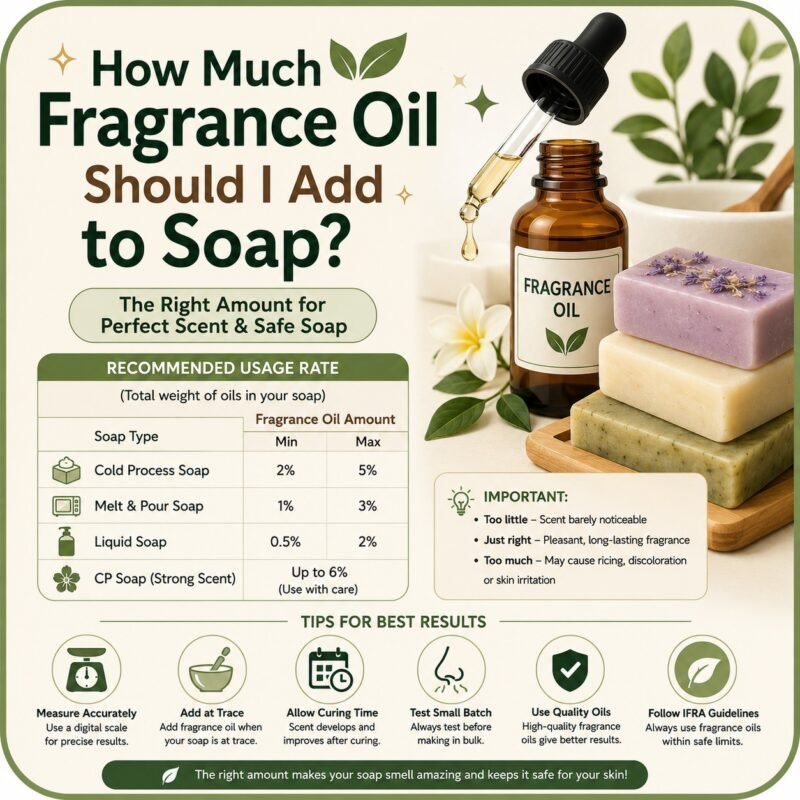
How Much Fragrance Oil Should I Add to Soap?
Learn the right fragrance oil usage rate for melt and pour soap, handmade soap bars, luxury soaps, herbal soaps, clay soaps, gift soaps, and small soap business production.
Quick Answer
For melt and pour soap, a beginner-friendly fragrance oil usage rate is usually around 1% to 3% of the total soap base weight. For 1 kg soap base, this means approximately 10 g to 30 g fragrance oil. Always check the fragrance supplier’s recommended usage level, IFRA category guidance, and your soap base compatibility before finalizing a formula. Too much fragrance oil can make soap soft, sweaty, oily, irritating, or unstable.
Table of Contents
- Why Fragrance Oil Percentage Matters
- Recommended Fragrance Oil Range
- Fragrance Oil Calculation Formula
- Fragrance Oil Usage Chart
- Soap Fragrance Calculation Examples
- How to Make Soap Smell Stronger
- What Happens If You Add Too Much Fragrance?
- Fragrance Oil vs Essential Oil in Soap
- Testing Checklist
- Common Mistakes
- FAQ
- Related Products
Why Fragrance Oil Percentage Matters
Fragrance oil gives handmade soap its aroma and customer appeal, but it must be used in the right amount. Adding too little fragrance may make the soap smell weak. Adding too much fragrance may cause sweating, softness, oily surface, poor lather, irritation risk, fragrance leakage, color change, or packaging issues.
Soap fragrance usage depends on soap base type, fragrance strength, product category, skin-contact level, IFRA guidance, storage conditions, packaging, and customer preference.
For soap fragrance oils, essential oils, soap bases, colors, clays, herbal powders, silicone molds, soap boxes and packaging, visit Jindeal.com.
Recommended Fragrance Oil Range
For beginner melt and pour soap making, use a controlled range and test the result before selling.
| Fragrance Level | Percentage | For 1 kg Soap Base | Best Use |
|---|---|---|---|
| Light Scent | 1% | 10 g | Face-care themed soaps, mild aroma, sensitive-use positioning |
| Medium Scent | 2% | 20 g | Most beginner soap bars and daily-use soaps |
| Strong Scent | 3% | 30 g | Gift soaps, body soaps, strong aroma soaps after testing |
| High Fragrance Load | Above 3% | Above 30 g | Only if supplier limit and soap testing allow it |
Fragrance Oil Calculation Formula
Always calculate fragrance oil by weight, not by drops, spoons, or ml. Use a digital weighing scale for accurate and repeatable results.
Example: If you are using 1000 g soap base and want 2% fragrance oil:
Fragrance Oil Usage Chart
Use this chart for quick melt and pour soap fragrance calculations.
| Soap Base Weight | 1% Light Scent | 2% Medium Scent | 3% Strong Scent |
|---|---|---|---|
| 100 g | 1 g | 2 g | 3 g |
| 250 g | 2.5 g | 5 g | 7.5 g |
| 500 g | 5 g | 10 g | 15 g |
| 750 g | 7.5 g | 15 g | 22.5 g |
| 1 kg | 10 g | 20 g | 30 g |
| 2 kg | 20 g | 40 g | 60 g |
| 5 kg | 50 g | 100 g | 150 g |
| 10 kg | 100 g | 200 g | 300 g |
- Use 1% when fragrance is naturally strong or soap is face-care themed.
- Use 2% as a beginner middle point for most melt and pour soaps.
- Use 3% only after checking fragrance limit and testing soap stability.
- For commercial sale, record fragrance name, percentage, batch number and supplier.
Soap Fragrance Calculation Examples
Example 1: 500 g Soap Base at 2%
500 × 2 ÷ 100 = 10 g fragrance oil.
Example 2: 1 kg Soap Base at 2.5%
1000 × 2.5 ÷ 100 = 25 g fragrance oil.
Example 3: 5 kg Soap Base at 2%
5000 × 2 ÷ 100 = 100 g fragrance oil.
Example 4: 10 Soap Bars of 100 g Each
Total soap batch = 1000 g. At 2% fragrance, use 20 g fragrance oil for the whole batch.
| Batch Plan | Soap Base | Fragrance % | Fragrance Oil Required |
|---|---|---|---|
| Small Trial Batch | 250 g | 2% | 5 g |
| Beginner Batch | 500 g | 2% | 10 g |
| 1 kg Production Batch | 1000 g | 2% | 20 g |
| Gift Soap Batch | 2000 g | 2.5% | 50 g |
| Bulk Soap Batch | 5000 g | 2% | 100 g |
How to Make Soap Smell Stronger
If soap smells weak, do not immediately add too much fragrance. First check product quality, timing, temperature, packaging, and storage.
What Happens If You Add Too Much Fragrance?
More fragrance does not always mean better soap. Excess fragrance can damage soap quality and customer experience.
| Problem | Possible Cause | Fix |
|---|---|---|
| Soap Sweating | Too much fragrance, humidity, poor compatibility | Reduce fragrance and improve packaging |
| Soft Soap | Excess fragrance or oils added | Lower fragrance/additive load |
| Oily Surface | Fragrance not fully incorporated or too high | Mix better and reduce percentage |
| Low Lather | Too much fragrance/additive affecting soap base | Use recommended limits |
| Color Change | Fragrance discoloration, vanilla-style notes, incompatible fragrance | Test fragrance in small batch |
| Strong Irritating Smell | Over-fragranced product | Use lower percentage and safer positioning |
| Label/Packaging Damage | Fragrance leakage or sweating | Improve formula and packaging material |
Fragrance Oil vs Essential Oil in Soap
Both fragrance oils and essential oils can be used in soap, but they behave differently.
| Point | Fragrance Oil | Essential Oil |
|---|---|---|
| Aroma Variety | Wide range: rose, coffee, musk, vanilla, sandalwood, fruit, floral | Natural plant aroma range is limited |
| Scent Strength | Often stronger and longer-lasting | Can fade faster depending on oil |
| Cost | Usually more economical for soap production | Often more expensive |
| Usage Limit | Check supplier and IFRA limit | Check safe dermal limit and suitability |
| Claims | Use aroma/cosmetic-safe claims | Avoid medical claims even if natural |
| Testing | Test discoloration, sweating, scent retention | Test fading, irritation risk, aroma retention |
Soap Fragrance Testing Checklist
Before selling scented soap, test fragrance performance and shelf appearance.
| Test Area | What to Check | Suggested Timing |
|---|---|---|
| Initial Aroma | Smell after soap sets | Same day |
| Scent Retention | Smell after storage | 7, 15, 30 days |
| Sweating | Moisture or oil droplets | 24 hours, 7 days |
| Softness | Soap firmness and demolding | After cooling and after storage |
| Color Change | Yellowing, browning, fading | 7, 15, 30 days |
| Packaging | Label peeling, wrap sticking, oily marks | 7 and 30 days |
| Customer Use | Lather, rinse feel, fragrance experience | After full storage test |
Common Mistakes
1. Measuring Fragrance by Drops
Drops are not accurate. Always weigh fragrance oil in grams.
2. Adding Too Much Fragrance
High fragrance can make soap soft, sweaty, oily, or irritating.
3. Ignoring Supplier Limit
Every fragrance oil can have different maximum usage guidance.
4. Adding Fragrance When Soap is Too Hot
Very hot soap can reduce aroma strength and increase fragrance loss.
5. Not Mixing Properly
Poor mixing can create fragrance pockets, oily spots and uneven scent.
6. No Storage Testing
Soap may smell strong on day one but weak after 30 days.
7. Using Candle Fragrance Without Checking Soap Use
Not every candle fragrance is suitable for skin-contact soap. Check suitability and limits.
8. Using Essential Oil Like Fragrance Oil
Essential oils need safe dilution and may fade differently.
9. Poor Packaging
Open storage can reduce fragrance and cause sweating in melt and pour soap.
10. Making Medical Claims
Do not claim scented soap cures stress, acne, eczema, dandruff, infection or disease.
FAQ
1. How much fragrance oil should I add to soap?
For melt and pour soap, a beginner-friendly range is usually 1% to 3% of the soap base weight. For 1 kg soap base, this equals about 10 g to 30 g fragrance oil.
2. How much fragrance oil for 500 g soap base?
At 2%, use 10 g fragrance oil for 500 g soap base.
3. How much fragrance oil for 1 kg soap base?
At 1% use 10 g, at 2% use 20 g, and at 3% use 30 g fragrance oil for 1 kg soap base.
4. Can I add more than 3% fragrance oil?
Only if the fragrance supplier’s recommended limit and soap testing allow it. Too much fragrance can create quality and safety issues.
5. Why does my soap smell weak?
Weak scent can happen due to low fragrance level, poor fragrance quality, high heat, open storage, fragrance fading, or poor packaging.
6. Why is my soap sweating after adding fragrance?
Sweating may happen due to excess fragrance, humidity, glycerin-rich soap base, poor packaging, or fragrance incompatibility.
7. Should fragrance oil be measured in grams or ml?
Use grams for accuracy. Cosmetic and soap formulas should be measured by weight.
8. Can I use candle fragrance oil in soap?
Only if the fragrance is suitable for soap/skin-contact use and has usage guidance for that product category.
9. Can I use essential oil instead of fragrance oil?
Yes, but essential oils need safe dilution, may cost more, and may fade faster depending on the oil.
10. When should I add fragrance oil to melt and pour soap?
Add fragrance after the soap base is melted and slightly cooled, but before it starts setting. Mix gently and evenly.
11. Can fragrance oil change soap color?
Yes. Some fragrances can discolor, especially vanilla-style or dark fragrance oils. Always test a small batch.
12. How do I make soap fragrance last longer?
Use good fragrance oil, proper percentage, correct temperature, good mixing, and moisture-resistant packaging.
13. Can strong fragrance irritate skin?
Over-fragranced soap can increase irritation risk. Use recommended levels and patch-test where suitable.
14. Can scented soap cure skin problems?
No. Avoid medical claims. Use cosmetic-safe wording like cleansing, aromatic, handmade, spa-style, luxury, herbal-inspired and gifting.
15. Where can I buy soap fragrance oils?
You can buy soap fragrance oils, essential oils, soap bases, colors, clays, herbal powders, molds and packaging from Jindeal.com.
Final Words
The right amount of fragrance oil makes soap smell beautiful without damaging texture, lather, shelf life or packaging. For melt and pour soap, start around 1% to 3%, measure in grams, follow supplier limits, and test before selling.
For soap fragrance oils, essential oils, melt and pour soap bases, colors, clays, herbal powders, silicone molds and packaging, visit Jindeal.com.
Shop Soap Fragrance Oils on Jindeal.com
Buy soap fragrance oils, essential oils, melt and pour soap bases, mica colors, cosmetic clays, herbal powders, silicone molds and soap packaging from Jindeal.com.