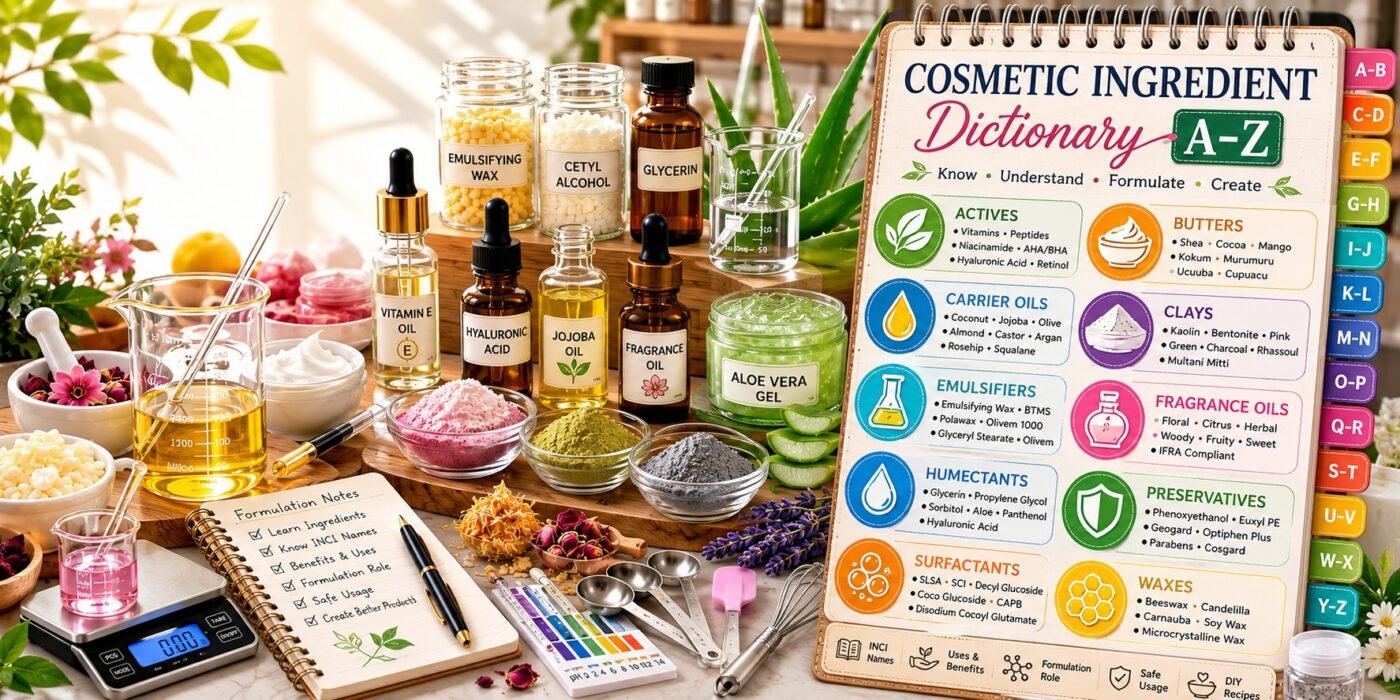
Cosmetic Ingredient Dictionary A-Z

Cosmetic Ingredient Dictionary A-Z | Beginner DIY Formulation Guide | Jindeal

Cosmetic Ingredient Dictionary A-Z

A beginner-friendly cosmetic raw material dictionary for DIY makers, small brands, soap makers, candle makers, skincare formulators, and handmade cosmetic businesses in India.

Quick Answer

A cosmetic ingredient dictionary helps beginners understand what each raw material does in a formula. Oils soften and condition, butters add richness, waxes add structure, clays add texture and color, humectants attract water, emulsifiers help oil and water mix, preservatives protect water-based products, surfactants create cleansing foam, and fragrances add aroma.

Table of Contents

  1. How to Read Cosmetic Ingredients
  2. Main Cosmetic Ingredient Categories
  3. A-Z Cosmetic Ingredient Dictionary
  4. Beginner Usage Chart
  5. Safety and Formulation Notes
  6. Common Mistakes
  7. FAQ
  8. Related Products

How to Read Cosmetic Ingredients

Every cosmetic ingredient has a purpose. Some ingredients create the base of a product, some improve feel, some add fragrance or color, some help preserve the formula, and some help the product spread, foam, thicken, or stay stable.

For example, a face serum may contain carrier oil, vitamin E oil, fragrance-free active oil, and packaging in a dropper bottle. A lotion may contain water, oil, emulsifier, humectant, thickener, preservative, and fragrance. A soap may contain soap base, fragrance oil, color, clay, and botanical powder.

For cosmetic raw materials, carrier oils, essential oils, clays, herbal powders, soap bases, butters, waxes, preservatives, emulsifiers, surfactants, jars, bottles, and packaging, visit Jindeal.com.

Important: This dictionary is for cosmetic education and formulation planning. It does not replace supplier documentation, safety data sheets, IFRA guidance, preservative testing, stability testing, or regulatory advice.

Main Cosmetic Ingredient Categories

Carrier OilsLiquid oils used in serums, massage oils, body oils, hair oils, balms, creams, and soaps.Examples: coconut oil, almond oil, castor oil, jojoba oil, olive oil.
ButtersSolid or semi-solid fats that add richness, body, and creamy texture.Examples: shea butter, cocoa butter, mango butter.
WaxesStructure-building ingredients for balms, solid perfume, lotion bars, and candles.Examples: beeswax, soy wax, emulsifying wax.
HumectantsIngredients that help attract water and improve hydration feel.Examples: glycerin, propylene glycol, sorbitol.
EmulsifiersIngredients that help oil and water mix into creams and lotions.Examples: emulsifying wax, polysorbate, glyceryl stearate.
PreservativesIngredients used to protect water-containing products from microbial growth.Examples depend on formula type and pH.
SurfactantsCleansing and foaming ingredients used in shampoos, body washes, cleansers, and bubble products.Examples: SLES, CAPB, SCI, decyl glucoside.
Clays and PowdersDry ingredients used for color, texture, oil-absorbing feel, and product theme.Examples: kaolin clay, Multani Mitti, French Green Clay, rose powder.

A-Z Cosmetic Ingredient Dictionary

Use this A-Z dictionary to understand common cosmetic raw materials and their beginner-friendly uses.

A

Aloe Vera PowderA botanical powder used in face masks, hair masks, soaps, ubtan, and rinse-off skincare products.Best for: dry masks, herbal powders, soap, hair-care themes.
Aloe Vera GelA water-based gel used in skincare and hair-care products. Needs preservation if stored.Best for: gels, masks, after-care cosmetic products.
Almond OilA carrier oil used in body oils, massage oils, hair oils, serums, creams, and balms.Best for: skin-feel, massage oil, premium oil blends.
Amla PowderA herbal powder used in hair masks, hair wash powders, and traditional hair-care themed products.Best for: hair masks, herbal hair blends, rinse-off products.
Arrowroot PowderA fine powder used to reduce greasy feel in body butters, deodorant-style products, and dry powders.Best for: body butter, dusting powder, balm texture.
Aritha PowderAlso called Reetha or soapnut powder. Used in herbal hair wash powders and shampoo-style concepts.Best for: rinse-off hair wash, herbal shampoo powder.

B

BeeswaxA natural wax used to harden balms, salves, lotion bars, solid perfumes, and candles.Best for: balms, solid products, structure.
Bentonite ClayA highly absorbent clay used in stronger clay mask, body pack, foot pack, and oily-skin themed products.Best for: rinse-off masks and body packs.
Bhringraj PowderA traditional hair-care powder used in hair masks, oils, and rinse-off herbal hair products.Best for: hair-care themed products.
Brazilian Purple ClayA colored cosmetic clay used for premium purple masks, soaps, and luxury skincare themes.Best for: masks, soap, decorative clay products.
ButtersSolid fats like shea, cocoa, and mango butter used for richness and structure.Best for: body butter, balm, cream, lotion bars.

C

Carrier OilA vegetable oil used to dilute essential oils and create oil-based products.Best for: massage oils, serums, hair oils, balms.
Castor OilA thick carrier oil used in hair oils, balms, lip balms, soaps, and massage products.Best for: hair oil blends, thick texture, soap formulas.
Cetearyl AlcoholA fatty alcohol used to thicken and improve the feel of lotions and creams.Best for: creams, lotions, conditioners.
Charcoal PowderA black powder used in soap, masks, and cleansing-style product themes.Best for: charcoal soap, black masks, men’s products.
Cocoa ButterA hard butter used in body butters, balms, lotion bars, and luxury formulations.Best for: rich texture and solid structure.
Coconut OilA popular carrier oil used in soaps, hair oils, body oils, balms, and massage blends.Best for: soap, hair oil, body oil, balms.
Cosmetic ClayFine clay used for color, texture, oil-absorbing feel, and spa product appeal.Best for: masks, soaps, body packs, bath powders.

D

Decyl GlucosideA mild non-ionic surfactant used in gentle cleanser and shampoo-style formulas.Best for: cleansers, body wash, shampoo concepts.
Diffuser BaseA base liquid used to carry fragrance in reed diffusers and home fragrance products.Best for: reed diffusers, home fragrance.
Distilled WaterPurified water used in lotions, creams, gels, toners, and water-based formulas.Best for: water phase. Needs preservation in finished products.

E

Emulsifying WaxAn emulsifier used to combine oil and water into creams and lotions.Best for: lotions, creams, emulsions.
Essential OilA concentrated aromatic oil from plants. Used for fragrance at safe diluted levels.Best for: aroma, soaps, oils, candles, cosmetics when suitable.
Eucalyptus Essential OilA strong fresh essential oil used in aromatherapy-style, bath, soap, and candle products.Best for: fresh spa aroma. Use safely.

F

French Green ClayA green cosmetic clay used in face masks, soap, body packs, and spa products.Best for: green clay masks and soap.
Fragrance OilAromatic oil used to scent soap, candles, diffuser products, body care, and cosmetic products if suitable.Best for: fragrance. Check safe use category.
Foaming Bath Butter BaseA ready base used for whipped soap, body scrub, and cleansing-style bath products.Best for: whipped soap and scrub concepts.

G

GlycerinA humectant used in soaps, lotions, gels, and cosmetic products to improve skin-feel.Best for: humectant, soap clarity, dispersion aid.
Goat Milk Soap BaseA melt and pour soap base with creamy appearance and premium product appeal.Best for: luxury soap and gentle soap themes.
Gum / ThickenerIngredients like xanthan gum used to thicken gels, lotions, and water-based products.Best for: viscosity and texture control.

H

Herbal PowderPlant-based powder used in masks, soaps, hair packs, ubtan, and bath powders.Best for: botanical label appeal and dry formulations.
Hibiscus PowderA botanical powder used in hair masks, hair wash powders, soaps, and natural hair-care themes.Best for: hair-care and herbal products.
HumectantAn ingredient that attracts water and improves hydration feel.Best for: lotions, gels, serums, creams.
HydrosolAromatic water used in toners, sprays, masks, and water-based products.Best for: facial mist, toner, mask liquid. Needs preservation if stored.

I

Indigo PowderA natural botanical powder used mainly in hair color and herbal hair-care products.Best for: hair-care products. Test staining and color.
Isopropyl AlcoholUsed in soap making to reduce bubbles on melt and pour soap surface.Best for: soap bubble control, tool cleaning.

J

Jojoba OilA lightweight liquid wax-like carrier oil used in serums, oils, balms, and hair-care products.Best for: premium face and hair oil blends.
JarsPackaging containers used for creams, scrubs, clays, powders, body butters, and balms.Best for: finished product packaging.

K

Kaolin ClayA soft fine cosmetic clay used in face masks, soap, bath powders, and gentle skincare-style products.Best for: beginner clay masks and soap.
Kokum ButterA hard plant butter used in balms, body butters, lotion bars, and solid cosmetic products.Best for: structure and richness.

L

Lavender Essential OilA popular floral-herbal essential oil used in soaps, candles, oils, and spa products.Best for: relaxing aroma theme. Avoid medical claims.
Lemongrass Essential OilA fresh citrus-like essential oil used in soaps, candles, and bath products at safe levels.Best for: fresh aroma products.
Liquid Soap ColorA ready liquid color used in melt and pour soap and handmade products.Best for: beginner soap coloring.
Lotion BaseA ready base or formulation used to create body lotions and creams.Best for: body lotion products. Check preservation and compatibility.

M

Mango ButterA plant butter used in body butters, creams, balms, and hair-care products.Best for: creamy texture and premium products.
Mica PowderA shimmery cosmetic colorant used in soap, bath bombs, body products, and decorative cosmetics if suitable.Best for: soap color and shimmer.
Multani MittiFuller’s earth clay used in face packs, ubtan, soap, body packs, and bath powders.Best for: traditional Indian skincare products.
Myrrh Essential OilA resinous essential oil used in premium aroma products, soaps, and oil blends at safe levels.Best for: luxury fragrance themes.

N

Neem PowderA traditional herbal powder used in masks, soap, hair packs, and rinse-off botanical products.Best for: herbal product themes. Avoid treatment claims.
Natural ColorantA colorant from clay, botanical powder, charcoal, or mineral pigment.Best for: natural-style soap and cosmetic products.
Non-Alcoholic Diffuser BaseA diffuser base used in reed diffuser products without alcohol-style positioning.Best for: home fragrance diffuser products.

O

Olive OilA carrier oil used in soaps, massage oils, body oils, creams, and balms.Best for: rich oil blends and soap making.
Orange Peel PowderA botanical powder used in ubtan, masks, soap, bath powders, and natural skincare-style products.Best for: fresh citrus product themes.
OilsLiquid fats used to soften, condition, dilute essential oils, and build anhydrous products.Best for: serums, hair oils, massage oils, balms.

P

Paraffin WaxA candle wax used in strong scented candles, molded candles, and economical candle products.Best for: candle making.
pHA measure of acidity or alkalinity that affects product safety, preservation, and skin feel.Best for: lotions, shampoos, gels, cleansers.
Phenoxyethanol BlendA common preservative type used in many water-containing cosmetic formulas when compatible.Best for: preserved water-based products. Check supplier usage.
PolysorbateA solubilizer/emulsifier used to help oils and fragrance disperse in water-based or bath products.Best for: sprays, bath oils, dispersing fragrance.
PreservativeAn ingredient used in water-containing products to reduce microbial risk.Best for: lotions, creams, gels, toners, scrubs with water.
Propylene GlycolA humectant and solvent used in some cosmetic and fragrance applications.Best for: humectant/solvent functions depending on formula.

R

Red Sandalwood PowderAlso called Rakta Chandan powder. Used for red-brown color and herbal product appeal.Best for: ubtan, masks, soap, bath powders.
Rhassoul ClayA premium mineral clay used in masks, body packs, hair masks, and soap.Best for: spa-style masks and luxury clay products.
Rose Petal PowderA floral botanical powder used in masks, ubtan, soaps, bath powders, and luxury skincare themes.Best for: floral herbal products.
Rosemary Essential OilA strong herbal essential oil used in hair-care themed oils, soaps, and aroma products at safe levels.Best for: hair-care aroma themes. Avoid hair growth claims.

S

SCI Powder / NoodlesSodium Cocoyl Isethionate, a surfactant used in shampoo bars and syndet bars.Best for: shampoo bars and cleansing bars.
Shea ButterA rich butter used in body butter, balms, creams, soaps, and lotion bars.Best for: rich texture and premium body products.
Shikakai PowderA traditional hair-care powder used in hair wash powders, shampoo bars, and herbal hair masks.Best for: rinse-off hair products.
Silicone MoldA flexible mold used for soap, candles, resin, wax melts, concrete, and DIY crafts.Best for: shaped products and easy demolding.
SLS / SLESSurfactants used in cleansing and foaming products. Use correct cosmetic grade and formula levels.Best for: shampoos, body wash, cleansers.
Soap BaseReady melt and pour base used to make soap without direct lye handling.Best for: beginner soap making.
SolubilizerAn ingredient that helps fragrance or essential oil disperse into water-based products.Best for: sprays, mists, bath products.
Soy WaxA vegetable wax used in jar candles, candle tins, wax melts, and massage candle concepts.Best for: candle making.
Stearic AcidA fatty acid used to thicken, harden, and improve structure in creams, candles, and some soaps.Best for: thickening and structure.
SurfactantCleansing ingredient that helps remove oil and create foam.Best for: shampoos, cleansers, body washes.

T

Tea Tree Essential OilA strong essential oil used in soaps, hair-care themed products, and cleansing-style formulas at safe levels.Best for: fresh herbal aroma. Avoid acne/dandruff cure claims.
ThickenerAn ingredient used to increase viscosity in gels, creams, lotions, and shampoos.Best for: texture control.
Tocopherol / Vitamin EAn antioxidant oil used in oil-based products to support oil stability and premium label appeal.Best for: oils, balms, body butter, soaps in small amount.
Turmeric-Style PowderA yellow botanical powder used in ubtan-style products, soaps, and masks.Best for: color and traditional product appeal. Test staining.

V

Vitamin E OilA cosmetic oil used in oils, balms, soaps, body butters, and premium formulations.Best for: antioxidant support in oil phase and label appeal.
Vegetable GlycerinA humectant used in soap, lotions, gels, and cosmetic products.Best for: moisture feel, soap clarity, dispersion.

W

Water PhaseThe water-based portion of a formula such as distilled water, hydrosol, aloe juice, or glycerin solution.Best for: lotions, creams, gels, shampoos. Needs preservation.
WaxA solid ingredient used for structure in balms, candles, solid perfumes, and lotion bars.Best for: hardening and structure.
WickThe burning component in a candle. Wick size affects flame, melt pool, smoke, and safety.Best for: candle making and testing.

X

Xanthan GumA thickener used in gels, lotions, creams, and water-based products.Best for: viscosity and suspension support.

Z

Zinc OxideA white mineral powder used in some cosmetic products. Needs correct grade and formulation knowledge.Best for: special formulas; avoid SPF claims unless properly tested and compliant.

Beginner Usage Chart

This chart gives broad beginner-friendly ranges. Always follow supplier documentation and test your exact formula.

Ingredient Type Typical Beginner Use Common Products Important Note
Carrier Oils1% to 100%Serums, oils, balms, body butterOil-only products do not need water-phase preservative but need good storage
Essential Oils0.1% to 2%Soaps, oils, balms, hair oils, candlesUse safe dilution and avoid sensitive areas
Fragrance Oils0.5% to 3% cosmetics, 6% to 10% candlesSoap, candles, scrubs, diffuser productsCheck skin-safe or candle-safe category
Clays0.5% to 100% dry masksMasks, soaps, bath powdersDry powders stay safer when kept dry
Herbal Powders0.5% to 100% dry blendsMasks, ubtan, hair packs, soapsCan fade, stain, or feel gritty
Humectants1% to 10%Lotions, gels, serums, cleansersToo much can feel sticky
Emulsifiers2% to 8%Creams, lotions, conditionersDepends on oil phase and emulsifier type
PreservativesAs supplier recommendedWater-based productsDepends on pH, formula type, and preservative system
SurfactantsDepends on active matterShampoo, cleanser, body washRequires formulation knowledge and pH testing
Colors / Mica0.1% to 0.5% starting rangeSoap, bath products, decorative cosmeticsUse cosmetic-grade and test staining
Simple Rule: Water-based products need preservation. Oil-only products need stability care. Powders must stay dry. Fragrance and essential oils need safe limits.

Safety and Formulation Notes

Cosmetic formulation requires more than mixing ingredients. You must consider ingredient compatibility, safe usage level, pH, preservation, packaging, stability, texture, fragrance level, and customer instructions.

  • Use cosmetic-grade raw materials for cosmetic products.
  • Do not use industrial, food-only, craft-only, or unknown-grade ingredients in cosmetics.
  • Water-containing products need suitable preservatives.
  • Dry masks and powders should be kept dry and packed in moisture-resistant packaging.
  • Essential oils and fragrance oils should be used at safe recommended levels.
  • Strong essential oils need extra caution in face, scalp, children’s, and sensitive-skin themed products.
  • Patch test finished products before regular use.
  • Keep batch records for raw material supplier, lot number, formula percentage, date, and testing notes.
  • Avoid medical claims such as curing acne, eczema, dandruff, hair fall, pigmentation, infection, or disease.
  • Check applicable labeling, GST, cosmetic manufacturing, and local business rules before selling.
Preservation Reminder: If your product contains water, aloe juice, hydrosol, floral water, milk, tea, fruit juice, or any water-based ingredient and will be stored, it needs a suitable preservative system and testing.

Common Mistakes

1. Mixing Ingredients Without Understanding Function

Every ingredient should have a purpose. Avoid adding ingredients only because they sound attractive.

2. Making Water-Based Products Without Preservative

This is one of the biggest beginner mistakes. Stored water-based products need preservation.

3. Using Too Much Essential Oil

Essential oils are concentrated and must be diluted safely.

4. Using Candle Fragrance in Skin Products

Candle fragrance oil should not be used in skin-contact products unless supplier confirms it is suitable.

5. Making Medical Claims

Cosmetic products should not claim to cure acne, eczema, dandruff, hair fall, pigmentation, infection, or disease.

6. Not Checking pH

pH matters in shampoos, cleansers, lotions, gels, and preservative performance.

7. Not Testing Stability

Products can separate, change smell, change color, grow contamination, or lose texture over time.

8. Using Non-Cosmetic Colors

Use cosmetic-grade colors and pigments only.

9. Poor Packaging Choice

Wrong packaging can cause leaking, contamination, moisture entry, oxidation, or product damage.

10. No Batch Records

Batch records help repeat good formulas and solve complaints.

FAQ

1. What is a cosmetic ingredient dictionary?

It is a reference guide that explains common cosmetic raw materials, their function, and where they are used in formulas.

2. What are carrier oils?

Carrier oils are vegetable oils used in serums, massage oils, hair oils, balms, body butters, and creams.

3. What are essential oils?

Essential oils are concentrated aromatic plant oils used for fragrance at safe diluted levels.

4. What is the difference between fragrance oil and essential oil?

Essential oil comes from plants, while fragrance oil is an aroma blend. Both need safe usage limits depending on product type.

5. What is an emulsifier?

An emulsifier helps oil and water mix into stable creams and lotions.

6. What is a preservative?

A preservative helps protect water-containing cosmetic products from microbial growth.

7. Do oil-based products need preservatives?

Oil-only products usually do not need water-phase preservatives, but they may need antioxidant support and clean manufacturing.

8. Do dry powders need preservatives?

Dry powders are easier to preserve if kept completely dry. Stored wet masks need preservatives.

9. What are surfactants?

Surfactants are cleansing and foaming ingredients used in shampoos, body washes, cleansers, and bath products.

10. What are humectants?

Humectants attract water and improve hydration feel in lotions, gels, creams, and serums.

11. Can herbal powders cure skin problems?

No. Avoid medical claims. Herbal powders can be used in cosmetic rinse-off products, masks, soaps, and hair-care themes.

12. Can essential oils cure hair fall?

No. Do not claim essential oils cure hair fall, dandruff, or scalp disease. Use cosmetic-safe hair-care wording.

13. What ingredients should beginners start with?

Beginners can start with soap base, carrier oils, clays, herbal powders, fragrance oils, essential oils, glycerin, jars, bottles, and silicone molds.

14. What should I check before selling cosmetics?

Check formulation safety, preservation, stability, labels, batch records, GST, cosmetic manufacturing rules, and local business requirements.

15. Where can I buy cosmetic ingredients?

You can buy cosmetic raw materials, oils, clays, herbal powders, soap bases, fragrance oils, essential oils, jars, bottles, and packaging from Jindeal.com.

Final Words

This Cosmetic Ingredient Dictionary A-Z gives beginners a simple way to understand common raw materials and their functions. Before making any cosmetic product, learn what each ingredient does, how much to use, whether it needs preservation, and how it behaves in the final formula.

Use cosmetic-grade ingredients, follow supplier guidance, test every formula, keep batch records, and avoid medical claims. For cosmetic raw materials, soap bases, clays, herbal powders, oils, butters, waxes, fragrance oils, essential oils, jars, bottles, and packaging, visit Jindeal.com.

Shop Cosmetic Ingredients on Jindeal.com

Buy carrier oils, essential oils, fragrance oils, soap bases, clays, herbal powders, butters, waxes, colors, mica, jars, bottles, molds, and packaging materials from Jindeal.com.

Leave a Reply