
Uncategorized, Waxes and Butters
Soy Wax vs Paraffin Wax vs Coconut Wax
Jun
Soy Wax vs Paraffin Wax vs Coconut Wax
Compare the three most popular candle waxes for handmade candle making. Learn which wax is best for scent throw, smooth finish, beginner candle making, luxury candles, jar candles, cost control, and business production.
Quick Answer
Soy wax is best for natural-style candles and clean branding but may frost. Paraffin wax is best for strong scent throw, smooth finish, and budget-friendly production. Coconut wax is best for premium luxury candles with creamy texture and good fragrance performance. The best wax depends on your product theme, cost, wick, and testing.
Table of Contents
What Are Soy, Paraffin and Coconut Waxes?
Candle wax is the main fuel and body of a candle. It controls burn time, scent throw, texture, surface finish, color appearance, frosting, wet spots, wick behavior, and overall candle quality.
Soy wax is a vegetable-based wax popular for natural-style jar candles. Paraffin wax is a petroleum-based wax known for strong fragrance throw and smooth finish. Coconut wax is often used in premium candle blends because of its creamy look and luxury feel.
There is no single best wax for every candle. The right choice depends on your brand positioning, customer expectations, candle jar, fragrance oil, wick size, room temperature, budget, and burn testing.
For soy wax, paraffin wax, coconut wax blends, candle fragrance oils, candle wicks, jars, colors, thermometers, pouring pots, and DIY candle-making supplies, visit Jindeal.com.
What Causes the Problem?
Many beginners face problems because they choose candle wax only by price or popularity. But each wax behaves differently. A wick, fragrance load, or pour temperature that works in paraffin wax may not work in soy wax or coconut wax.
Common problems happen when:
- Soy wax is used without understanding frosting and wet spots
- Paraffin wax is selected but marketed as natural without clarity
- Coconut wax is used without proper wick and cost calculation
- The same wick is used for all waxes
- Fragrance load is copied without checking wax limit
- Wax is overheated or poured at the wrong temperature
- Candles are cooled too fast
- Fragrance oil is not mixed properly
- Wide jars are not burn tested properly
- Customer product theme does not match wax choice
- Costing is not calculated before bulk production
- Candles are sold without full burn testing
For example, soy wax may look natural and premium but can show frosting. Paraffin wax can throw fragrance strongly but may not match a natural branding message. Coconut wax can feel luxury but may increase product cost.
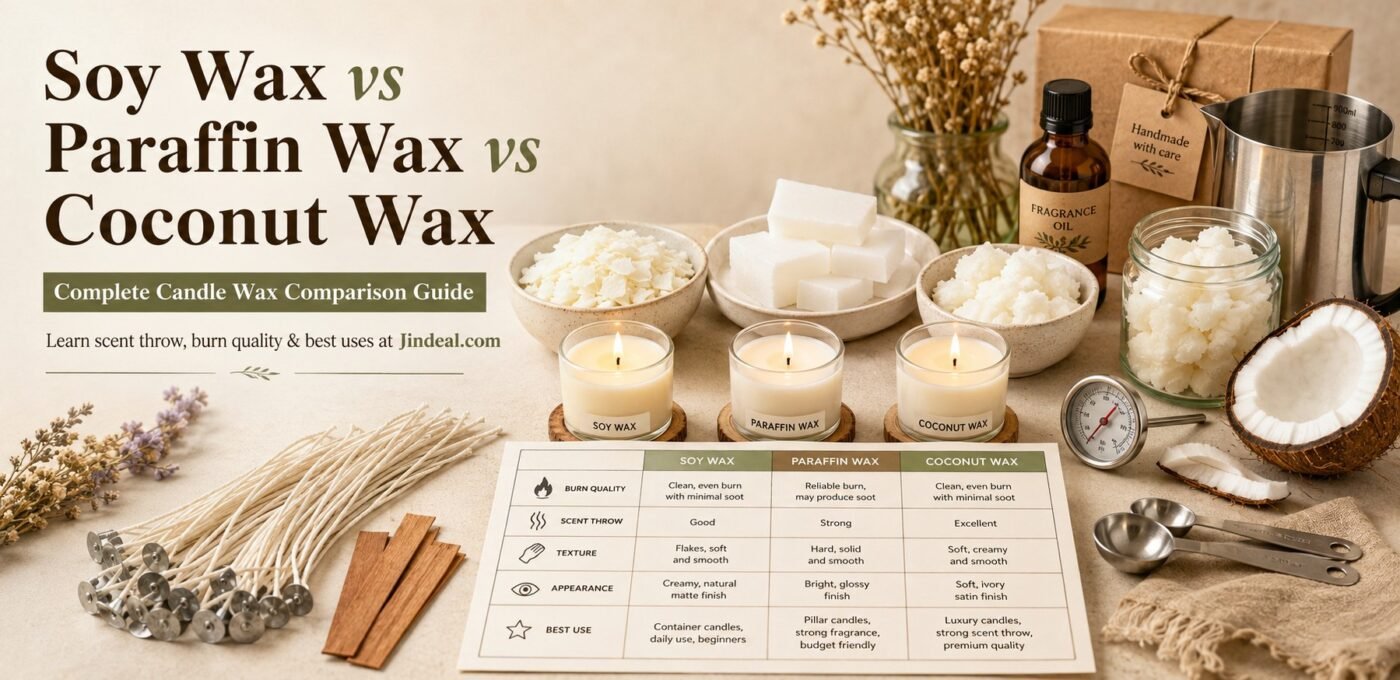
Soy Wax vs Paraffin Wax vs Coconut Wax Chart
Use this beginner-friendly comparison chart to choose the right candle wax for your project.
| Feature | Soy Wax | Paraffin Wax | Coconut Wax |
|---|---|---|---|
| Best For | Natural-style jar candles, handmade candles, eco-themed branding | Strong scented candles, smooth finish, budget-friendly production | Luxury candles, creamy finish, premium blends |
| Scent Throw | Good, but may need cure time and wick testing | Usually strong hot throw and cold throw | Good to excellent, depending on blend |
| Appearance | Creamy, natural, may frost | Smooth, glossy or clean finish | Very creamy, soft, premium-looking |
| Common Issue | Frosting, wet spots, weaker hot throw if not tested | Soot if wrong wick or fragrance load is high | Softness, cost, wick testing sensitivity |
| Beginner Friendly | Yes, but needs patience and testing | Yes, often easier for strong scent throw | Good, but better for premium tested formulas |
| Cost | Medium | Usually economical | Usually higher |
| Brand Positioning | Natural, handmade, clean lifestyle | Strong fragrance, commercial, value range | Luxury, premium, boutique candles |
| Wick Testing | Very important | Important | Very important |
Step-by-Step Solution
Step 1: Decide Your Candle Brand Theme
Before choosing wax, decide your product theme. Are you making natural handmade candles, strong fragrance candles, budget candles, festive candles, or luxury premium candles?
Step 2: Check Your Candle Type
Different candles need different waxes. Container candles need wax that works well in jars. Pillar candles need harder wax. Wax melts need good fragrance release without wick performance concerns.
Step 3: Compare Fragrance Throw
If your main goal is strong room fragrance, paraffin wax or a paraffin blend often performs strongly. Soy wax can also perform well, but it usually needs correct cure time, wick testing, and fragrance matching. Coconut wax blends can give a premium scent experience when properly formulated.
Step 4: Check Appearance Needs
If you want a smooth glossy finish, paraffin wax may be easier. If you want natural creamy appearance, soy wax works well but may frost. If you want luxury creamy finish, coconut wax blends are attractive.
Step 5: Match Wick with Wax
Do not use the same wick without testing. Soy wax, paraffin wax, and coconut wax burn differently. The wick must match wax type, jar diameter, fragrance load, and color.
Step 6: Choose Fragrance Load Carefully
Each wax has a fragrance-holding limit. Too little fragrance gives weak scent. Too much fragrance can cause sweating, black smoke, poor burn, or separation.
Step 7: Control Pour Temperature
Each wax has its own melting, fragrance-adding, and pouring temperature range. Use a thermometer and follow supplier guidelines. Guessing temperature can create frosting, wet spots, cracks, sinkholes, or weak scent throw.
Step 8: Test Cure Time
Soy wax often needs more cure time for better scent throw. Paraffin may show fragrance faster, but still benefits from testing. Coconut wax blends should also be tested after curing.
Step 9: Do Burn Testing
Burn testing is compulsory before selling. Check flame height, melt pool, scent throw, smoke, soot, tunneling, mushrooming, jar temperature, and total burn time.
Step 10: Calculate Final Cost
Wax choice affects profit. Coconut wax may create a premium candle but costs more. Paraffin may be economical. Soy wax may fit handmade branding. Calculate material cost, jar cost, fragrance cost, packaging, wastage, and selling price.
Common Mistakes
1. Choosing Wax Only by Price
Cheap wax may not match your fragrance throw, finish, or brand positioning.
2. Using the Same Wick for Every Wax
Every wax needs separate wick testing. Soy, paraffin, and coconut wax do not burn the same.
3. Expecting Soy Wax to Look Perfect Always
Soy wax can show frosting and wet spots because of natural crystallization and cooling behavior.
4. Assuming Paraffin Is Always Bad
Paraffin is widely used for strong fragrance and smooth candles. Choose it honestly according to your product theme.
5. Using Coconut Wax Without Costing
Coconut wax can be premium but may increase final product cost.
6. Adding Too Much Fragrance
More fragrance does not always mean better candle. It can cause sweating, smoke, and poor burn.
7. Not Checking Pour Temperature
Wrong temperature can create surface problems and weak scent performance.
8. Cooling Candles Too Fast
Fast cooling can cause frosting, wet spots, cracks, and uneven finish.
9. Not Testing Final Jar Size
A wax may work in one jar but fail in another jar diameter.
10. Selling Without Burn Testing
Every wax formula must be tested before selling to customers.
Expert Tips
- Use soy wax for natural and handmade candle branding.
- Use paraffin wax for strong fragrance throw and smooth finish.
- Use coconut wax blends for premium luxury candles.
- Always match wick size with wax type and jar diameter.
- Use candle-grade fragrance oil only.
- Do not exceed wax supplier fragrance load limits.
- Use a thermometer for melting, fragrance adding, and pouring.
- Cool candles slowly at stable room temperature.
- Test candles after curing before judging scent throw.
- Record every wax, wick, fragrance, color, and jar result.
- Calculate costing before bulk production.
- Buy soy wax, paraffin wax, coconut wax blends, wicks, jars, fragrance oils, and packaging from Jindeal.com.
FAQ
1. Which wax is best for candle making?
It depends on your goal. Soy wax is good for natural-style candles, paraffin for strong scent throw, and coconut wax for premium luxury candles.
2. Is soy wax better than paraffin wax?
Soy wax is better for natural handmade branding, but paraffin wax often gives stronger scent throw and smoother finish.
3. Is coconut wax better than soy wax?
Coconut wax can give a premium creamy finish and good scent throw, but it is usually more costly than soy wax.
4. Which wax gives the best scent throw?
Paraffin wax is often known for strong scent throw. Coconut wax blends can also perform very well. Soy wax needs proper cure and wick testing.
5. Which wax is best for beginners?
Soy wax and paraffin wax are both beginner-friendly. Soy fits handmade branding, while paraffin can be easier for strong fragrance results.
6. Which wax is best for luxury candles?
Coconut wax blends are popular for luxury candles because of their creamy texture and premium feel.
7. Why does soy wax frost?
Soy wax can frost due to natural crystallization, cooling speed, temperature changes, and storage conditions.
8. Does paraffin wax smoke?
Any wax can smoke if the wick is too large, fragrance load is high, or the candle is not burn tested properly.
9. Can I mix soy wax and paraffin wax?
Yes, wax blends are common. Mixing can improve scent throw, finish, hardness, and burn quality, but testing is required.
10. Can I mix coconut wax with soy wax?
Yes, coconut-soy blends are popular for premium candles. Test wick, fragrance load, and burn performance.
11. Which wax is best for jar candles?
Soy wax, paraffin container wax, and coconut wax blends can all work for jar candles if the formula is tested.
12. Which wax is cheaper?
Paraffin wax is often economical, soy wax is usually mid-range, and coconut wax is usually premium-priced.
13. Which wax needs more cure time?
Soy wax often benefits from more cure time for better scent throw. Other waxes also need testing before final judgment.
14. Do I need different wicks for different waxes?
Yes. Soy, paraffin, and coconut wax can need different wick sizes or wick types.
15. Where can I buy candle wax and supplies?
You can buy soy wax, paraffin wax, coconut wax blends, candle wicks, jars, fragrance oils, colors, thermometers, molds, packaging, and DIY candle-making supplies from Jindeal.com.
Final Words
Soy wax, paraffin wax, and coconut wax all have their own strengths. Soy wax is great for natural handmade candles, paraffin wax is strong for scent throw and smooth finish, and coconut wax is excellent for premium luxury candles.
The best wax is the one that fits your brand, cost, fragrance goal, jar size, and testing results. For soy wax, paraffin wax, coconut wax blends, wicks, jars, fragrance oils, colors, thermometers, and packaging supplies, visit Jindeal.com.
Choose the Best Candle Wax with Jindeal.com
Shop soy wax, paraffin wax, coconut wax blends, candle wicks, jars, fragrance oils, colors, thermometers, molds, packaging, and DIY candle-making materials from Jindeal.com.
