
Soap Base, Uncategorized
Melt and Pour Soap Calculator
Jun
Melt and Pour Soap Calculator
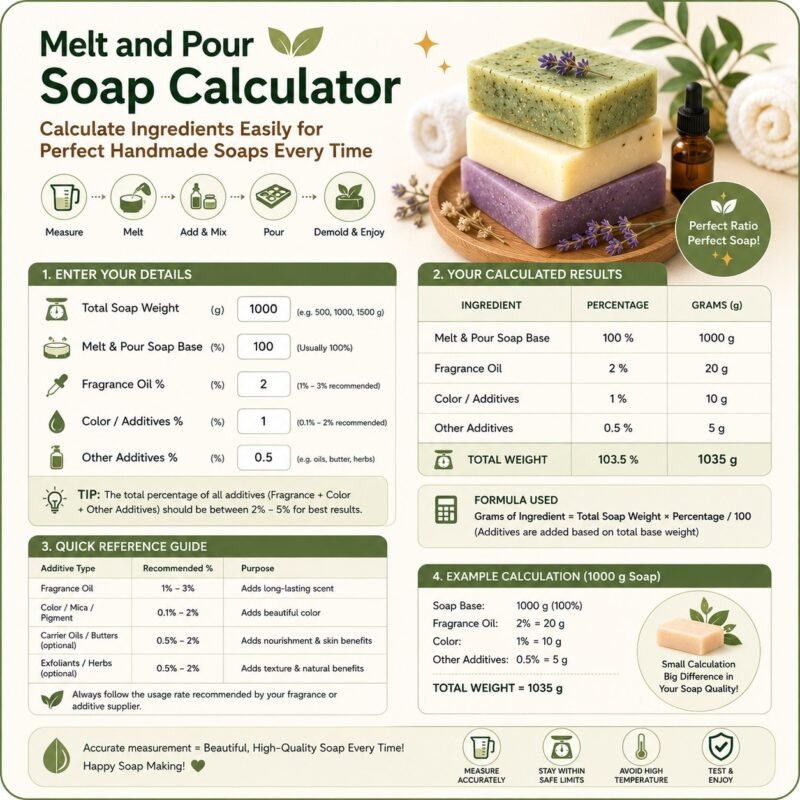
Calculate soap base quantity, fragrance oil, essential oil, color, clay/herbal powder, wastage, batch cost, cost per soap bar, and suggested selling price for handmade melt and pour soap.
Quick Answer
Use this melt and pour soap calculator by entering your soap bar weight, number of bars, fragrance percentage, additive percentage, wastage, raw material cost, packaging cost, and target profit margin. The calculator will estimate how much soap base, fragrance oil, color/additives, total batch cost, cost per bar, and suggested selling price you need.
Melt and Pour Soap Calculator
Enter your batch details below. All weights are in grams and costs are in ₹.
Table of Contents
How to Use This Calculator
Enter the weight of one soap bar and the number of soap bars you want to make. Then add your fragrance percentage, color percentage, clay or herbal powder percentage, wastage, and cost details. The calculator will give you a practical batch plan.
- For beginner melt and pour soap, use fragrance oil around 1% to 3% of total soap batch weight.
- Keep mica/color low. Too much color can stain foam or make soap look uneven.
- Use clay and herbal powders carefully. Too much powder can reduce lather or make soap gritty.
- Always test a small batch before selling.
Soap Calculation Formulas
Fragrance and Additive Usage Chart
| Ingredient | Beginner Usage Range | For 1 kg Soap Batch | Notes |
|---|---|---|---|
| Fragrance Oil | 1% to 3% | 10 g to 30 g | Check supplier/IFRA guidance and test soap stability |
| Essential Oil | 0.5% to 2% | 5 g to 20 g | Use safe dilution and avoid medical claims |
| Mica Color | 0.1% to 0.5% | 1 g to 5 g | Start low and increase slowly |
| Clay | 0.5% to 2% | 5 g to 20 g | Too much clay can reduce lather |
| Herbal Powder | 0.5% to 2% | 5 g to 20 g | Use fine, dry cosmetic-grade powder |
| Extra Carrier Oil | 0.5% to 1% | 5 g to 10 g | Too much oil can soften soap |
Example Calculation
If you want to make 10 bars of 100 g soap:
| Item | Calculation | Result |
|---|---|---|
| Finished Soap | 100 g × 10 bars | 1000 g |
| With 5% Wastage | 1000 × 1.05 | 1050 g |
| Fragrance at 2% | 1050 × 2% | 21 g |
| Mica at 0.3% | 1050 × 0.3% | 3.15 g |
| Clay at 1% | 1050 × 1% | 10.5 g |
| Soap Base Needed | 1050 – 21 – 3.15 – 10.5 | 1015.35 g |
Soap Costing Tips
For a soap business, do not calculate price only from soap base and fragrance oil. Add packaging, label, labor, wastage, rejected pieces, shipping material, payment gateway fee, marketplace fee, GST/tax planning, marketing cost, and profit margin.
| Cost Head | Include | Why Important |
|---|---|---|
| Raw Material | Soap base, fragrance, color, clay, herbal powder | Main product cost |
| Packaging | Wrap, soap box, label, sticker, carton | Premium look and protection |
| Labor | Making, cutting, demolding, packing, cleaning | Your time has value |
| Wastage | Spillage, rejected pieces, test samples | Protects profit |
| Selling Cost | Ads, website, marketplace, payment gateway | Real business expense |
| Profit | Business growth and reinvestment | Long-term sustainability |
Common Mistakes
1. Not Adding Wastage
Always add 3% to 8% wastage for melting, pouring, scraping and rejected pieces.
2. Using Too Much Fragrance Oil
Too much fragrance can make soap soft, oily, sweaty, or unstable.
3. Measuring by Spoons
Use a digital scale and measure everything in grams.
4. Adding Too Many Powders
Excess clay or herbal powder can reduce lather and make soap gritty.
5. Ignoring Packaging Cost
Packaging can be a major part of handmade soap cost.
6. Selling Without Testing
Test fragrance, sweating, color, hardness, packaging, and shelf appearance before selling.
FAQ
1. How much soap base do I need for 10 bars?
If each bar is 100 g, you need about 1000 g finished soap plus wastage. With 5% wastage, plan around 1050 g total batch.
2. How much fragrance oil for 1 kg melt and pour soap?
A common beginner range is 10 g to 30 g fragrance oil for 1 kg soap batch, depending on fragrance strength and supplier guidance.
3. Should I calculate fragrance by soap base weight or total batch?
For practical small-batch soap making, calculate fragrance as a percentage of total batch weight and stay consistent in your records.
4. Can I add extra oil to melt and pour soap?
Use extra oil carefully and in low percentage. Too much oil can make soap soft and reduce lather.
5. How much mica should I add to soap?
Start around 0.1% to 0.5% of total batch weight and test color strength.
6. How much clay can I add to melt and pour soap?
Start around 0.5% to 2%. Too much clay can reduce lather and create draggy feel.
7. How do I price handmade soap?
Add raw material, packaging, label, labor, wastage, selling cost and profit margin. Do not price only from soap base cost.
8. Can this calculator be used for cold process soap?
This calculator is designed for melt and pour soap. Cold process soap needs a lye calculator and separate safety process.
9. Why is my soap sweating?
Soap sweating can happen due to glycerin, humidity, poor packaging, excess fragrance, or too many liquid additives.
10. Where can I buy melt and pour soap supplies?
You can buy melt and pour soap base, fragrance oils, essential oils, mica colors, clays, herbal powders, silicone molds, and packaging from Jindeal.com.
Shop Melt and Pour Soap Supplies on Jindeal.com
Buy melt and pour soap bases, fragrance oils, essential oils, soap colors, mica, cosmetic clays, herbal powders, silicone molds, soap boxes and packaging materials from Jindeal.com.