
Uncategorized
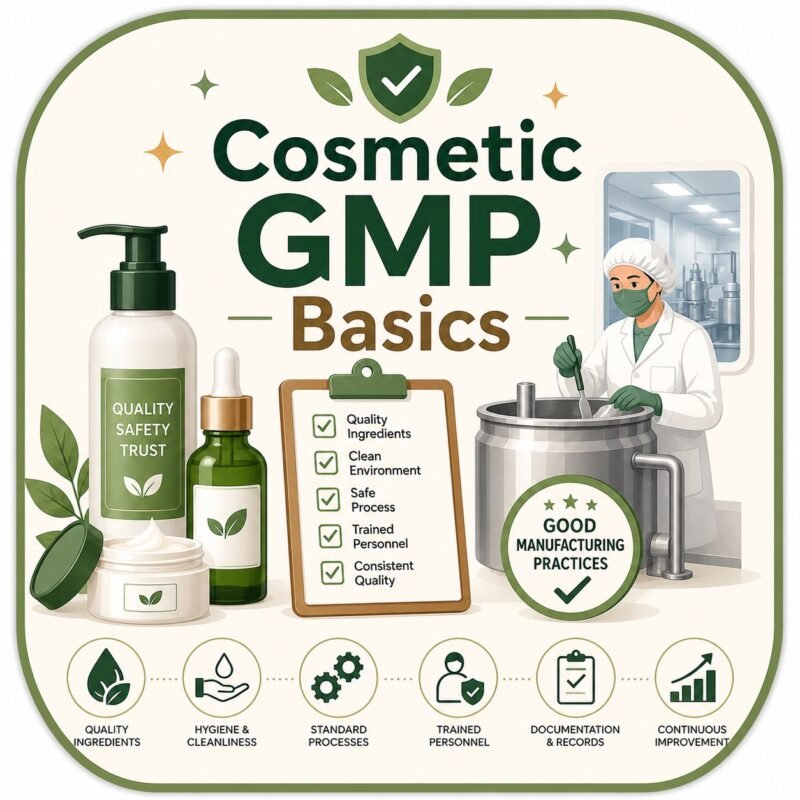
Cosmetic GMP Basics
Jun
Cosmetic GMP Basics
Learn the basics of Good Manufacturing Practices for cosmetic production, handmade cosmetics, skincare, soap, hair-care products, bath products, oils, clays, herbal powders, and small cosmetic business manufacturing.
Quick Answer
Cosmetic GMP means making cosmetics in a clean, controlled, traceable, and repeatable way. A basic GMP system includes approved raw materials, clean production area, trained staff, sanitized equipment, written formulas, batch records, in-process checks, quality control, packaging inspection, retain samples, storage control, complaint records, and corrective action. GMP helps reduce contamination, mix-ups, unstable products, wrong labels, customer complaints, and unsafe products.
Table of Contents
- What is Cosmetic GMP?
- Why GMP is Important
- Core GMP Principles
- Premises and Production Area
- Personnel Hygiene and Training
- Raw Material Control
- Equipment and Cleaning
- Production and Batch Records
- Quality Control and Testing
- Packaging, Labeling and Storage
- GMP Documents You Should Keep
- Simple GMP Audit Checklist
- India Compliance Reminder
- Common GMP Mistakes
- FAQ
- Related Products
What is Cosmetic GMP?
GMP means Good Manufacturing Practices. In cosmetics, GMP is a system of working that helps ensure products are made consistently, hygienically, and according to written procedures. It is not only about a large factory. Even a small cosmetic business should follow basic GMP habits from the first day.
GMP covers the complete product journey: raw material purchase, material inspection, storage, weighing, mixing, filling, packaging, labeling, quality checking, record keeping, dispatch, customer complaints, and recall readiness.
For cosmetic raw materials, oils, clays, herbal powders, soap bases, fragrance oils, essential oils, jars, bottles, labels, molds, and DIY cosmetic supplies, visit Jindeal.com.
Why GMP is Important
Cosmetic products come in contact with skin, hair, lips, scalp, body, or bath water. Poor manufacturing habits can cause contamination, wrong ingredient use, wrong label, leakage, product separation, bad smell, unstable texture, customer complaints, and business risk.
Core GMP Principles
Every small cosmetic business can start with these simple GMP principles.
| GMP Principle | Meaning | Small Business Action |
|---|---|---|
| Write What You Do | Use written procedures and formulas | Create SOPs, formula sheets and checklists |
| Do What You Write | Follow the approved process every time | Use the same steps for every batch |
| Record What You Did | Keep proof of production and checks | Maintain batch manufacturing record |
| Check Before Release | Inspect product before selling | QC check appearance, smell, weight, label and packaging |
| Keep Things Clean | Control hygiene and contamination | Clean area, tools, containers and hands |
| Trace Every Batch | Know which raw material went into which product | Use batch number and lot tracking |
| Improve Problems | Investigate mistakes and prevent repeat issues | Keep complaint and correction records |
Premises and Production Area
Your production area should be clean, organized, well-lit, and easy to clean. It should protect raw materials and products from dust, pests, moisture, cross-contamination, and mix-ups.
| Area | What to Check | Good Practice |
|---|---|---|
| Production Table | Clean, smooth, washable surface | Clean before and after production |
| Floor and Walls | No dust, peeling paint, dampness or pests | Keep clean and dry |
| Lighting | Enough light for weighing and inspection | Avoid dark corners and shadows |
| Ventilation | No strong odor buildup or dust flow | Keep controlled airflow where possible |
| Water Source | Suitable water quality for cleaning and formulation | Use purified/distilled water where formula requires it |
| Storage Area | Separate raw materials, packaging and finished goods | Use labels and shelves |
| Pest Control | No insects, rodents or contamination signs | Keep doors closed and use pest control procedure |
| Waste Area | Waste separated from production | Remove waste after production |
Personnel Hygiene and Training
People can be a major source of contamination and mistakes. Even in small batch production, basic hygiene and training are important.
| Checklist Item | What to Follow | Why It Matters |
|---|---|---|
| Clean Hands | Wash hands before production and after breaks | Reduces contamination |
| Gloves | Use gloves where product contact risk exists | Protects product |
| Hair Control | Use hair cover or tied hair | Prevents hair contamination |
| Clean Clothing | Use clean apron or production coat | Reduces dust and contamination |
| No Illness Handling | Avoid production when sick, coughing or infected | Protects product and team |
| No Jewelry | Avoid rings, watches, loose accessories | Prevents contamination and accidents |
| Training | Train on formula, weighing, cleaning, labeling and safety | Reduces mistakes |
| Visitor Control | Limit visitors in production area | Reduces contamination and distraction |
Raw Material Control
Raw materials must be checked before use. Do not directly use a new material without inspection and documentation.
| Checklist Item | What to Check | Record Needed |
|---|---|---|
| Supplier Name | Trusted supplier and invoice | Supplier invoice |
| Material Name | Correct ingredient and grade | Raw material list |
| Cosmetic Grade | Suitable for cosmetic use | Specification / supplier confirmation |
| Batch / Lot Number | Supplier batch number | Lot tracking sheet |
| COA / MSDS | Certificate or safety document where available | Document file |
| Appearance | Color, smell, texture, leakage, contamination | Incoming inspection record |
| Expiry / Best Before | Use within suitable period | Inventory sheet |
| Status Label | Approved / quarantine / rejected | Material status tag |
| Storage Condition | Cool, dry, sealed, away from sunlight | Storage record |
Equipment and Cleaning
Equipment and tools should be suitable for the product, easy to clean, and dedicated to cosmetic production. Cleaning should be recorded.
| Equipment / Tool | GMP Check | Good Practice |
|---|---|---|
| Digital Scale | Accurate weighing | Check with known weight regularly |
| Beakers and Bowls | Clean, dry, suitable material | Separate for cosmetic use only |
| Spatulas | Clean and non-rusting | Wash, dry and store covered |
| Mixers | Clean blades and no residue | Clean immediately after use |
| Thermometer | Working and clean | Use for waxes, emulsions and heat-sensitive products |
| pH Meter / Strips | Suitable for formula checks | Calibrate pH meter if used |
| Filling Tools | No residue, leakage or contamination | Clean before filling |
| Storage Containers | Closed and labeled | Do not use unmarked containers |
- Clean tools before and after production.
- Dry tools fully before use.
- Do not use rusty or cracked equipment.
- Keep cleaning cloths, brushes, and sanitizing items separate.
- Record cleaning date, product made, and responsible person.
Production and Batch Records
A batch record is the heart of GMP. It proves what was made, when it was made, who made it, which ingredients were used, and whether the product passed checks.
| Batch Record Field | What to Write | Example |
|---|---|---|
| Batch Number | Unique product batch code | BB-0626-001 |
| Product Name | Exact product name | Rose Body Butter |
| Formula Version | Approved formula number | Formula V1.2 |
| Batch Size | Total quantity planned | 5 kg / 100 jars |
| Manufacturing Date | Date of making | 29 Jun 2026 |
| Raw Materials | Ingredient, lot number, quantity | Shea butter lot no., 2 kg |
| Weighing Record | Actual grams used | 500 g, 100 g, 5 g |
| Process Steps | Heating, mixing, cooling, filling | Mixed 10 min, filled at 45°C |
| In-Process Checks | Appearance, smell, pH, viscosity, weight | Smooth, pH 5.5 |
| Yield | Expected vs actual output | Expected 100 pcs, actual 96 pcs |
| QC Approval | Approved, rejected, or hold | Approved |
Quality Control and Testing
Quality control means checking the product before release. The type of testing depends on product category, formula risk, and commercial scale.
| QC Test | What to Check | Products Where Important |
|---|---|---|
| Appearance | Color, texture, separation, lumps, contamination | All products |
| Odor | Expected smell, no rancid or off odor | Oils, creams, soaps, scrubs |
| pH | pH within formula target | Lotions, shampoos, gels, cleansers |
| Viscosity | Thickness and flow | Lotions, shampoos, gels |
| Net Weight | Correct fill weight | All packed products |
| Leak Test | Cap, pump, dropper and seal | Oils, serums, lotions, shampoos |
| Stability | Color, smell, separation over time | All new formulas |
| Preservation Review | Preservative suitability for water-based products | Creams, lotions, gels, toners |
| Packaging Check | Label, cap, box, seal, print and damage | All finished products |
| Retain Sample | Keep sample from every batch | All commercial batches |
Packaging, Labeling and Storage
Packaging and labels are part of GMP because wrong packaging or wrong label can make a good formula unsafe, misleading, or unsellable.
| Checklist Item | What to Check | Good Practice |
|---|---|---|
| Correct Packaging | Right jar, bottle, pouch, tube or box | Use approved packaging for each product |
| Packaging Cleanliness | No dust, smell, damage or contamination | Inspect before filling |
| Label Match | Correct label for product and batch | Verify before sticking |
| Batch Number | Batch printed or sticker applied | Every unit should be traceable |
| Fill Weight | Correct weight or volume | Random weight checks during filling |
| Cap and Seal | Tight closure, no leakage | Leak test before dispatch |
| Storage Label | Storage condition visible where needed | Cool, dry place away from sunlight |
| Finished Goods Status | Approved, hold or rejected | Separate stock by status |
| FIFO / FEFO | First in first out or first expiry first out | Sell older stock first |
GMP Documents You Should Keep
Documents do not need to be complicated in the beginning, but they must be clear, updated, and easy to find.
| Document | Purpose | Suggested Format |
|---|---|---|
| Master Formula Sheet | Approved formula and process | Spreadsheet or printed formula file |
| Batch Manufacturing Record | Actual production details | One sheet per batch |
| Raw Material Register | Supplier, lot, expiry and approval status | Spreadsheet |
| Cleaning Record | Proof that tools and area were cleaned | Checklist |
| Equipment Log | Scale checks, mixer cleaning, tool maintenance | Logbook |
| QC Release Record | Final product approval | Checklist with signature |
| Packaging Record | Labels, caps, boxes, batch code check | Packing checklist |
| Retain Sample Register | Retained sample location and date | Spreadsheet |
| Complaint Record | Customer issue and corrective action | Complaint log |
| Supplier Documents | COA, MSDS/SDS, invoice, specification | Digital folder by supplier |
Simple GMP Audit Checklist
Use this checklist once a month to review your cosmetic production setup.
| Audit Point | Question | Status |
|---|---|---|
| Production Area | Is the area clean, dry, organized and pest-free? | Pass / Needs Action |
| Raw Materials | Are all raw materials labeled with supplier, lot and expiry? | Pass / Needs Action |
| Quarantine | Are unchecked/rejected materials separated? | Pass / Needs Action |
| Equipment | Are tools clean, dry and suitable for cosmetic use? | Pass / Needs Action |
| Scale | Is weighing scale clean and checked? | Pass / Needs Action |
| Formula | Are approved formulas written and version controlled? | Pass / Needs Action |
| Batch Records | Is every batch recorded properly? | Pass / Needs Action |
| QC Checks | Are finished products inspected before sale? | Pass / Needs Action |
| Labels | Are correct labels used with batch number and details? | Pass / Needs Action |
| Retain Samples | Is one sample kept from each batch? | Pass / Needs Action |
| Storage | Are finished goods stored batch-wise in good conditions? | Pass / Needs Action |
| Complaints | Are customer complaints recorded and investigated? | Pass / Needs Action |
India Compliance Reminder
In India, cosmetics are regulated under the Drugs and Cosmetics framework and the Cosmetics Rules, 2020. CDSCO publishes the Cosmetics Rules, 2020, and the official rules include a self-certificate of compliance with Good Manufacturing Practices for manufacture of cosmetics. Domestic cosmetic manufacturing requirements should be checked with the relevant state licensing authority or a qualified regulatory consultant before commercial production.
| Compliance Area | What to Review | Practical Action |
|---|---|---|
| Manufacturing Route | Own facility, loan licence, third-party manufacturer or white label | Check licensing and documentation route |
| GMP Compliance | Premises, equipment, hygiene, records and quality checks | Maintain GMP records and SOPs |
| Ingredient Standards | Restricted/prohibited ingredients and product standards | Use cosmetic-grade ingredients and supplier documents |
| Labeling | Product name, net quantity, batch, MFG, best before, ingredients and responsible details | Review labels before printing |
| Claims | Cosmetic claims only; no drug/medical claims | Review labels, website and ads |
| Quality Records | Batch records, raw material traceability and retain samples | Keep batch-wise files |
| GST / Business | Tax, invoices, business registration and sale channel rules | Check with accountant |
Common GMP Mistakes
1. No Written Formula
Do not make commercial products by memory. Write formula percentages and actual grams.
2. No Batch Number
Without batch numbers, complaint handling and stock tracking become difficult.
3. Using Unchecked Raw Materials
Every raw material should be inspected, labeled, and approved before use.
4. Poor Cleaning Records
Clean tools are important, but recorded cleaning is also important for GMP discipline.
5. Mixing Raw Material and Finished Goods
Keep raw materials, work-in-progress, rejected goods and finished products separate.
6. No pH or Preservation Review
Water-based products need suitable preservation and often pH control.
7. Wrong Label or Missing Batch Code
Wrong labels create serious customer and compliance problems.
8. No Retain Samples
Retain samples help investigate complaints and observe shelf life.
9. No Complaint Log
Customer complaints should be recorded, investigated, and used for improvement.
10. Making Medical Claims
Do not claim cosmetics cure acne, eczema, dandruff, hair fall, pigmentation, infection, or disease.
FAQ
1. What is cosmetic GMP?
Cosmetic GMP means Good Manufacturing Practices for making cosmetics in a clean, controlled, documented, and repeatable way.
2. Is GMP only for large factories?
No. Even small cosmetic brands should follow basic GMP habits such as hygiene, batch records, raw material control, and QC checks.
3. Why are batch records important?
Batch records help prove what was made, which ingredients were used, when it was made, and whether it passed quality checks.
4. What is a retain sample?
A retain sample is one sample kept from each batch for future reference, shelf observation, and complaint investigation.
5. What documents should a small cosmetic brand keep?
Keep formula sheets, batch records, raw material register, supplier documents, cleaning records, QC release records, packaging records, retain sample records, and complaint logs.
6. Do water-based cosmetics need extra GMP care?
Yes. Lotions, creams, gels, shampoos, body washes and toners need suitable preservation, pH checks, clean production and stronger quality control.
7. Can I use kitchen utensils for cosmetic production?
Use dedicated cosmetic tools and equipment. Do not mix food-use utensils and cosmetic production tools.
8. What is raw material quarantine?
Quarantine means holding new or unchecked raw material separately until it is inspected and approved for use.
9. What is QC release?
QC release means final approval after checking product appearance, smell, weight, packaging, label and product-specific tests.
10. What is an SOP?
An SOP is a Standard Operating Procedure. It is a written instruction for repeated tasks such as cleaning, weighing, mixing, filling, labeling and dispatch.
11. How often should production tools be cleaned?
Tools should be cleaned before and after production, and cleaning should be recorded.
12. Does GMP help shelf life?
Yes. Clean production, controlled raw materials, proper packaging, and storage records help improve product stability and shelf appearance.
13. Can cosmetics claim to cure skin or hair problems?
No. Avoid medical claims. Use cosmetic-safe wording such as cleansing, moisturizing feel, aromatic, premium, spa-style, handmade, herbal-inspired and gifting.
14. Who checks cosmetic manufacturing rules in India?
Cosmetic manufacturing requirements should be verified through official sources and relevant state licensing authority or a qualified regulatory consultant.
15. Where can I buy cosmetic raw materials?
You can buy cosmetic raw materials, oils, essential oils, fragrance oils, clays, herbal powders, soap bases, jars, bottles, molds, labels and packaging from Jindeal.com.
Final Words
Cosmetic GMP basics are simple but powerful: keep the production area clean, use approved raw materials, write formulas, record every batch, clean equipment, inspect finished products, keep retain samples, store properly, and handle complaints professionally. These habits help small cosmetic brands improve product quality and customer trust.
For cosmetic raw materials, oils, soap bases, clays, herbal powders, fragrance oils, essential oils, bottles, jars, molds, labels and packaging, visit Jindeal.com.
Build GMP-Friendly Cosmetic Production with Jindeal.com
Buy cosmetic-grade raw materials, soap bases, carrier oils, essential oils, fragrance oils, clays, herbal powders, jars, bottles, molds, labels and packaging materials from Jindeal.com.