
Uncategorized
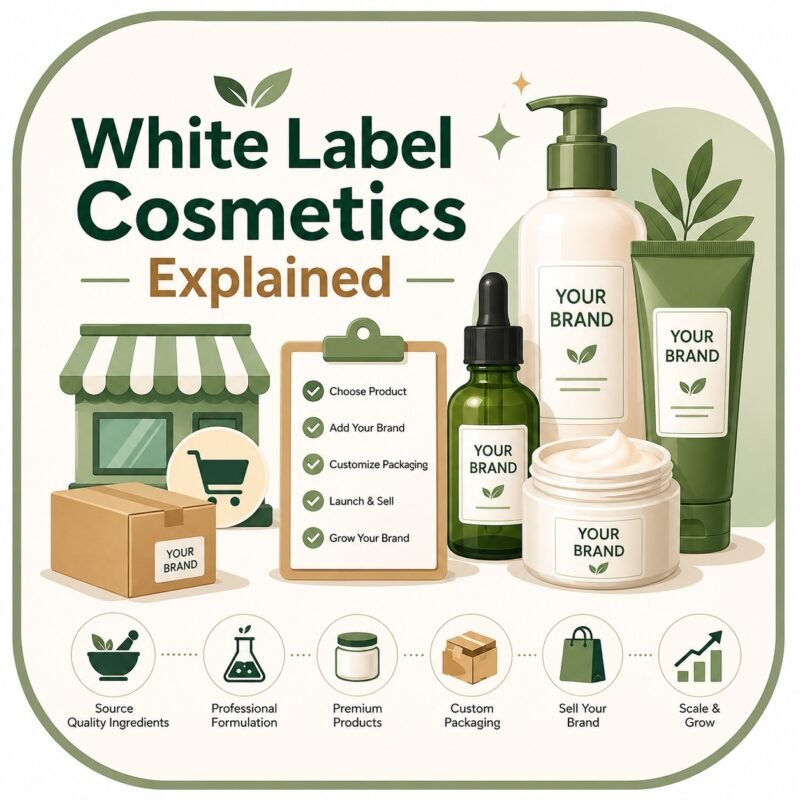
White Label Cosmetics Explained
Jun
White Label Cosmetics Explained
Learn what white label cosmetics means, how it works, how it differs from private label cosmetics, what documents to check, how to choose products, and how to launch a beauty brand without setting up your own manufacturing unit.
Quick Answer
White label cosmetics are ready-made cosmetic products manufactured by another company and sold under your brand name with your label and packaging. It is a faster way to launch a beauty brand because the formula is already developed. However, you must still check product quality, supplier documents, label compliance, batch details, claims, packaging, pricing, and applicable cosmetic regulations before selling.
Table of Contents
- What Are White Label Cosmetics?
- How White Label Cosmetics Work
- White Label vs Private Label vs Contract Manufacturing
- Best White Label Cosmetic Products
- Benefits of White Label Cosmetics
- Risks and Limitations
- Supplier Checklist
- Costing and Pricing
- Labeling and Claims
- India Compliance Reminder
- Launch Checklist
- Common Mistakes
- FAQ
- Related Products
What Are White Label Cosmetics?
White label cosmetics are ready cosmetic products made by a manufacturer and supplied to multiple brands. The buyer adds their own brand name, label, packaging style, and marketing. The core formula usually remains the same or has very limited customization.
This model is useful for small beauty brands, salons, influencers, ecommerce sellers, spa owners, gifting brands, and startups that want to launch quickly without investing in formula development, large equipment, production staff, or full manufacturing setup.
For cosmetic raw materials, oils, clays, herbal powders, soap bases, fragrance oils, bottles, jars, labels, molds, and DIY business supplies, visit Jindeal.com.
How White Label Cosmetics Work
| Step | What Happens | What You Should Check |
|---|---|---|
| 1. Choose Product | Select ready products from supplier catalogue | Formula type, ingredients, product claim, MOQ |
| 2. Request Samples | Supplier sends sample for testing | Texture, smell, packaging, shelf look, customer experience |
| 3. Check Documents | Supplier provides product and manufacturing documents | COA, MSDS/SDS, ingredient list, batch details, licence info where applicable |
| 4. Create Brand Label | Your logo and product label are designed | Claims, net quantity, batch, MFG, best before, manufacturer/marketer details |
| 5. Confirm Packaging | Choose jar, bottle, pouch, box, cap, label and outer packaging | Leakage, compatibility, label adhesion, shipping safety |
| 6. Place Order | Supplier manufactures or packs under your brand | MOQ, lead time, payment terms, rejection policy |
| 7. Quality Check | Finished goods are checked before dispatch | Fill weight, label, cap, batch, smell, texture, leakage |
| 8. Launch and Sell | You sell on website, marketplace, salon, retail, or social media | Product page, safe claims, price, reviews, return policy |
White Label vs Private Label vs Contract Manufacturing
These terms are often used together, but they are not exactly the same.
| Model | Meaning | Customization | Best For |
|---|---|---|---|
| White Label | Ready product sold under your brand | Low customization | Fast launch, small brands, testing market demand |
| Private Label | Product made for your brand with some customization | Medium customization | Brands wanting unique fragrance, packaging, or ingredient positioning |
| Contract Manufacturing | Manufacturer makes your own formula or custom product | High customization | Established brands, custom formulations, long-term product line |
| DIY Small Batch | You make products yourself in small batches | Full control but higher process responsibility | Testing ideas, handmade brand, workshops, small batch sales |
Best White Label Cosmetic Products
White label works best when the product is easy to explain, easy to package, and has stable customer demand.
Benefits of White Label Cosmetics
| Benefit | Why It Helps | Best Use Case |
|---|---|---|
| Fast Launch | Formula and production are already available | New brand launch |
| Lower Setup Cost | No need to buy full production equipment | Small cosmetic startup |
| Less Formula Work | Manufacturer already has base formulas | Beginner brand owners |
| Professional Production | Supplier may have established process and facility | Commercial selling |
| Brand Focus | You can focus on packaging, marketing, sales and customers | Ecommerce and influencer brands |
| Easy Product Testing | You can launch small range and see demand | Market validation |
| Scalability | Supplier can often produce repeat batches | Growing brands |
Risks and Limitations
White label cosmetics are easier to start, but they are not risk-free. You still own the customer experience and brand promise.
| Risk | Problem | How to Reduce Risk |
|---|---|---|
| Same Formula as Others | Other brands may sell similar product | Differentiate with packaging, fragrance, bundle, content and service |
| Low Formula Control | You may not be able to change texture or ingredients | Ask customization options before order |
| Supplier Dependence | Your stock depends on supplier quality and lead time | Keep reorder planning and backup supplier |
| Compliance Responsibility | Your label and claims must still be reviewed | Check documents and consult experts where needed |
| Quality Variation | Batch differences can affect customer trust | Approve samples, keep retain samples, inspect every batch |
| MOQ Pressure | High MOQ can block cash flow | Start with low MOQ products and limited range |
| Weak Claims Control | Overclaims may create regulatory and customer issues | Use cosmetic-safe wording only |
White Label Supplier Checklist
Before placing an order, ask the supplier clear questions and collect documents. A professional supplier should be able to explain product formula type, batch process, ingredient list, packaging, MOQ, lead time and documentation.
| Checklist Item | What to Ask | Why Important |
|---|---|---|
| Manufacturer Details | Who manufactures the product? | Traceability and compliance |
| Licence / Facility Info | Manufacturing licence or approved facility details where applicable | Commercial selling confidence |
| Ingredient List | Full ingredient list and formula type | Label and safety review |
| COA / MSDS | Available documents for product or key ingredients | Quality and documentation |
| Batch Number | Batch coding system and manufacturing date | Complaint and recall tracking |
| MOQ | Minimum order quantity per product | Cash flow planning |
| Lead Time | Production and packing timeline | Stock planning |
| Packaging Options | Jar, bottle, pouch, box, label type | Brand look and product safety |
| Customization | Can fragrance, color, label, packaging or formula be changed? | Differentiation |
| Testing | Stability, pH, microbial, shelf-life or internal QC checks | Quality confidence |
| Rejection Policy | What happens if goods are damaged or wrong? | Business protection |
| Repeat Batch Consistency | Can the same product be repeated? | Customer repeat order trust |
Costing and Pricing
White label pricing should include more than supplier product cost. Add label, packaging, design, photography, website, samples, marketing, shipping material, returns, marketplace fee, payment gateway, and profit margin.
| Cost Item | Example | Why Include It |
|---|---|---|
| Supplier Product Cost | Finished cream, soap, oil, serum, powder | Main cost |
| Label Cost | Product label, batch sticker, MRP sticker | Branding and compliance |
| Packaging Upgrade | Box, ribbon, pouch, tamper seal, outer carton | Premium look and shipping protection |
| Design and Photography | Logo, label design, product photos | Online conversion |
| Testing and Samples | Approval samples and retain samples | Quality control |
| Selling Cost | Ads, marketplace fee, payment gateway, website | Real online business cost |
| Wastage and Returns | Damaged goods, rejected pieces, customer returns | Protects margin |
| Profit Margin | Business growth and reinvestment | Long-term sustainability |
Labeling and Claims
Your label and marketing claims must match the product. Do not copy claims from random sellers. Avoid medical, treatment, or disease-related claims unless the product is legally supported for that claim.
| Label / Claim Area | Safe Planning | Avoid |
|---|---|---|
| Product Name | Rose Body Butter, Clay Mask Powder, Hair Oil | Medicine-style names |
| Benefits | Moisturizing feel, cleansing, aromatic, spa-style, handmade, premium | Cures acne, eczema, dandruff, hair fall, pigmentation |
| Ingredient Claims | With aloe vera, with kaolin clay, with almond oil | Guaranteed results or treatment promises |
| Usage Direction | Apply small amount, rinse off, mix with water, store dry | Unclear or unsafe usage |
| Batch Details | Batch number, MFG, best before | No traceability |
| Manufacturer/Marketer | Correct business details as applicable | Missing responsible party details |
India Compliance Reminder
In India, cosmetics are regulated under the Drugs and Cosmetics framework and the Cosmetics Rules, 2020. CDSCO states that cosmetics imported or manufactured must comply with prescribed specifications under the Cosmetics Rules, 2020. CDSCO also publishes FAQs that note CDSCO does not grant licences to manufacture cosmetics in India; domestic manufacturing licensing is handled through the relevant state authority route.
| Compliance Area | What to Review | Practical Action |
|---|---|---|
| Manufacturer Status | Who is manufacturing and under what authorization? | Ask supplier for manufacturing details and documents |
| Product Category | Cosmetic vs drug/medicine claim | Avoid treatment claims |
| Ingredient List | Full and correct ingredient declaration | Review before label printing |
| Labeling | Net quantity, batch, MFG, best before, manufacturer/marketer details | Check with qualified consultant where needed |
| Imported Products | Registration and import requirements where applicable | Check CDSCO import process |
| Claims | Cosmetic-safe and non-misleading claims | Review website, ads, labels and social content |
| Quality Records | COA, MSDS/SDS, batch records, retain samples | Keep documents for every order |
| GST / Business | Invoice, tax, trade name, business registration | Review with accountant |
White Label Cosmetics Launch Checklist
| Step | Checklist | Status |
|---|---|---|
| 1 | Choose product category and target customer | Pending / Done |
| 2 | Shortlist white label suppliers | Pending / Done |
| 3 | Request samples and test product experience | Pending / Done |
| 4 | Collect ingredient list, COA/MSDS where available, batch and supplier details | Pending / Done |
| 5 | Check packaging compatibility, leakage and label surface | Pending / Done |
| 6 | Create brand name, logo and label design | Pending / Done |
| 7 | Review cosmetic claims and label compliance | Pending / Done |
| 8 | Calculate total cost, MRP, wholesale price and profit margin | Pending / Done |
| 9 | Place small launch order first | Pending / Done |
| 10 | Inspect finished goods before dispatch | Pending / Done |
| 11 | Take product photos and create product pages | Pending / Done |
| 12 | Launch website, Instagram, WhatsApp catalog or marketplace listing | Pending / Done |
| 13 | Collect customer feedback and reviews | Pending / Done |
| 14 | Reorder best sellers and discontinue weak products | Pending / Done |
Common Mistakes
1. Choosing Supplier Only by Lowest Price
Low price can mean poor formula, weak packaging, missing documents or inconsistent batches. Check quality first.
2. Not Testing Samples
Always test texture, smell, packaging, leakage, label fit, shelf look and customer experience before ordering.
3. Copying Claims From Competitors
Competitor claims may be unsafe or non-compliant. Use your own cosmetic-safe wording.
4. No Batch Details
Without batch number, manufacturing date and supplier records, complaint handling becomes difficult.
5. Too Many Products at Launch
Start with 5 to 10 products. Too many SKUs increase stock risk and cash blockage.
6. Weak Packaging
Packaging must survive storage, shipping and customer handling. Test jars, bottles, labels and boxes.
7. No Price Calculation
Include supplier cost, label, packaging, ads, shipping, returns, commission and profit before fixing MRP.
8. Ignoring Compliance
White label still needs correct labeling, claims, product documentation and regulatory review.
9. No Differentiation
Since formula may be similar to others, build value through packaging, bundles, education, service and brand story.
10. No Quality Inspection
Inspect every batch before selling. Check leaks, fill weight, labels, smell, texture, color and packaging damage.
FAQ
1. What are white label cosmetics?
White label cosmetics are ready-made cosmetic products manufactured by another company and sold under your brand name with your label and packaging.
2. Is white label cosmetics good for beginners?
Yes. It can be a faster and lower-investment way to test a beauty brand, but quality, documents, labeling and compliance must be checked.
3. What is the difference between white label and private label?
White label usually has low customization and a ready formula. Private label may allow more customization in fragrance, packaging, ingredients or formula positioning.
4. What products are best for white label?
Soaps, body butter, hair oil, clay mask powder, body scrub, lip balm, face serum and gift sets are common white label options.
5. Do I need to test white label products?
Yes. Test samples for texture, smell, packaging, leakage, shelf appearance and customer-use experience before ordering.
6. What documents should I ask from supplier?
Ask for manufacturer details, ingredient list, batch number, COA/MSDS where available, licence/facility details where applicable, and quality documents.
7. Can I change the formula in white label cosmetics?
Usually customization is limited. If you need major formula changes, private label or contract manufacturing may be better.
8. Can I sell white label cosmetics online?
Yes, after checking product quality, label requirements, claims, business setup, GST, packaging and applicable cosmetic compliance.
9. Who is responsible for product claims?
Your brand is responsible for claims used on labels, website, ads and social media. Keep claims cosmetic-safe and non-misleading.
10. Can white label products claim to cure acne or hair fall?
No. Avoid medical claims. Use cosmetic-safe language like cleansing, moisturizing feel, aromatic, spa-style, premium, herbal-inspired and gifting.
11. How do I price white label cosmetics?
Add supplier cost, label, packaging, design, photography, shipping material, ads, platform fee, returns and profit margin.
12. How many products should I launch first?
Start with 5 to 10 products and expand after customer feedback and sales data.
13. Can I use my own label?
Yes, but the label should include correct product, ingredient, batch, manufacturing, net quantity, best-before, responsible business and claim details as applicable.
14. Is white label better than making cosmetics myself?
White label is faster and easier to scale, while making yourself gives more control but requires more formulation, production, testing and compliance responsibility.
15. Where can I buy cosmetic raw materials and packaging?
You can buy cosmetic raw materials, oils, clays, herbal powders, soap bases, fragrance oils, jars, bottles, molds, labels and packaging from Jindeal.com.
Final Words
White label cosmetics are a practical way to launch a beauty brand faster without setting up your own manufacturing unit. The key is to choose the right supplier, test samples, verify documents, design compliant labels, use safe claims, calculate pricing properly and launch a focused product range.
For cosmetic raw materials, oils, soap bases, clays, herbal powders, fragrance oils, essential oils, bottles, jars, molds and packaging, visit Jindeal.com.
Build Your Beauty Brand with Jindeal.com
Buy cosmetic-grade raw materials, soap bases, carrier oils, essential oils, fragrance oils, clays, herbal powders, jars, bottles, molds, labels and packaging materials from Jindeal.com.