
Uncategorized
Essential Oil Blending Guide
Jun
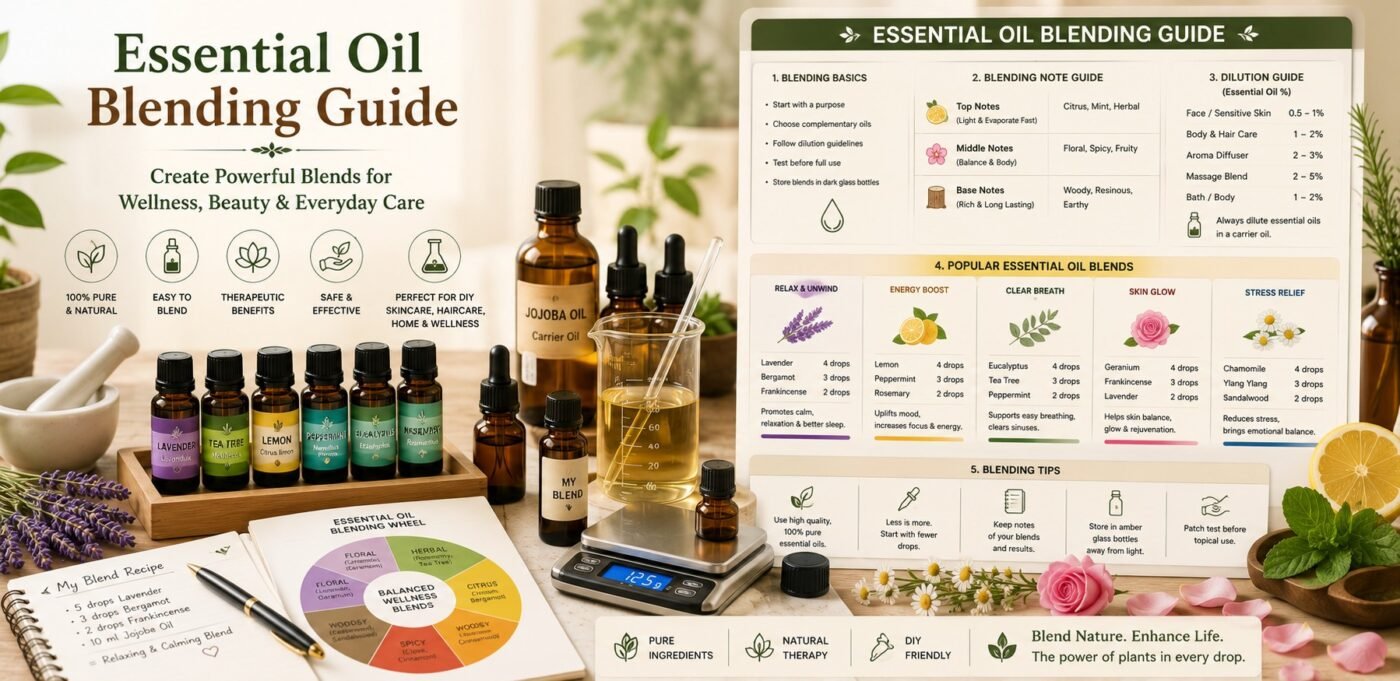
Essential Oil Blending Guide
Learn how to blend essential oils for soaps, candles, diffusers, massage oils, bath products, hair-care themed products, and DIY cosmetic formulations using top, middle, and base notes.
Quick Answer
An essential oil blend is usually made by combining top notes, middle notes, and base notes. A beginner-friendly aroma blend ratio is 30% top note, 50% middle note, and 20% base note. For skin-contact products, essential oils must be diluted safely in carrier oil, soap base, lotion base, or other suitable product base. Never apply undiluted essential oils directly to skin.
Table of Contents
Essential Oil Blending Basics
Essential oil blending is the process of combining two or more essential oils to create a balanced aroma. A good blend has a pleasant first impression, a stable body, and a smooth finishing note.
Essential oil blends can be used in soaps, candles, diffuser blends, massage oils, bath salts, body oils, scrubs, balms, and hair-care themed products. The same blend may not perform the same in every product, so testing is important.
For essential oils, carrier oils, fragrance oils, soap bases, candle wax, diffuser base, cosmetic jars, bottles, and DIY raw materials, visit Jindeal.com.
Top, Middle and Base Notes
Essential oil notes describe how fast an aroma appears and fades. A balanced blend usually contains all three note types.
| Note Type | Aroma Role | Common Essential Oils | Blend Behavior |
|---|---|---|---|
| Top Notes | Fresh first smell | Lemon, orange, peppermint, eucalyptus, lemongrass | Strong at first but fades faster |
| Middle Notes | Main body of the blend | Lavender, rosemary, geranium, tea tree, palmarosa | Balances the blend and gives character |
| Base Notes | Deep long-lasting finish | Cedarwood, patchouli, sandalwood, vetiver, myrrh | Helps anchor the blend and last longer |
Beginner Blending Ratios
Start with small test blends. Use drops only for aroma testing, then convert to grams for production.
| Blend Style | Top Note | Middle Note | Base Note | Best For |
|---|---|---|---|---|
| Balanced Blend | 30% | 50% | 20% | Soap, body oil, diffuser, candle testing |
| Fresh Blend | 50% | 40% | 10% | Room fresh, bath products, summer soaps |
| Floral Blend | 20% | 60% | 20% | Luxury soap, body oil, diffuser |
| Woody Blend | 15% | 35% | 50% | Men’s products, candles, premium oils |
| Herbal Blend | 25% | 60% | 15% | Hair-care themed products, soaps, massage oils |
10-Drop Test Blend Example
For a balanced 10-drop aroma test: 3 drops top note + 5 drops middle note + 2 drops base note.
100 g Production Blend Example
For a balanced 100 g essential oil blend: 30 g top note + 50 g middle note + 20 g base note.
Aroma Families
Aroma families help you choose oils that blend well together.
Best for fresh, bright, uplifting aroma themes.
Best for beauty, luxury, soap, and body oil themes.
Best for hair-care themed, spa, and cleansing-style products.
Best for fresh soap, foot products, and cooling aroma themes.
Best for men’s products, candles, and premium blends.
Best for deep, grounding, long-lasting aroma profiles.
Best for festive products, but use very carefully at low levels.
Best for luxury, incense, spa, and premium candle themes.
Beginner Blend Ideas
These are aroma ideas for testing. Always check safe usage level for your final product type.
| Blend Name | Essential Oil Ratio | Aroma Style | Best Product Ideas |
|---|---|---|---|
| Fresh Spa Blend | 40% eucalyptus + 40% lavender + 20% cedarwood | Fresh, herbal, spa | Soap, candle, diffuser, bath salts |
| Lavender Woods Blend | 60% lavender + 30% cedarwood + 10% orange | Soft floral woody | Body oil, soap, candle, diffuser |
| Rosemary Mint Blend | 50% rosemary + 30% peppermint + 20% cedarwood | Fresh herbal mint | Hair-care themed oil, shampoo bar, soap |
| Citrus Morning Blend | 60% sweet orange + 25% lemon + 15% lavender | Bright citrus floral | Soap, diffuser, bath products |
| Tea Tree Herbal Blend | 50% tea tree + 30% lavender + 20% eucalyptus | Clean herbal | Soap, foot soak, scalp-care themed products |
| Deep Woody Blend | 50% cedarwood + 30% patchouli + 20% orange | Woody earthy citrus | Men’s soap, candles, diffuser products |
| Floral Herbal Blend | 50% lavender + 30% palmarosa + 20% rosemary | Floral herbal | Soap, body oil, cream fragrance concept |
| Festive Warm Blend | 60% orange + 25% cedarwood + 15% cinnamon-style oil | Warm festive | Candle, diffuser, festive soap; use spice oils carefully |
Using Essential Oil Blends in Products
The same essential oil blend needs different usage percentages depending on product type.
| Product Type | Beginner Usage Range | Example for 1 kg Product | Important Note |
|---|---|---|---|
| Melt and Pour Soap | 0.5% to 2% | 5 g to 20 g essential oil blend | Check soap-safe usage and fragrance retention |
| Body Oil / Massage Oil | 0.5% to 2% | 5 g to 20 g blend in carrier oil | Patch test; avoid sensitive areas |
| Face Oil | 0.1% to 0.5% | 1 g to 5 g blend in 1 kg oil | Face products need extra caution |
| Body Butter / Balm | 0.5% to 1.5% | 5 g to 15 g blend | Use skin-safe levels only |
| Bath Salts | 0.5% to 2% | 5 g to 20 g blend | Disperse properly; avoid oil floating |
| Candles | 3% to 6% | 30 g to 60 g blend in 1 kg fill | Hot throw may be softer than fragrance oils |
| Diffuser Blend | Depends on diffuser base | Follow base recommendation | Not for skin use unless formulated separately |
Safe Dilution Guide
Essential oils should not be applied directly to skin. They must be diluted in a suitable carrier or product base.
| Dilution Level | Essential Oil in 100 g Product | Best Use | Beginner Note |
|---|---|---|---|
| 0.25% | 0.25 g | Very cautious face product testing | Many face products are better fragrance-free |
| 0.5% | 0.5 g | Face oil, sensitive-style product themes | Patch test carefully |
| 1% | 1 g | Body oils, body butter, balms | Good beginner body-care level |
| 2% | 2 g | Rinse-off products, soaps, massage oils for adults | Check oil-specific safety |
| 3%+ | 3 g or more | Special cases only | Not beginner-friendly for leave-on skin products |
Testing and Batch Records
Essential oil blends can change over time. Some oils fade quickly, some dominate the blend, and some change in soap, candle wax, or carrier oils. Test before bulk production.
| Test Area | What to Check | When to Check | Why Important |
|---|---|---|---|
| Aroma Balance | Does one oil dominate? | After blending, 24 hours, 7 days | Blend may mature over time |
| Soap Performance | Scent retention, sweating, discoloration | 7, 15, and 30 days | Soap can change aroma and color |
| Candle Performance | Cold throw, hot throw, wick performance | After cure and burn test | Essential oil throw can be softer |
| Skin Feel | Comfort, aroma strength, patch test | Before regular use | Skin-contact products need caution |
| Stability | Color, smell, separation, oxidation | Ongoing storage checks | Helps shelf-life planning |
Common Mistakes
1. Applying Essential Oil Directly to Skin
Essential oils are concentrated and should be diluted in carrier oil or a suitable product base.
2. Using Too Much Essential Oil
More essential oil does not mean better product. High levels can irritate skin, overpower aroma, or affect product stability.
3. Not Understanding Notes
A blend with only top notes may smell strong at first but fade quickly. Add middle and base notes for better balance.
4. Measuring by Drops for Production
Drops are fine for aroma testing but not for business production. Use grams for accurate formulas.
5. Using Strong Oils Carelessly
Spice oils, mint oils, and some herbal oils can be strong and need extra caution.
6. Using Essential Oil in Lip Products Without Suitability
Do not use essential oils in lip products unless the oil is suitable for lip-use and used at safe levels.
7. Expecting Strong Candle Throw from Every Essential Oil
Essential oils may not throw as strongly as candle fragrance oils in wax.
8. Not Testing Soap Discoloration
Some essential oils can affect soap smell, color, or stability.
9. Not Checking Product Type Safety
Usage levels are different for face products, body oils, soap, candles, bath products, and diffusers.
10. Making Medical Claims
Do not claim essential oils cure stress, insomnia, headache, acne, dandruff, hair fall, infection, or any disease.
FAQ
1. What is essential oil blending?
Essential oil blending is combining two or more essential oils to create a balanced aroma for soap, candles, diffusers, oils, bath products, and cosmetics.
2. What are top, middle, and base notes?
Top notes smell first and fade fast, middle notes form the body of the blend, and base notes add depth and long-lasting aroma.
3. What is a good beginner blending ratio?
A beginner ratio is 30% top note, 50% middle note, and 20% base note.
4. Can I apply essential oils directly to skin?
No. Essential oils should be diluted in carrier oil or a suitable cosmetic base before skin use.
5. How much essential oil should I use in soap?
For melt and pour soap, a beginner range is usually 0.5% to 2%, but always check supplier safe usage limits.
6. How much essential oil should I use in body oil?
For adult body oil, many beginners start around 1%, but the safe level depends on the exact essential oil and product use.
7. Can I use essential oils in candles?
Yes, but essential oils may have softer hot throw than candle fragrance oils. Burn testing is required.
8. Can I mix essential oil and fragrance oil?
Yes, if both are suitable for the product type and the total usage level stays within safe limits.
9. Which essential oils blend well with lavender?
Lavender blends well with cedarwood, rosemary, orange, eucalyptus, peppermint, tea tree, and geranium-style oils.
10. Which essential oils blend well with rosemary?
Rosemary blends well with peppermint, lavender, cedarwood, tea tree, eucalyptus, and lemon-style oils.
11. Which essential oils are good for hair-care themed products?
Rosemary, tea tree, lavender, peppermint, cedarwood, and eucalyptus are popular hair-care aroma choices, but avoid hair growth or dandruff cure claims.
12. Can essential oils cure anxiety or insomnia?
No. Do not make medical claims. Essential oils can be described for aroma, spa, ambience, relaxation-style mood, or personal care fragrance.
13. Should face products use essential oils?
Face products need extra caution. Many face products are better fragrance-free or use very low levels after proper safety review.
14. How do I make my blend last longer?
Add a suitable base note like cedarwood, patchouli, sandalwood-style, vetiver, or myrrh to anchor the aroma.
15. Where can I buy essential oils?
You can buy essential oils, carrier oils, fragrance oils, soap bases, candle wax, diffuser base, bottles, jars, and packaging from Jindeal.com.
Final Words
Essential oil blending becomes easier when you understand top, middle, and base notes. Start with simple ratios, test small blends, dilute safely, and record every formula. A balanced blend should smell pleasant at first, stay smooth in the middle, and finish with a long-lasting base note.
Use essential oils safely, follow supplier guidance, test in the final product, and avoid medical claims. For essential oils, carrier oils, soap bases, candle wax, diffuser base, bottles, jars, and packaging, visit Jindeal.com.
Shop Essential Oils on Jindeal.com
Buy essential oils, carrier oils, fragrance oils, soap bases, candle wax, diffuser base, bottles, jars, molds, and DIY cosmetic raw materials from Jindeal.com.
