
Essential Oils, Uncategorized
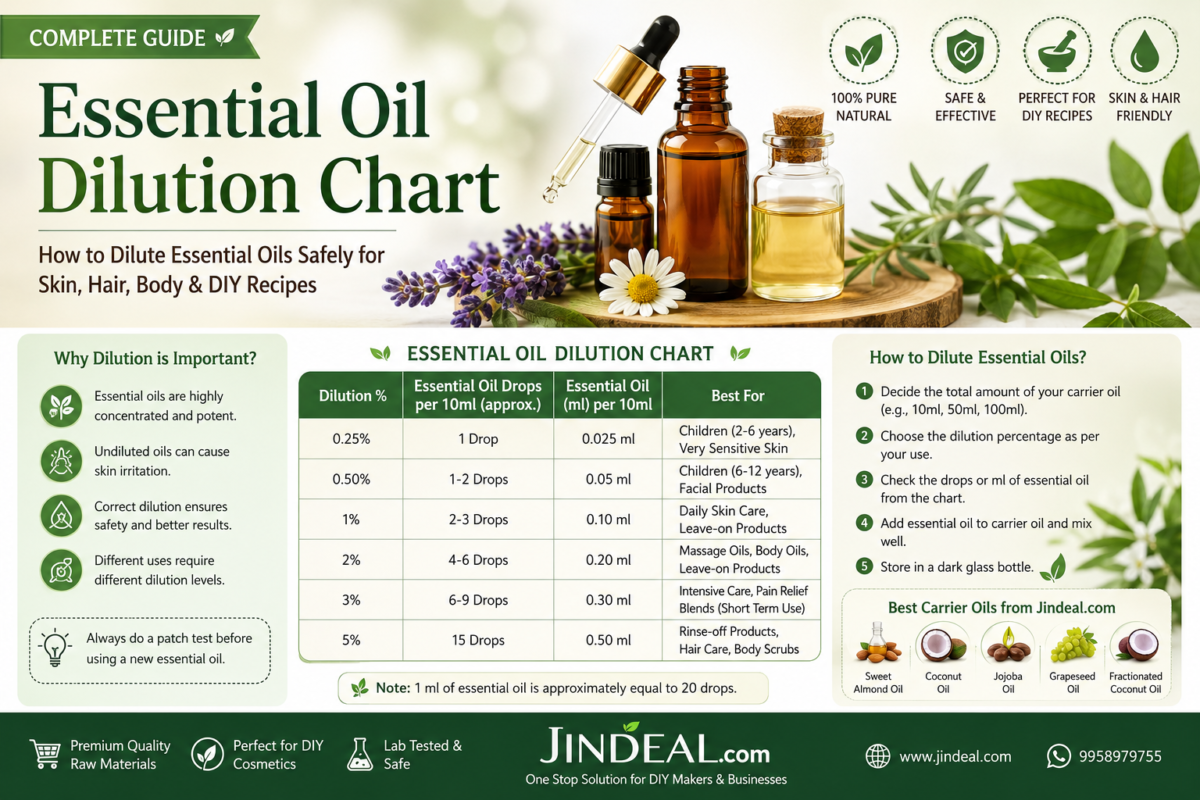
Essential Oil Dilution Chart
Jun
Essential Oil Dilution Chart: How to Dilute Essential Oils Safely
Learn the correct essential oil dilution ratio for skincare, massage oil, body oil, hair oil, roll-ons, balms, creams, lotions, and DIY cosmetics.
Quick Answer
An Essential Oil Dilution Chart helps you mix essential oils safely with carrier oils, creams, lotions, or cosmetic bases. Most leave-on skin products use 0.5% to 2% dilution, while rinse-off products may use slightly higher levels. Correct dilution reduces irritation, improves safety, and gives better results in DIY formulations.
Table of Contents
What Is an Essential Oil Dilution Chart?
An Essential Oil Dilution Chart is a simple guide that shows how much essential oil should be mixed with a carrier oil or cosmetic base. Essential oils are highly concentrated plant extracts, so they should not be used directly on skin without proper dilution.
This chart is useful for making massage oils, body oils, face oils, hair oils, roll-on perfumes, beard oils, creams, lotions, balms, salves, soaps, bath oils, and other DIY cosmetic products.
Correct dilution helps make the product safer, more skin-friendly, and more professional. It also helps avoid common problems like burning sensation, redness, itching, strong smell, skin sensitivity, or allergic reactions.
For essential oils, carrier oils, cosmetic raw materials, soap bases, candle-making supplies, fragrance oils, clays, herbal powders, and DIY ingredients, you can visit Jindeal.com.
What Causes the Problem?
Most essential oil problems happen when the oil is used too strongly or without proper measurement. Many beginners add essential oils by guessing drops instead of calculating the percentage.
Common causes include:
- Using essential oil directly on the skin
- Adding too many drops without measuring
- Using strong oils like cinnamon, clove, peppermint, lemongrass, or tea tree at high levels
- Using essential oils on the face at body-care percentage
- Not checking IFRA or supplier usage guidelines
- Using essential oils in baby products without expert guidance
- Using photosensitive citrus oils before sun exposure
- Not doing a patch test
- Assuming all essential oils have the same safe usage level
- Using poor-quality or adulterated essential oils
For example, 10 drops of essential oil in 10 ml carrier oil can be too strong for many skin applications. A proper dilution chart helps you select the right percentage depending on the product type and skin area.
Essential Oil Dilution Chart
Use this chart as a general starting point. Final usage should always follow the essential oil supplier recommendation, IFRA guideline, product type, age group, and skin sensitivity.
| Dilution % | Approx. Drops in 10 ml Carrier Oil | Best For | Use Level |
|---|---|---|---|
| 0.25% | Approx. 1 drop | Very sensitive skin, delicate products | Very low |
| 0.5% | Approx. 1 drop | Face oils, sensitive skin, leave-on products | Low |
| 1% | Approx. 2 drops | Face serum, beard oil, daily body oil | Mild |
| 2% | Approx. 4 drops | Body oil, massage oil, general skincare | Standard |
| 3% | Approx. 6 drops | Short-use body products, stronger aroma blends | Strong |
| 5% | Approx. 10 drops | Rinse-off or special-use products only | High |
Step-by-Step Solution
Step 1: Decide the Product Type
First, decide where the product will be used. Face products need lower dilution than body products. Rinse-off products may allow a different usage level compared to leave-on products.
General guide:
- Face oil: 0.5% to 1%
- Body oil: 1% to 2%
- Massage oil: 1% to 3%
- Hair oil: 0.5% to 2%
- Roll-on perfume: 1% to 5%, depending on oil and IFRA limit
- Rinse-off product: follow supplier and IFRA guideline
Step 2: Choose the Right Carrier Oil
Essential oils should be diluted in a suitable carrier oil or cosmetic base. Popular carrier oils include sweet almond oil, coconut oil, jojoba oil, olive oil, castor oil, grapeseed oil, argan oil, and sunflower oil.
Carrier oil choice depends on skin type, product feel, absorption, and final use.
Step 3: Select the Dilution Percentage
Select the dilution percentage according to your formula. For most beginners, 1% is a good starting point for face products and 2% is commonly used for body products.
Example:
For 100g body oil at 2% dilution:
100g × 2 ÷ 100 = 2g essential oil
Step 4: Calculate Drops for Small Batches
For small DIY batches, drops can be used as an approximate method. A common estimate is 20 drops = 1 ml, but this is not exact.
Example for 10 ml carrier oil:
- 0.5% dilution = approx. 1 drop
- 1% dilution = approx. 2 drops
- 2% dilution = approx. 4 drops
- 3% dilution = approx. 6 drops
Step 5: Mix Properly
Add carrier oil first, then add essential oil. Mix slowly and thoroughly. For creams, lotions, or balms, add essential oil during the cool-down phase if the formula allows it.
Step 6: Do a Patch Test
Apply a small amount on the inner arm and wait 24 hours. If redness, itching, burning, or irritation occurs, do not use the product.
Step 7: Label Your Formula
Write the essential oil name, carrier oil name, dilution percentage, batch date, and usage instructions. This is very helpful for repeat batches and customer safety.
Common Mistakes
1. Applying Essential Oil Directly on Skin
Essential oils are concentrated and may cause irritation if used undiluted. Always dilute before skin use.
2. Using Too Many Drops
More drops do not mean better results. High concentration can make the product unsafe or uncomfortable.
3. Using the Same Dilution for Face and Body
Facial skin is more sensitive than body skin. Use lower dilution for face products.
4. Ignoring Strong Essential Oils
Oils like cinnamon, clove, oregano, thyme, peppermint, and lemongrass can be very strong. Use them carefully and at low levels.
5. Not Checking Photosensitivity
Some citrus oils may increase sun sensitivity. Avoid sun exposure after using photosensitive oils on skin.
6. Not Measuring by Weight
Drops are only approximate. For professional production, use a weighing scale for better accuracy.
7. Using Essential Oil in Baby Products Without Guidance
Baby and child products need special safety consideration. Do not use essential oils for babies without expert guidance.
8. Not Doing Patch Test
A patch test helps identify sensitivity before applying the product on a larger skin area.
9. Mixing Too Many Oils Together
Complex blends can increase the chance of irritation. Start with simple blends.
10. Buying Low-Quality Essential Oils
Poor-quality or adulterated oils can affect aroma, safety, and product performance.
Expert Tips
- Use 0.5% to 1% dilution for face products.
- Use 1% to 2% dilution for daily body oils.
- Use 2% to 3% dilution for massage oils, depending on skin type.
- Always check IFRA or supplier usage guideline before making products.
- Use a digital scale for professional batches.
- Start with a low dilution and increase only if required.
- Do not use strong oils at high percentages.
- Store essential oils in dark glass bottles away from heat and sunlight.
- Use cosmetic-grade carrier oils and clean packaging.
- Keep formula records for every batch.
- Use patch testing before regular skin application.
- Buy essential oils, carrier oils, bottles, jars, and cosmetic raw materials from Jindeal.com.
FAQ
1. What is an Essential Oil Dilution Chart?
An Essential Oil Dilution Chart helps you calculate how much essential oil to mix with carrier oil or cosmetic base for safe skin use.
2. Why should essential oils be diluted?
Essential oils are highly concentrated. Dilution helps reduce the risk of skin irritation, burning, redness, and sensitivity.
3. What is the best dilution for face oil?
For face oils, 0.5% to 1% dilution is commonly used, depending on the essential oil and skin sensitivity.
4. What is the best dilution for body oil?
For general body oil, 1% to 2% dilution is commonly used. Sensitive skin should start at a lower percentage.
5. How many drops of essential oil in 10 ml carrier oil?
For 10 ml carrier oil, use around 1 drop for 0.5%, 2 drops for 1%, 4 drops for 2%, and 6 drops for 3% dilution.
6. Can I apply essential oil directly on skin?
It is not recommended. Essential oils should usually be diluted with carrier oil or cosmetic base before applying to skin.
7. Which carrier oil is best for dilution?
Sweet almond oil, jojoba oil, coconut oil, olive oil, grapeseed oil, argan oil, and sunflower oil are popular carrier oils.
8. Can I use essential oil in hair oil?
Yes, essential oils can be used in hair oil at a safe dilution, generally around 0.5% to 2%, depending on the oil and scalp sensitivity.
9. Can I use essential oil in soap?
Yes, essential oils can be used in soap, but the percentage should follow supplier or IFRA recommendation for soap-making use.
10. Can I use essential oil in candle making?
Essential oils can be used in candles, but fragrance performance may vary. Many candle makers prefer fragrance oils for stronger scent throw.
11. What happens if I use too much essential oil?
Too much essential oil may cause skin irritation, strong smell, formula instability, sensitivity, or unsafe product performance.
12. Are all essential oils safe at the same percentage?
No. Every essential oil has a different strength and safe usage level. Always check the supplier guideline before use.
13. Can children use essential oil products?
Children need special safety consideration. Use very low dilution only when suitable, and avoid strong oils without expert advice.
14. What is the safest dilution for beginners?
For beginners, 1% dilution is a safe starting point for many body-care products, but sensitive skin may need 0.5% or lower.
15. Where can I buy essential oils and carrier oils?
You can buy essential oils, carrier oils, cosmetic raw materials, bottles, jars, soap bases, and DIY supplies from Jindeal.com.
Final Words
An Essential Oil Dilution Chart is very useful for making safe, balanced, and professional DIY cosmetic products. It helps you choose the right essential oil percentage for face oils, body oils, hair oils, massage oils, roll-ons, creams, lotions, and other formulations.
Always start with a low dilution, use a digital scale for accuracy, check supplier guidelines, and do a patch test before regular use. For essential oils, carrier oils, bottles, jars, soap bases, fragrance oils, and DIY cosmetic supplies, visit Jindeal.com.
All Your DIY Cosmetic Needs at Jindeal.com
Shop essential oils, carrier oils, cosmetic raw materials, soap bases, fragrance oils, jars, bottles, and DIY supplies from Jindeal.com.
