
Soap Base, Uncategorized
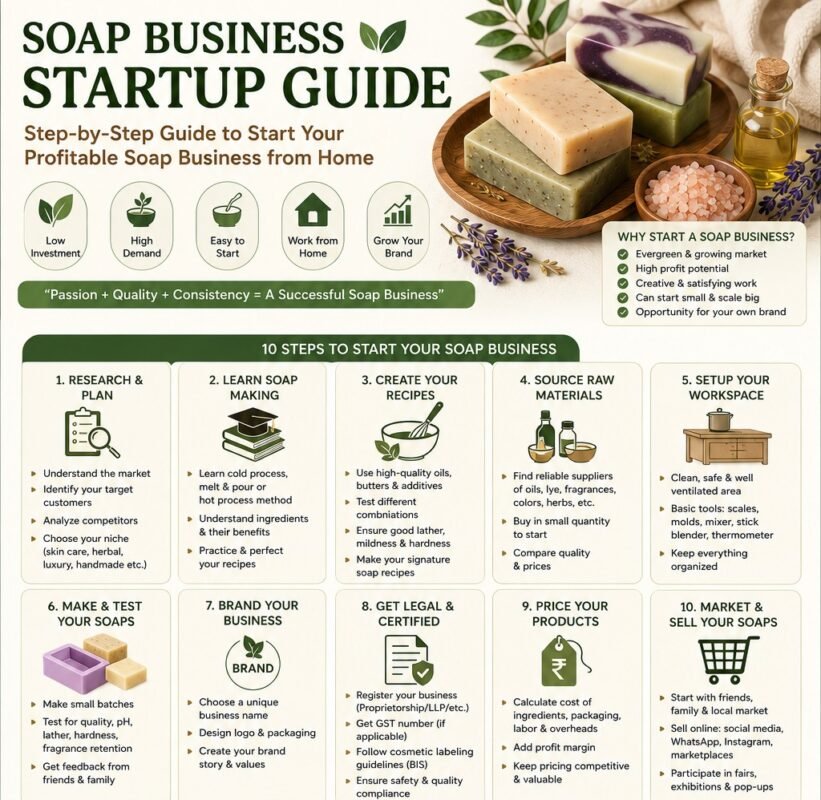
Soap Business Startup Guide
Jun
Soap Business Startup Guide
A practical step-by-step guide to start a handmade soap business in India using melt and pour soap base, fragrance oils, essential oils, colors, clays, herbal powders, silicone molds, packaging, pricing, branding, and ecommerce selling.
Quick Answer
To start a soap business, choose a focused soap category, source cosmetic-grade soap base and ingredients, test small batches, finalize fragrances and designs, calculate cost per bar, create compliant labels, use moisture-safe packaging, set up product photos and online selling, and launch with 5 to 10 well-tested soaps. Start with melt and pour soap if you want a beginner-friendly route, then expand after customer feedback.
Table of Contents
Choose Your Soap Business Model
A soap business can be started in different ways. For beginners, melt and pour soap is the easiest because the soap base is already made and you focus on melting, adding fragrance/color/additives, pouring, packaging and branding.
| Business Model | Difficulty | Best For | Important Note |
|---|---|---|---|
| Melt and Pour Soap | Easy | Beginners, DIY kits, gifting, quick launch | Test sweating, fragrance and packaging |
| Cold Process Soap | Advanced | Experienced makers and custom recipes | Needs lye safety, curing and deep formulation knowledge |
| White Label Soap | Easy to Medium | Fast brand launch without production | Check manufacturer documents and label compliance |
| Private Label Soap | Medium | Brands needing custom fragrance/design | Higher MOQ and supplier coordination |
| Soap DIY Kit Business | Easy | Workshops, kids craft, hobby customers | Include clear instructions and safety notes |
| Raw Material Resale | Medium | Supplying makers and small businesses | Requires inventory and product education content |
For soap base, fragrance oils, essential oils, colors, clays, herbal powders, silicone molds, soap boxes and packaging, visit Jindeal.com.
Best Soap Products to Start With
Do not launch too many designs on day one. Start with simple, repeatable, attractive soap variants that are easy to photograph and explain.
Raw Materials and Tools
Soap quality depends on ingredient quality, accurate measurement and clean production habits. Use cosmetic-grade materials and keep supplier records.
| Item | Examples | Use |
|---|---|---|
| Soap Base | Ultra clear, white, goat milk, shea butter, aloe vera | Main soap body |
| Fragrance Oil | Rose, coffee, sandalwood, musk, mogra, lavender-style fragrance | Aroma and product identity |
| Essential Oil | Lavender, tea tree, rosemary, peppermint, eucalyptus | Aroma blends after safety review |
| Colors | Mica, liquid soap color, cosmetic pigments | Soap design and visual appeal |
| Clays | Kaolin clay, Multani Mitti, French Green Clay, Rhassoul Clay | Spa-style soap themes |
| Herbal Powders | Rose powder, hibiscus, shikakai, red sandalwood, aloe powder | Herbal-inspired soap designs |
| Molds | Silicone soap molds, loaf molds, floral molds, bar molds | Shape and presentation |
| Tools | Digital scale, beakers, spatula, thermometer, alcohol spray | Accurate and clean production |
| Packaging | Shrink wrap, soap boxes, sleeves, labels, pouches | Protection and branding |
Basic Soap Formula Planning
Melt and pour soap does not require a lye calculation because the soap base is already made. You mainly calculate soap base, fragrance, color and additives.
| Ingredient | Beginner Range | For 1 kg Soap Batch | Notes |
|---|---|---|---|
| Soap Base | Balance of formula | Approx. 950 g to 990 g | Depends on fragrance/additives |
| Fragrance Oil | 1% to 3% | 10 g to 30 g | Check supplier and IFRA guidance |
| Mica / Color | 0.1% to 0.5% | 1 g to 5 g | Start low and test color |
| Clay | 0.5% to 2% | 5 g to 20 g | Too much can reduce lather |
| Herbal Powder | 0.5% to 2% | 5 g to 20 g | Use fine, dry cosmetic-grade powder |
| Extra Carrier Oil | 0.5% to 1% | 5 g to 10 g | Too much can soften soap |
Startup Cost and Pricing
A soap business can be started lean, but pricing must include all costs. Do not calculate only soap base and fragrance cost.
| Cost Head | Budget Start | Professional Start | Notes |
|---|---|---|---|
| Soap Base and Ingredients | ₹5,000 to ₹20,000 | ₹50,000+ | Depends on number of SKUs |
| Molds and Tools | ₹3,000 to ₹15,000 | ₹30,000+ | Scale, molds, beakers, thermometer |
| Packaging | ₹5,000 to ₹20,000 | ₹50,000+ | Soap boxes, labels, wrap, cartons |
| Branding and Photos | ₹2,000 to ₹15,000 | ₹50,000+ | Logo, label design, product photos |
| Website and Marketing | ₹5,000 to ₹25,000 | ₹1,00,000+ | Website, ads, samples, influencer kits |
| Compliance / Consulting | Variable | Variable | Depends on manufacturing and selling route |
Packaging and Labeling
Soap packaging should protect the bar from dust, moisture, fragrance loss and damage. Melt and pour soap especially needs protection from humidity and sweating.
| Packaging Type | Best For | Benefit | Watch Out |
|---|---|---|---|
| Shrink Wrap | Melt and pour soap | Moisture protection and clear display | Needs neat sealing |
| Soap Box | Premium soap, gifting | Professional retail look | Use inner wrap for glycerin soap |
| Soap Sleeve | Low-cost branding | Good label space | Does not cover full soap |
| Clear Pouch | Budget soap and samples | Easy to pack and display | Choose good-quality pouch |
| Gift Box | Combos and hampers | Higher perceived value | Add protective inserts |
A soap label should plan product name, net weight, ingredient list, batch number, manufacturing date, best-before/expiry planning, manufacturer/marketer details, usage directions, storage instructions, caution and customer care details.
India Compliance Reminder
In India, cosmetics are regulated under the Drugs and Cosmetics framework and the Cosmetics Rules, 2020. CDSCO lists the Cosmetics Rules, 2020 on its official website. CDSCO’s cosmetics FAQ states that cosmetic manufacturing licences in India are issued by the respective State Licensing Authorities. Before commercial soap manufacturing or selling, verify your exact product category, manufacturing route, label, claims, GST, business registration and local requirements with official sources and qualified advisors.
| Compliance Area | What to Review | Practical Action |
|---|---|---|
| Business Setup | Proprietorship, partnership, LLP or company | Discuss with accountant/CA |
| GST and Billing | GST registration, invoices, HSN/tax planning | Check with tax advisor |
| Manufacturing Route | Own production, third-party, white label or DIY kits | Check licence/compliance route |
| State Licensing | Cosmetic manufacturing licence where applicable | Contact relevant state authority/consultant |
| Labeling | Ingredients, batch, MFG, expiry, manufacturer/marketer details | Review before printing labels |
| Claims | Cosmetic-safe and non-medical claims only | Review labels, website, ads and social media |
| Batch Records | Formula, raw material lot, production date and QC | Maintain records for every batch |
| Quality Checks | Appearance, smell, sweating, hardness, packaging | Test before sale |
Marketing and Selling Plan
Soap is a visual and fragrance-led product. Good product photos, clear descriptions and strong packaging can improve trust and sales.
Soap Business Launch Checklist
| Step | Checklist | Status |
|---|---|---|
| 1 | Choose soap business model and target customer | Pending / Done |
| 2 | Finalize 5 to 10 launch soap designs | Pending / Done |
| 3 | Buy cosmetic-grade soap base, fragrance, colors and additives | Pending / Done |
| 4 | Make test batches and check sweating, scent and hardness | Pending / Done |
| 5 | Calculate cost per bar and MRP | Pending / Done |
| 6 | Choose packaging and test for humidity/moisture | Pending / Done |
| 7 | Create label with batch, MFG, ingredients and details | Pending / Done |
| 8 | Review compliance, GST, labeling and claim safety | Pending / Done |
| 9 | Take product photos and create website/WhatsApp catalog | Pending / Done |
| 10 | Prepare shipping boxes, inserts and damage policy | Pending / Done |
| 11 | Launch small batch and collect customer feedback | Pending / Done |
| 12 | Reorder best sellers and improve weak products | Pending / Done |
Common Mistakes
1. Launching Too Many Designs
Too many SKUs increase cost, confusion and stock risk. Start focused.
2. Using Excess Fragrance
Too much fragrance can make soap soft, oily, sweaty or unstable.
3. Poor Packaging
Melt and pour soap can sweat in humidity. Use moisture-safe packaging.
4. No Batch Records
Batch number and formula records help quality control and complaints.
5. Wrong Claims
Do not make medical claims for cosmetic soap.
6. Ignoring Wastage
Spillage, rejected bars and testing must be included in pricing.
7. No Product Photos
Soap needs high-quality photos for ecommerce sales.
8. Not Testing in Monsoon
Humidity can affect sweating and packaging.
9. No Customer Education
Add usage, storage and first-use tips on product pages.
10. Selling Before Compliance Review
Check label, manufacturing route and claims before commercial sale.
FAQ
1. How do I start a soap business?
Choose a soap model, source cosmetic-grade materials, test small batches, calculate cost, create labels and packaging, check compliance and launch with a focused range.
2. Is melt and pour soap good for beginners?
Yes. Melt and pour soap is beginner-friendly because the soap base is already made.
3. How much money is needed to start?
A small test setup may start with a modest budget, while professional launch cost depends on ingredients, packaging, branding, website, compliance and marketing.
4. How many soaps should I launch first?
Start with 5 to 10 well-tested soaps and expand after customer feedback.
5. How much fragrance oil should I add to soap?
For many melt and pour soaps, 1% to 3% is a common beginner range, but always check supplier guidance and test.
6. Why does my soap sweat?
Glycerin soap can attract moisture from humid air. Wrap quickly and use moisture-resistant packaging.
7. What packaging is best for melt and pour soap?
Shrink wrap, inner wrap plus box, clear pouches and moisture-barrier packaging work well.
8. Do I need a licence to sell soap in India?
Commercial cosmetic manufacturing requirements should be verified with the relevant State Licensing Authority or a qualified consultant.
9. Can handmade soap cure acne or dandruff?
No. Avoid treatment claims. Use cosmetic-safe language such as cleansing, aromatic, handmade, premium and herbal-inspired.
10. How do I price handmade soap?
Add soap base, fragrance, color, additives, packaging, label, labor, wastage, selling cost and profit margin.
11. Can I sell soap on my website?
Yes, after planning product quality, labels, packaging, payment, shipping, GST and applicable compliance.
12. What tools do I need?
Digital scale, microwave/double boiler, beakers, spatulas, thermometer, molds, cutting tools and packaging supplies.
13. Can I add herbs to melt and pour soap?
Yes, but use fine dry cosmetic-grade powders in controlled quantity and test texture, color and lather.
14. What is the best soap base for business?
Clear, white, goat milk, shea butter and aloe vera soap bases are popular. Choose based on design, customer preference and price.
15. Where can I buy soap making supplies?
You can buy melt and pour soap base, fragrance oils, essential oils, colors, clays, herbal powders, silicone molds and packaging from Jindeal.com.
Final Words
A soap business becomes easier when you start small, test every formula, price correctly, use moisture-safe packaging, create clear labels, avoid medical claims and build strong product photos and SEO content. Start with a focused range, listen to customers and scale the best-selling soaps.
For soap base, fragrance oils, essential oils, colors, clays, herbal powders, silicone molds, soap boxes and packaging, visit Jindeal.com.
Start Your Soap Business with Jindeal.com
Buy melt and pour soap bases, fragrance oils, essential oils, soap colors, cosmetic clays, herbal powders, silicone molds, soap boxes and packaging materials from Jindeal.com.