
Uncategorized
Fragrance Oil Usage Calculator
Jun
Fragrance Oil Usage Calculator
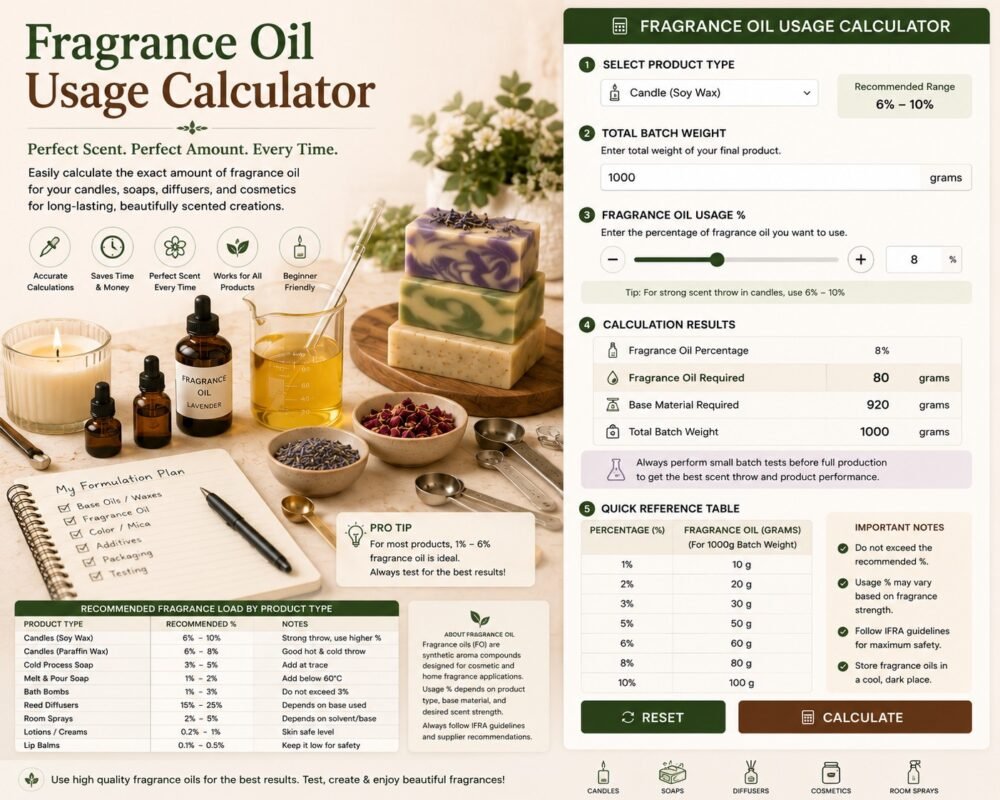
Calculate fragrance oil quantity for melt and pour soap, candles, wax melts, body butter, scrubs, bath salts, diffuser-style products, and DIY cosmetic formulations with simple percentage-based calculation.
Quick Answer
A fragrance oil usage calculator helps you calculate how many grams of fragrance oil you need based on product batch size and usage percentage. Enter total batch weight, fragrance percentage, fragrance cost, and product quantity to estimate fragrance amount and cost per product. Always follow supplier recommended safe usage limits for each fragrance and product type.
Table of Contents
Fragrance Oil Usage Calculator
Use this calculator to estimate fragrance oil quantity and cost for your DIY batch. It works for soap, candles, wax melts, scrubs, body butters, bath salts, and other fragrance-based products.
Your Fragrance Oil Result
Enter values and click calculate.
How the Calculator Works
The calculator uses a simple percentage formula. You enter your total product batch weight and desired fragrance percentage. The calculator gives fragrance oil in grams.
Example: If your soap batch is 1000 g and fragrance oil is 2%, fragrance oil needed is 20 g. If your candle batch is 1000 g and fragrance load is 8%, fragrance oil needed is 80 g.
For fragrance oils, essential oils, soap bases, candle wax, diffuser base, cosmetic raw materials, clays, herbal powders, jars, bottles, molds, and packaging, visit Jindeal.com.
Fragrance Oil Usage Chart
This chart gives beginner-friendly starting points. Always follow the supplier’s recommended safe usage level for the exact fragrance and product type.
| Product Type | Beginner Starting Range | Common Use | Important Note |
|---|---|---|---|
| Melt and Pour Soap | 1% to 3% | Scented soap bars | Too much may cause sweating, softness, or irritation risk |
| Cold Process Soap | 2% to 5% | Handmade soap bars | Check acceleration, discoloration, and usage limit |
| Soy / Paraffin Candles | 6% to 8% | Jar candles and candle tins | Follow wax supplier max fragrance load |
| Wax Melts | 8% to 12% | Wax warmers | Test sweating, melting, and scent throw |
| Body Butter / Balm | 0.5% to 1.5% | Leave-on body products | Use skin-safe fragrance only |
| Face Product | 0.1% to 0.5% | Face creams or face oils | Face products need extra caution |
| Body Scrub | 0.5% to 2% | Rinse-off scrub products | Patch test and avoid strong allergens |
| Bath Salts / Bath Powder | 0.5% to 2% | Aromatic bath products | Disperse fragrance properly |
| Reed Diffuser | 10% to 25% | Home fragrance diffuser | Not a skin product; use correct diffuser base |
| Room Spray | 1% to 5% | Home fragrance spray | Needs solubilizer/base compatibility testing |
Batch Examples
| Product | Batch Size | Fragrance % | Fragrance Needed | Base/Product Needed |
|---|---|---|---|---|
| Melt and Pour Soap | 1000 g | 2% | 20 g | 980 g soap base |
| Candle | 1000 g | 8% | 80 g | 920 g wax |
| Wax Melts | 1000 g | 10% | 100 g | 900 g wax |
| Body Butter | 1000 g | 1% | 10 g | 990 g base |
| Body Scrub | 1000 g | 1.5% | 15 g | 985 g scrub base |
| Reed Diffuser | 1000 g | 15% | 150 g | 850 g diffuser base |
Example 1: Soap Fragrance
For 1 kg melt and pour soap at 2%, use 20 g fragrance oil. Too much fragrance can cause sweating or softness.
Example 2: Candle Fragrance
For 1 kg candle fill weight at 8%, use 80 g fragrance oil and 920 g wax before wastage.
Example 3: Body Butter Fragrance
For 1 kg body butter at 1%, use 10 g skin-safe fragrance oil and 990 g base ingredients.
Safety and IFRA-Style Notes
Fragrance oils are not used at one fixed percentage for all products. The safe level depends on product type, leave-on or rinse-off use, skin contact area, age group, fragrance composition, supplier documentation, and recommended maximum usage level.
- Use candle fragrance only in candles if it is not approved for skin-contact products.
- Use skin-safe fragrance oil for soap, scrubs, body butter, creams, and balms.
- Use lower fragrance levels for face products.
- Follow supplier safe usage recommendation for each fragrance oil.
- Patch test finished cosmetic products before regular use.
- Do not use fragrance oils in lip products unless specifically suitable for lip use.
- Do not claim fragrance oils cure stress, insomnia, headache, anxiety, disease, or any medical condition.
Fragrance Costing Formula
Fragrance oil can be one of the biggest costs in soap, candles, body care, and diffuser products. Costing helps you price products correctly.
| Cost Item | Include This | Why Important |
|---|---|---|
| Fragrance Oil Cost | Cost per kg or per litre | Main aroma cost |
| Usage Percentage | Soap 1-3%, candles 6-8%, body butter around 1% | Controls cost and safety |
| Wastage | Spillage, testing, residue in beaker, failed batches | Must be included in real cost |
| Testing Cost | Burn tests, stability tests, sample batches | Important before selling |
| Packaging | Labels, bottles, jars, boxes, warning stickers | Part of final product cost |
Common Mistakes
1. Using Same Percentage for Every Product
Soap, candles, body butter, face products, and diffusers all need different fragrance levels.
2. Adding Too Much Fragrance
Excess fragrance can cause sweating, separation, irritation risk, candle smoking, poor burn, or product instability.
3. Not Checking Skin-Safe Use
Not every fragrance oil is suitable for skin-contact products. Check supplier recommendation.
4. Measuring by Drops
Use grams and a digital scale. Drops are not accurate for business production.
5. Ignoring Fragrance Cost
High-cost fragrance oils can change product profit margin significantly.
6. Not Testing Candle Wick
Changing fragrance oil can change candle burning performance.
7. Not Testing Soap Stability
Some fragrances can discolor, accelerate, sweat, or change soap appearance.
8. Using Strong Fragrance in Face Products
Face products need very cautious fragrance use or fragrance-free positioning.
9. No Batch Record
Record fragrance name, supplier, batch number, percentage, and final result.
10. Making Medical Claims
Do not claim fragrance oils cure anxiety, insomnia, headache, depression, infection, or disease.
Expert Tips
- Always measure fragrance oil by weight in grams.
- Follow supplier recommended usage limits for each product type.
- Use lower fragrance levels for leave-on skincare than rinse-off products.
- Use separate fragrance oils for candles and skin products if required.
- Test soap for sweating, color change, softness, and fragrance retention.
- Test candles for hot throw, cold throw, wick size, smoke, and jar heat.
- Add fragrance cost into final product pricing.
- Keep batch records for repeat production.
- Use fragrance-free option for sensitive-skin themed products.
- Keep claims cosmetic-safe and avoid medical claims.
- Buy fragrance oils, essential oils, soap bases, candle wax, diffuser base, jars, bottles, and packaging from Jindeal.com.
FAQ
1. What is a fragrance oil usage calculator?
It is a tool that calculates how many grams of fragrance oil you need based on batch size and fragrance percentage.
2. How much fragrance oil should I add to soap?
For melt and pour soap, a beginner starting range is 1% to 3%, but always check supplier safe usage limit.
3. How much fragrance oil for 1 kg soap?
At 2%, use 20 g fragrance oil for a 1 kg soap batch.
4. How much fragrance oil should I add to candles?
For many jar candles, 6% to 8% is a common starting range, but always follow wax and fragrance supplier recommendations and test the candle.
5. How much fragrance oil for 1 kg candle wax?
At 8% of final candle fill weight, use 80 g fragrance oil and 920 g wax before wastage.
6. Can I use candle fragrance oil in soap?
Only if the supplier confirms it is suitable for skin-contact soap use. Candle-only fragrance should not be used in cosmetics.
7. Can I use perfume oil in candles?
Use candle-safe fragrance oil designed for wax. Perfume oil may not burn safely or perform well in candles.
8. Can fragrance oil irritate skin?
Yes, if used too high or if the user is sensitive. Use safe levels and patch test finished products.
9. Should face products be fragranced?
Face products should use very low fragrance or be fragrance-free, depending on product positioning and safety requirements.
10. Why is my soap sweating after adding fragrance?
Too much fragrance, humidity, soap base type, and storage conditions can cause sweating.
11. Why is my candle smoking after adding fragrance?
Possible causes include high fragrance load, wrong wick, poor fragrance compatibility, or poor candle testing.
12. Can fragrance oil cure stress or insomnia?
No. Do not make medical claims. Use aroma, mood, ambience, spa, and gifting language instead.
13. How do I calculate fragrance cost?
Fragrance cost = fragrance grams ÷ 1000 × fragrance cost per kg.
14. Should I add wastage in fragrance calculation?
Yes. Add a small wastage percentage for testing, residue in beakers, spillage, and batch loss.
15. Where can I buy fragrance oils?
You can buy fragrance oils, essential oils, soap bases, candle wax, diffuser base, bottles, jars, and packaging from Jindeal.com.
Final Words
A fragrance oil usage calculator helps you make accurate, safe, repeatable, and profitable soap, candle, body care, diffuser, and DIY product batches. It reduces wastage and helps you calculate fragrance cost before production.
Always use supplier recommended usage limits, test every product, keep batch records, and avoid medical claims. For fragrance oils, essential oils, soap bases, candle wax, diffuser base, bottles, jars, and packaging, visit Jindeal.com.
Shop Fragrance Oils on Jindeal.com
Buy fragrance oils, essential oils, soap bases, candle wax, diffuser base, carrier oils, jars, bottles, tins, molds, and packaging materials from Jindeal.com.