
Uncategorized
Why Did My Lotion Separate?
Jun
Why Did My Lotion Separate?
Learn why handmade lotion separates into oil and water layers, why creams become watery or grainy, and how to fix emulsion problems with the right emulsifier, phase temperature, mixing, thickener, preservative, pH, and formula balance.
Quick Answer
Lotion separates when the oil phase and water phase do not emulsify properly or the emulsion becomes unstable. Common causes include too little emulsifier, wrong emulsifier type, incorrect heating temperature, poor mixing, too much oil, missing stabilizer, wrong pH, or adding heat-sensitive ingredients at the wrong stage.
Table of Contents
What Is Lotion Separation?
Lotion separation means the product breaks apart instead of staying smooth and creamy. You may see oil floating on top, water collecting at the bottom, watery liquid leaking from cream, grainy texture, curdled appearance, or a lotion that becomes thin after a few days.
A lotion is an emulsion. It usually contains a water phase, oil phase, emulsifier, thickener or stabilizer, preservative, and cool-down ingredients. Because oil and water naturally do not mix, the emulsifier is needed to hold them together.
If the emulsifier level, temperature, pH, mixing, oil ratio, or stabilizer system is wrong, the lotion may separate immediately or after storage.
For emulsifying wax, cosmetic preservatives, carrier oils, butters, glycerin, thickeners, fragrance oils, jars, bottles, and DIY cosmetic raw materials, visit Jindeal.com.
What Causes the Problem?
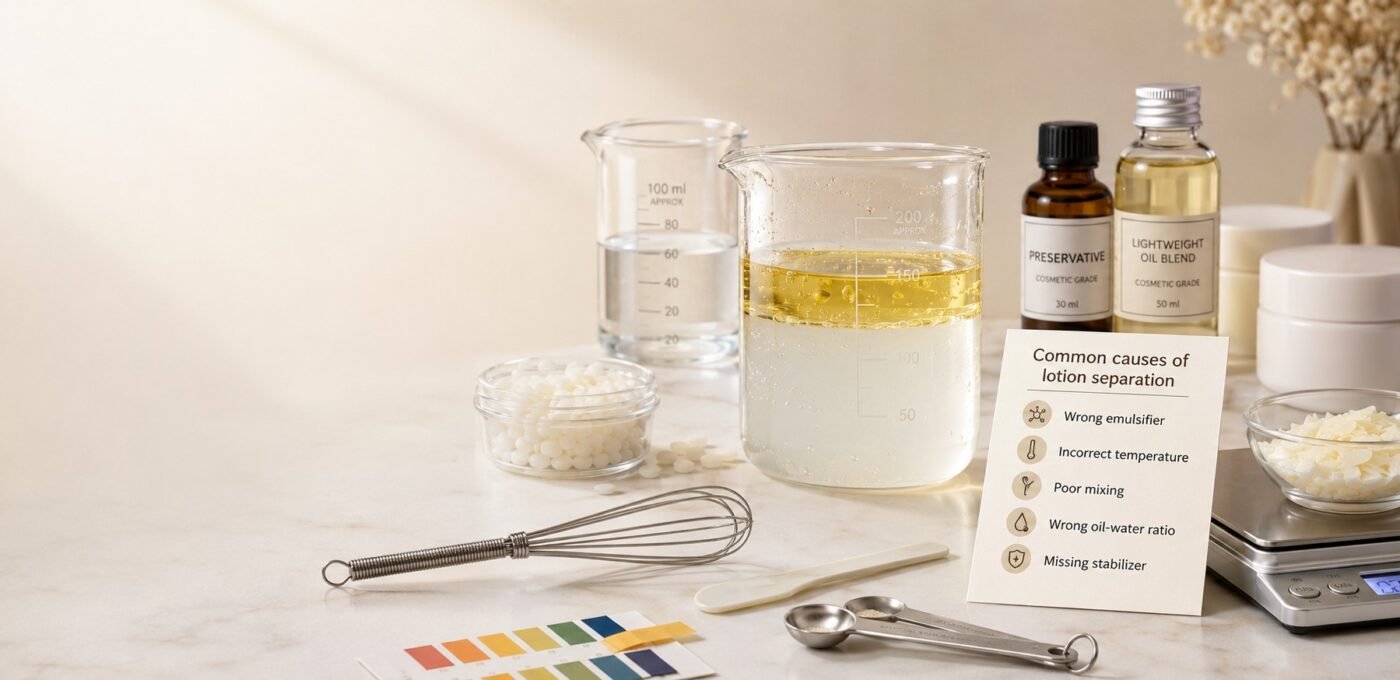
Lotion separates because the emulsion is not strong enough to hold the oil and water phases together. This can happen due to formula imbalance, wrong process, wrong temperature, or ingredient incompatibility.
- Too little emulsifying wax or emulsifier
- Wrong emulsifier for the formula type
- Oil phase is too high for the emulsifier level
- Water phase and oil phase were not heated properly
- Oil and water phases were combined at different temperatures
- Mixing was too weak or too short
- No thickener or stabilizer was used
- Cool-down ingredients were added too early or too hot
- Fragrance oil or essential oil was too high
- pH is outside preservative or emulsifier range
- Electrolytes or extracts destabilized the formula
- Product was stored in heat, cold, or direct sunlight
For example, if you add only a small amount of emulsifying wax to a high-oil lotion, the emulsifier may not be strong enough to hold the oil and water together, so the lotion separates after cooling.
Lotion Separation Fix Chart
Use this quick chart to identify why your lotion separated and how to fix the formula.
| Lotion Problem | Likely Cause | Best Fix |
|---|---|---|
| Oil floating on top | Too little emulsifier or too much oil | Increase emulsifier or reduce oil phase |
| Water leaking from cream | Weak emulsion or missing stabilizer | Add suitable thickener or stabilizer |
| Lotion separates after cooling | Oil and water phases mixed at wrong temperature | Heat both phases correctly and combine at similar temperature |
| Lotion becomes thin after few days | Formula instability or pH issue | Check pH, thickener, preservative, and emulsifier compatibility |
| Curdled or grainy lotion | Poor mixing or incompatible ingredients | Improve mixing and simplify formula |
| Separation after fragrance added | Fragrance level too high or incompatible | Reduce fragrance and check supplier compatibility |
Step-by-Step Solution
Step 1: Check Your Formula Balance
A stable lotion needs a balanced ratio of water, oil, emulsifier, thickener, preservative, and optional additives. If the oil phase is high, the emulsifier level must be strong enough to hold it.
Step 2: Use the Correct Emulsifier
Use a complete emulsifier or emulsifying wax suitable for lotions and creams. Some waxes are only thickeners and cannot emulsify by themselves. Beeswax alone is usually not enough to make a stable lotion.
Step 3: Use Enough Emulsifier
Follow the emulsifier supplier’s recommended usage range. Too little emulsifier may create a lotion that looks good at first but separates later.
Step 4: Heat Oil and Water Phases Correctly
Heat the oil phase and water phase separately according to the formulation method. They should usually be combined when both phases are hot and close in temperature, depending on the emulsifier system.
Step 5: Mix Properly
Use proper mixing equipment. A spoon is usually not enough for a stable lotion. Use a stick blender or suitable cosmetic mixer to create a good emulsion, then continue gentle mixing while cooling.
Step 6: Add Thickener or Stabilizer
Thickeners and stabilizers help improve lotion texture and reduce separation. Examples include xanthan gum, cetyl alcohol, stearic acid, fatty alcohols, or suitable polymeric thickeners depending on formula type.
Step 7: Add Cool-Down Ingredients at the Right Time
Preservatives, fragrance oils, essential oils, heat-sensitive extracts, and some actives should be added during cool-down phase at the temperature recommended by the supplier.
Step 8: Check Fragrance and Essential Oil Level
Too much fragrance or essential oil can destabilize the lotion. Use only skin-safe fragrance oils or essential oils within supplier-recommended leave-on limits.
Step 9: Check pH
pH affects preservative performance, thickener performance, and formula stability. Use pH strips or a pH meter and adjust according to your preservative and ingredient requirements.
Step 10: Use a Proper Preservative
Any lotion containing water needs a broad-spectrum preservative. Vitamin E, essential oils, and herbs are not complete preservatives for lotions.
Step 11: Test Stability
Check your lotion after 24 hours, 7 days, 2 weeks, and 1 month. Observe separation, smell, color, pH, texture, viscosity, and packaging compatibility.
Step 12: Store Correctly
Store lotion away from heat, sunlight, and extreme temperature changes. Poor storage can break an otherwise stable formula.
Common Mistakes
1. Using Beeswax as the Only Emulsifier
Beeswax thickens but is not a complete emulsifier for stable lotion.
2. Using Too Little Emulsifying Wax
Low emulsifier can cause oil and water to separate after cooling.
3. Adding Too Much Oil
A high oil phase needs the correct emulsifier system and stabilizer support.
4. Mixing with a Spoon Only
Lotions usually need stronger mixing to form a stable emulsion.
5. Combining Phases at Wrong Temperature
If oil and water phases are too far apart in temperature, the emulsion may break.
6. Skipping Thickener or Stabilizer
Some formulas need a stabilizer to prevent watery separation.
7. Adding Preservative Too Hot
Some preservatives are heat-sensitive and should be added during cool-down.
8. Ignoring pH
Wrong pH can make preservative, thickener, or emulsifier perform poorly.
9. Adding Too Many Extracts
Too many extracts, salts, actives, or electrolytes can destabilize the lotion.
10. Selling Without Stability Testing
A lotion can separate after days or weeks. Test before selling.
Expert Tips
- Use distilled water, not tap water, for lotions.
- Use a complete emulsifier or emulsifying wax suitable for creams.
- Do not rely on beeswax alone for lotion emulsification.
- Follow supplier usage rate for emulsifier and preservative.
- Heat oil and water phases correctly before combining.
- Use a stick blender or suitable mixer for better emulsion.
- Add thickener or stabilizer for better texture and stability.
- Add preservatives and fragrance during correct cool-down temperature.
- Check pH after formulation.
- Use broad-spectrum preservative for any water-containing lotion.
- Make small test batches before bulk production.
- Buy emulsifying wax, preservatives, carrier oils, butters, thickeners, jars, and DIY cosmetic raw materials from Jindeal.com.
FAQ
1. Why did my lotion separate?
Your lotion may separate because of too little emulsifier, wrong emulsifier, poor mixing, wrong temperature, too much oil, missing stabilizer, wrong pH, or incompatible ingredients.
2. Can I fix separated lotion?
You may be able to reprocess a small test batch by reheating and blending with correct emulsifier, but separated lotion planned for sale should be reformulated and retested.
3. Why is oil floating on top of my lotion?
Oil floating usually means the emulsion failed, often because emulsifier was too low, oil phase was too high, or mixing was not strong enough.
4. Why is water leaking from my cream?
Water leaking can happen when the emulsion is weak, missing stabilizer, poorly mixed, or affected by pH and temperature changes.
5. Can beeswax emulsify lotion?
Beeswax alone is not a complete emulsifier for stable lotion. Use proper emulsifying wax or a suitable emulsifier system.
6. Do lotions need preservatives?
Yes. Any lotion containing water needs a suitable broad-spectrum preservative system.
7. Is vitamin E a preservative for lotion?
No. Vitamin E is mainly an antioxidant for oils and does not protect water-based lotion from bacteria, yeast, and mold.
8. Why did my lotion separate after a few days?
The formula may be unstable due to insufficient emulsifier, missing stabilizer, wrong pH, incompatible ingredients, or poor storage.
9. Does pH affect lotion stability?
Yes. pH can affect emulsifier, preservative, thickener, and active ingredient performance.
10. Can fragrance oil separate lotion?
Yes, too much fragrance oil or incompatible fragrance can destabilize lotion.
11. What mixer should I use for lotion?
A stick blender or suitable cosmetic mixer is better than a spoon for creating a stable lotion emulsion.
12. Why did my lotion become thin?
Lotion can become thin because of formula instability, wrong thickener, pH changes, too much water, or separation.
13. Can aloe vera gel cause separation?
Aloe vera gel or extracts can affect formula stability depending on type, pH, electrolytes, and usage level.
14. Can I sell separated lotion?
No. Separated lotion should not be sold. Reformulate, preserve properly, and test stability before selling.
15. Where can I buy lotion-making ingredients?
You can buy emulsifying wax, preservatives, carrier oils, butters, glycerin, thickeners, fragrance oils, jars, bottles, and DIY cosmetic raw materials from Jindeal.com.
Final Words
Lotion separation usually means the emulsion is unstable. The solution is to balance the formula, use the right emulsifier, heat phases correctly, blend properly, add stabilizer when needed, check pH, and use a proper preservative system.
For emulsifying wax, preservatives, carrier oils, butters, glycerin, thickeners, fragrance oils, jars, bottles, and DIY cosmetic raw materials, visit Jindeal.com.
Make Stable Lotions with Jindeal.com
Shop emulsifying wax, cosmetic preservatives, carrier oils, butters, thickeners, glycerin, jars, bottles, and DIY cosmetic-making materials from Jindeal.com.
